Last reviewed: November 2026 · Sources: NIDDK, NCCIH, MedlinePlus, the American College of Gastroenterology, the US Dietary Guidelines and peer-reviewed studies (listed at the end)
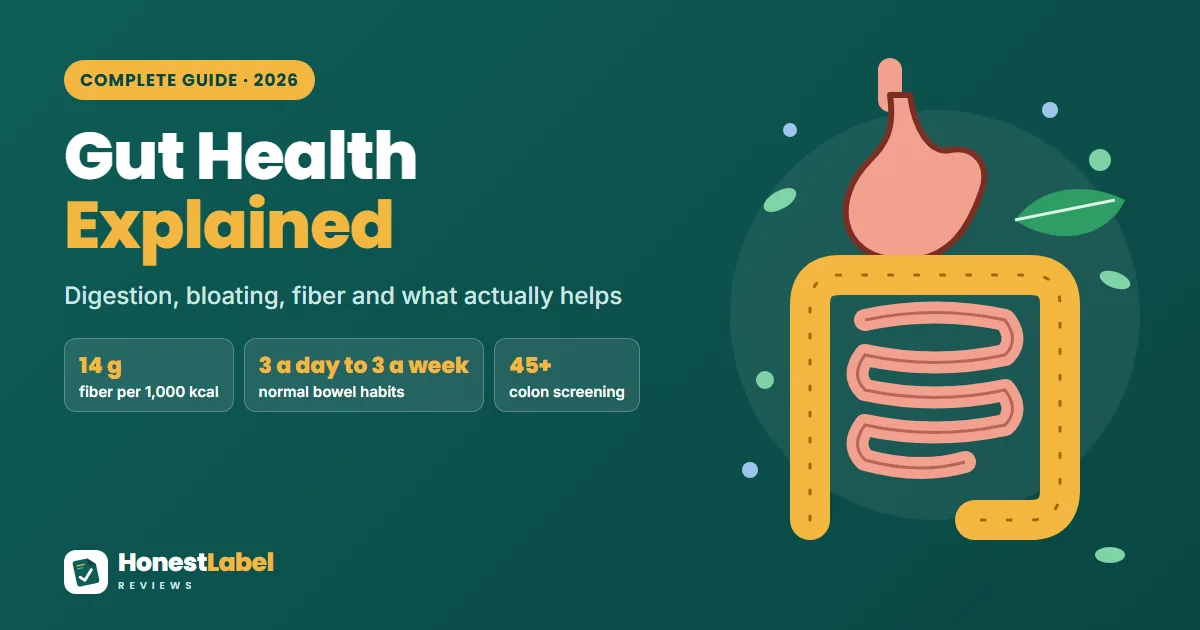
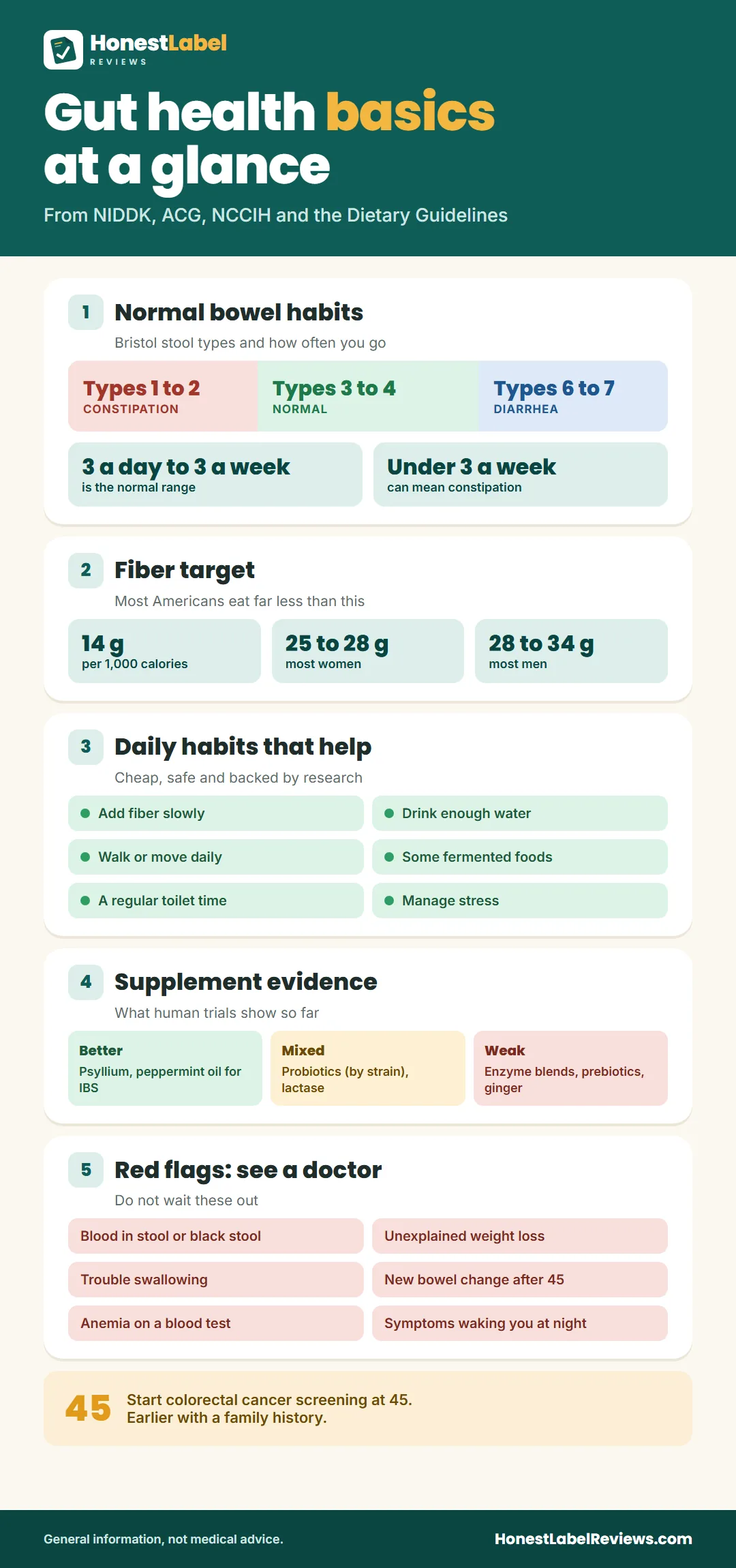
Good gut health mostly means regular, comfortable digestion: soft, formed stools passed anywhere from three times a day to three times a week, no ongoing pain, and no alarm signs such as blood. The habits with the best evidence are cheap ones. Eat about 14 grams of fiber per 1,000 calories, drink enough water, move every day, and get checked for colon cancer from age 45.
“Gut health” has turned into a marketing phrase, and it now gets attached to everything from kombucha to mail-in stool test kits. Underneath the hype is a real and fairly well understood system. Your digestive tract breaks food down, absorbs what you need, and gets rid of the rest, and trillions of microbes live along the way. When it works, you barely notice it. When it doesn’t, you get bloating, gas, constipation, diarrhea or heartburn, and those problems are very common.
Below we cover how digestion works, what is known about the microbiome, common gut problems, normal bowel habits, the habits and supplements with real evidence, and the warning signs that need a doctor. If you already have a digestive condition, use this page as background and follow your own care plan.
How digestion works
Digestion starts before you swallow. Chewing breaks food into smaller pieces, and saliva starts breaking down starch. From there, food travels through a tube about 30 feet long, and each section has its own job. The NIH’s National Institute of Diabetes and Digestive and Kidney Diseases (NIDDK) describes the route like this:
- Esophagus. Muscles push swallowed food down to the stomach. A ring of muscle at the bottom, the lower esophageal sphincter, opens to let food in and closes to keep acid out.
- Stomach. Acid and enzymes mix with food and start breaking down protein. The stomach slowly empties a soupy mix into the small intestine.
- Small intestine. This is where most of the work happens. Juices from the pancreas, bile from the liver and enzymes from the intestinal wall break food into sugars, amino acids and fats, and the lining absorbs them along with most vitamins and minerals.
- Large intestine (colon). What is left, mostly fiber, water and dead cells, moves into the colon. Here bacteria ferment the fiber and the colon absorbs water, turning liquid waste into stool.
- Rectum and anus. Stool is stored in the rectum until you are ready to go.
Nerves and hormones coordinate the whole trip. The gut has its own nerve network, sometimes called the “second brain”, which talks to the brain in your head through the vagus nerve. That two-way link is one reason stress can upset your stomach and why an irritable gut can affect your mood.
The full journey from mouth to toilet usually takes somewhere between one and three days, and it varies a lot from person to person. Food fills the stomach within seconds, leaves it over a few hours, and then spends most of its time moving slowly through the colon.
The gut microbiome: what is known and what is hype
The gut microbiome is the community of bacteria, fungi, viruses and other microbes living in your digestive tract, mostly in the colon. You may have heard that bacteria outnumber your own cells ten to one. That old estimate has been revised. A 2016 analysis put the numbers at roughly 38 trillion bacteria and 30 trillion human cells, closer to one to one (Sender et al., 2016). It is still a huge population.
What we know with reasonable confidence
- Gut bacteria ferment fiber that you cannot digest yourself. That process makes short-chain fatty acids such as butyrate, which feed the cells lining the colon.
- The microbiome helps train the immune system and helps keep harmful germs from taking over.
- Antibiotics can disrupt it for weeks or months, which is why they sometimes cause diarrhea. In rare cases this lets a harmful germ called C. difficile take hold.
- Diet shapes it. People who eat a wide variety of plant foods tend to have more diverse gut bacteria.
What is still uncertain
Scientists have found links between the microbiome and obesity, diabetes, depression, allergies and many other conditions. Most of those links come from studies in mice or from snapshots of people’s stool, which can’t show cause and effect. Nobody has defined what a “healthy” microbiome looks like, because healthy people have very different mixes of bacteria.
That is why we would be careful with home microbiome test kits. They can tell you which bacteria were in a sample, but there is no agreed standard to compare the result with, and the advice that comes with them usually goes far beyond the evidence. The same goes for claims that a single product will “reset” or “rebalance” your gut. We don’t belive any current product can do that in a way that has been shown in good human trials.
Common gut problems
Digestive complaints are some of the most common reasons people see a doctor. Most of them are not dangerous, but they can make daily life miserable.
Bloating and gas
Bloating is a feeling of fullness or swelling in the belly, sometimes with a belly that looks bigger by evening. The NIDDK says research suggests 16% to 31% of people experience bloating, and in a large US survey about 20% said they had it in the past week.
Passing gas many times a day is normal. Gas comes from two sources: air you swallow (from eating fast, chewing gum, fizzy drinks or drinking through a straw) and gas made by bacteria when they ferment carbohydrates you didn’t absorb. Beans, onions, cabbage, broccoli, whole grains, some fruits and sugar alcohols such as sorbitol are common triggers. Constipation makes bloating worse, because stool sitting in the colon keeps fermenting.
Constipation
The NIDDK defines constipation as having fewer than three bowel movements a week, or stools that are hard, dry, lumpy or painful to pass, or a feeling that you haven’t fully emptied. About 16 out of 100 adults have symptoms, rising to about 33 out of 100 adults aged 60 and older. Low fiber, too little fluid, inactivity, ignoring the urge to go, and medicines such as opioids, iron pills and some antacids are frequent causes.
Diarrhea
Diarrhea means loose, watery stools three or more times a day. Short bouts lasting a day or two are usually caused by a virus, bacteria or something you ate, and they clear up on their own. MedlinePlus notes that diarrhea lasting more then a few days, or coming with fever, blood or signs of dehydration, needs medical care. Diarrhea that lasts for weeks can point to conditions such as celiac disease, inflammatory bowel disease, microscopic colitis or a food intolerance like lactose intolerance.
Irritable bowel syndrome (IBS)
IBS is a disorder of how the gut and brain work together. It causes repeated belly pain linked to bowel movements, along with diarrhea, constipation or both. About 12 percent of people in the US have it, according to the NIDDK. IBS doesn’t damage the bowel or raise the risk of colon cancer, but it can be hard to live with. Doctors diagnose it from the symptom pattern and a few tests to rule out other causes. The American College of Gastroenterology’s 2021 IBS guideline recommends a “positive” diagnosis based on symptoms, instead of putting everyone through a long series of tests.
Acid reflux and GERD
Reflux happens when stomach acid flows back up into the esophagus, causing heartburn or a sour taste. Reflux that happens occasionally after a big meal is normal. When it happens twice a week or more, or causes damage, it is called gastroesophageal reflux disease (GERD). Researchers estimate about 20 percent of people in the US have GERD (NIDDK). Large late meals, lying down soon after eating, extra weight around the belly, smoking, alcohol and some foods such as fatty meals, chocolate and peppermint can make it worse.
Signs of an unhealthy gut
People search for “signs of an unhealthy gut” and find lists that include tiredness, skin problems, sugar cravings and mood swings. Those symptoms have so many possible causes that they tell you very little about your gut. The signs that do point to a digestive problem are more direct:
- Bloating, gas or belly pain most days
- Stools that are usually hard and lumpy, or usually loose and watery
- Going less than three times a week, or straining most of the time
- Heartburn twice a week or more
- A sudden change in your usual bowel pattern that lasts more than a few weeks
- Symptoms that wake you up at night
What normal bowel habits look like
There is no single “right” number of bowel movements. Anywhere from three a day to three a week is generally considered normal, and the NIDDK notes that only you know what is normal for you. A change from your own usual pattern matters more than the number itself.
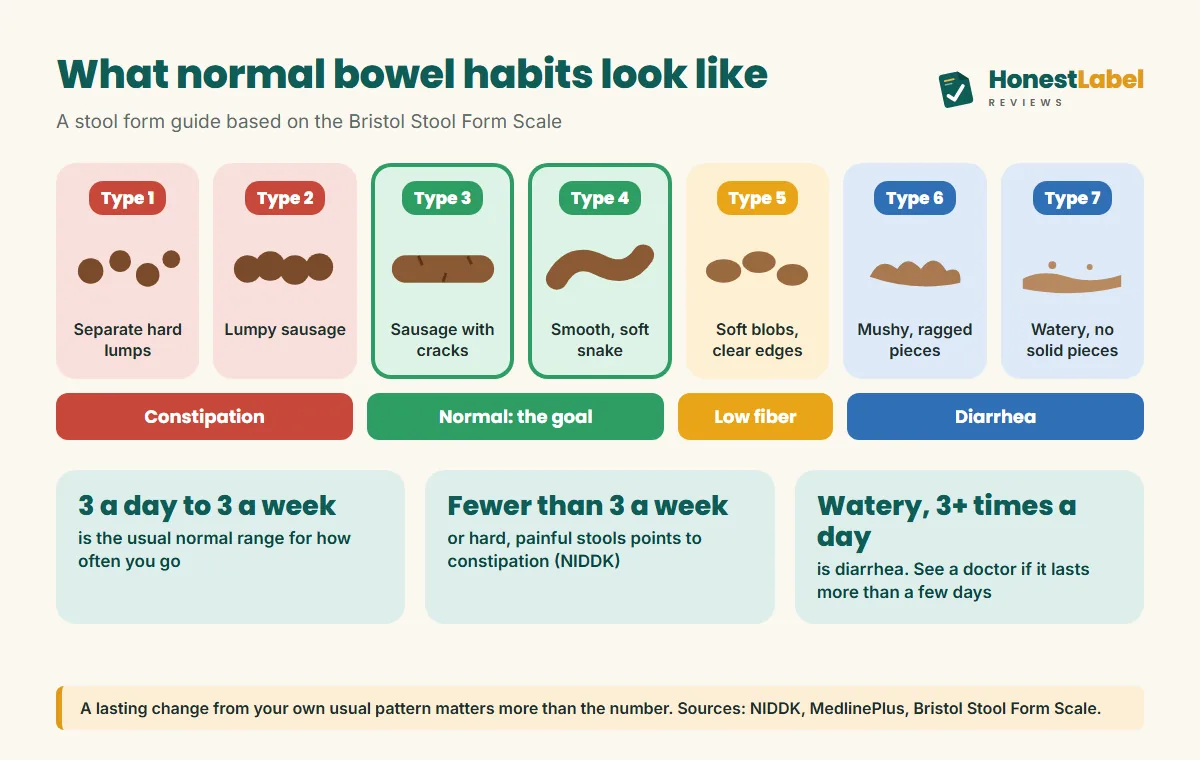
Stool shape gives a useful clue about how fast things are moving. Doctors use the Bristol Stool Form Scale, a seven-type chart developed at Bristol Royal Infirmary in the 1990s. Harder, lumpier types mean waste moved slowly, and looser types mean it moved fast.
| Bristol type | What it looks like | What it usually means |
|---|---|---|
| Types 1 and 2 | Separate hard lumps, or a lumpy sausage | Slow transit, constipation |
| Types 3 and 4 | A sausage with cracks, or a smooth soft snake | Normal, the goal |
| Type 5 | Soft blobs with clear edges | Borderline, often low on fiber |
| Types 6 and 7 | Mushy pieces, or entirely liquid | Fast transit, diarrhea |
Color is less important than people think. Brown, tan and even green are usually just food and bile. Black, tarry stool, bright red blood, or pale clay-colored stool are different and need a doctor’s opinion. Iron pills and bismuth (the pink stomach remedy) can also turn stool black, so mention those if you take them.
How to improve gut health: habits with research behind them
The good news is that most of what helps your gut costs nothing. The steps below have support from guidelines or decent trials, and none of them involve a product.
1. Eat enough fiber
Fiber is the single most useful thing most people can change. The Dietary Guidelines for Americans recomend about 14 grams of fiber for every 1,000 calories you eat. That works out to roughly 25 to 28 grams a day for most adult women and 28 to 34 grams for most adult men. Most Americans eat well below that.
There are two main kinds. Soluble fiber (oats, beans, lentils, apples, psyllium) dissolves into a gel, softens stool and feeds gut bacteria. Insoluble fiber (wheat bran, whole grains, vegetable skins, nuts) adds bulk and speeds things up. Most plant foods contain both.
| Food | Typical serving | Fiber (approx.) |
|---|---|---|
| Lentils or black beans, cooked | 1 cup | 15 g |
| Raspberries | 1 cup | 8 g |
| Chia seeds | 2 tablespoons | 8 g |
| Pear, with skin | 1 medium | 5 to 6 g |
| Broccoli, cooked | 1 cup | 5 g |
| Oatmeal, cooked | 1 cup | 4 g |
| Apple, with skin | 1 medium | 4 to 5 g |
| Almonds | 1 ounce (about 23) | 3.5 g |
| Whole wheat bread | 1 slice | 2 to 3 g |
Values vary by brand and cooking method, so check the label. The most common mistake is adding a lot of fiber at once, which brings on gas and bloating. Add a few grams every few days over two or three weeks and drink more water as you go. Fiber also slows down how fast carbohydrates hit your blood, which helps keep blood sugar levels steadier after meals.
2. Add some fermented foods
Yogurt with live cultures, kefir, sauerkraut, kimchi, miso and tempeh contain live microbes or the products they make. The most interesting trial here came from Stanford. Researchers put 36 healthy adults on either a high-fermented-food diet or a high-fiber diet for 10 weeks. The fermented food group had a steady rise in microbiome diversity and lower levels of several inflammation markers, while the fiber group did not see a rise in diversity over that time (Wastyk et al., 2021). It was a small study, so treat it as promising rather than settled. Fermented foods are safe for most people, but kimchi, sauerkraut and miso are high in salt, and some kombucha has a lot of sugar.
3. Drink enough water
Fiber pulls water into stool, so fiber without fluid can make constipation worse. There is no magic number of glasses for everyone. A practical check is your urine: pale yellow usually means you are drinking enough. Needs go up in hot weather, with exercise, and with diarrhea or vomiting.
4. Move every day
Physical activity helps the colon contract and move stool along. Even a daily walk helps many people with constipation, and the general advice of about 150 minutes of moderate exercise a week is good for the gut too. A short walk after a big meal can also ease that heavy, bloated feeling and may reduce reflux compared with lying on the sofa.
5. Manage stress
Because of the gut-brain link, stress and anxiety can speed up or slow down digestion and make the gut more sensitive to normal amounts of gas. This is especialy true in IBS. The ACG guideline recommends gut-directed psychotherapy, such as cognitive behavioral therapy or gut-directed hypnotherapy, for IBS symptoms. Regular sleep, exercise and breathing exercises are reasonable everyday steps for anyone.
6. Give your bowels a routine
The colon is most active after waking and after meals. Sitting on the toilet at the same time each day, often after breakfast, and not ignoring the urge helps a lot of people with constipation. Raising your feet on a small stool so your knees sit above your hips puts the rectum at an easier angle.
7. Eat to limit reflux
For heartburn, eat smaller meals, finish dinner two to three hours before bed, and raise the head of the bed. Triggers vary between people, so notice which foods set yours off.
What about FODMAPs?
FODMAPs are a group of short-chain carbohydrates that are poorly absorbed and quickly fermented by gut bacteria. They include fructans (wheat, onion, garlic), lactose (milk), excess fructose (apples, honey), galacto-oligosaccharides (beans and lentils) and polyols (sorbitol, mannitol, some stone fruits). In people with IBS, the gas and water they draw in can cause pain and bloating.
A low-FODMAP diet is done in three steps: cut high-FODMAP foods for two to six weeks, bring them back one group at a time to find your triggers, then settle on a long-term diet that avoids only the foods that bother you. The ACG guideline suggests a limited trial of this diet for IBS. It is quite restrictive, though, and it lowers fiber and can reduce helpful bacteria if kept up long term, so it works best with a dietitian. It is meant as a test for people with IBS, not as a general gut health diet.
Gut health supplements: what the evidence shows
The gut health aisle is one of the busiest in any store. Here is a plain summary of the ingredients you will see most, sorted from stronger evidence to weaker. None of them replace a diagnosis, and the supplement industry is regulated far more loosely than medicines. The US government does not check supplements for safety or effectiveness before they go on sale.
Psyllium and other fiber supplements: good evidence
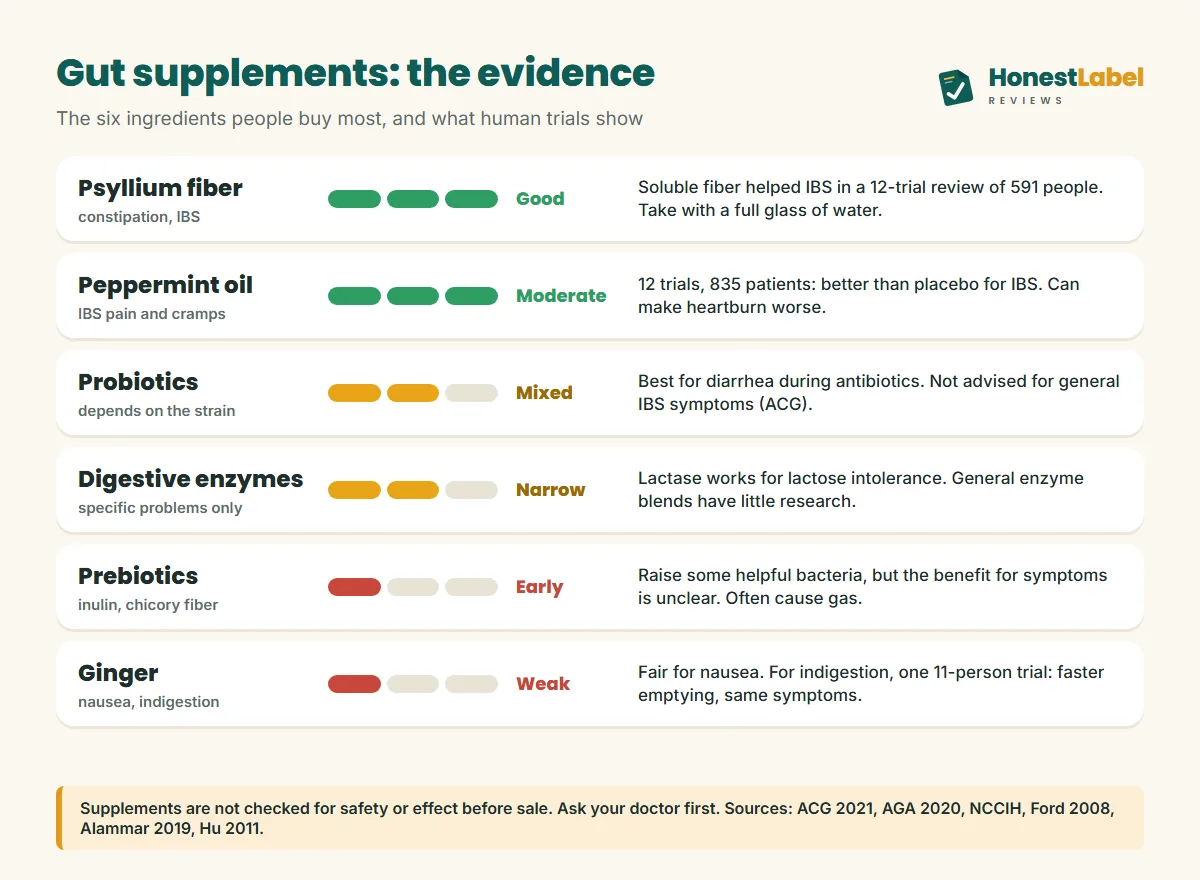
Psyllium (also called ispaghula) is a soluble fiber from plant seeds. It has some of the best evidence of any gut supplement. A 2008 BMJ meta-analysis of 12 trials with 591 people with IBS found that soluble fiber such as psyllium improved symptoms, while insoluble wheat bran did not (Ford et al., 2008). The ACG guideline recommends soluble fiber for IBS, and fiber supplements are a standard first step for chronic constipation. Start with a small dose, drink a full glass of water with each one, and take other medicines at a separate time, about two hours apart, becuase fiber can slow how they are absorbed.
Peppermint oil for IBS: moderate evidence
Peppermint oil relaxes the smooth muscle of the gut. The same 2008 BMJ review found that in 4 trials with 392 people, peppermint oil was clearly better than placebo for IBS. A larger 2019 meta-analysis of 12 trials with 835 patients also found it improved overall IBS symptoms and belly pain, with side effects similar to placebo (Alammar et al., 2019). The ACG guideline gives it a conditional recommendation. Most trials used enteric-coated capsules, which pass the stomach before opening. Peppermint can make heartburn worse, so it is a poor choice if you have reflux.
Probiotics: mixed, depends on the strain and the problem
Probiotics are live microbes meant to give a health benefit. The NIH’s National Center for Complementary and Integrative Health (NCCIH) notes that effects depend on the exact strain, and that a benefit from one strain doesn’t mean another will work. The research is strongest for preventing diarrhea linked to antibiotics. The American Gastroenterological Association’s 2020 guideline gave a conditional recommendation for certain strains to help prevent C. difficile infection in adults on antibiotics, but recommended probiotics for IBS and several other conditions only within clinical trials. The ACG IBS guideline also suggests against probiotics for overall IBS symptoms. For healthy people with no gut problem, there is little proof they add anything.
Probiotics are generally safe for healthy people. The NCCIH warns that people who are seriously ill, have a weakened immune system, or are premature infants can develop serious infections from them.
Digestive enzymes: good for specific problems only
Some enzymes work well for a narrow job. Lactase pills help people with lactose intolerance digest dairy, and alpha-galactosidase can reduce gas from beans for some people. Prescription pancreatic enzymes are a proven treatment when the pancreas can’t make enough, for example in cystic fibrosis or chronic pancreatitis. Broad “digestive enzyme blends” sold for general bloating have very litle research behind them in people with healthy digestion.
Prebiotics: early and mixed evidence
Prebiotics such as inulin, chicory root fiber and galacto-oligosaccharides are fibers that feed gut bacteria. They do raise counts of some bacteria, such as bifidobacteria, in studies. Whether that leads to fewer symptoms or better health is much less clear, and because they are FODMAPs, they often cause gas and bloating, especially in people with IBS. Getting them from food (onions, garlic, leeks, bananas, oats) is a gentler way to start.
Ginger: weak but low risk
Ginger has fair evidence for nausea, including pregnancy nausea. For digestion more broadly, the data are thin. In one small crossover trial, 11 people with functional dyspepsia took 1.2 grams of ginger. Their stomachs emptied faster than with placebo, but their symptoms did not improve (Hu et al., 2011). Ginger tea is a reasonable thing to try. Large doses can cause heartburn and may add to the effect of blood thinners.
If you try a supplement, check that the label gives exact strain names and amounts instead of a “proprietary blend”, look for a third-party seal such as USP or NSF, and give it about four weeks before judging it.
Who should be careful
- People with a weakened immune system, including those on chemotherapy, after an organ transplant or with a central line, should talk to a doctor before taking probiotics.
- Anyone with trouble swallowing should not take psyllium or other bulk fiber powders without medical advice, because they can swell and cause choking or a blockage.
- People with bowel narrowing (strictures) from Crohn’s disease or past surgery should ask before adding a lot of fiber.
- People taking other medicines should space fiber supplements about two hours away from them. Ask a pharmacist about interactions, especially with blood thinners, diabetes drugs and thyroid medicine.
- People with reflux may find peppermint oil and large doses of ginger make heartburn worse.
- Pregnant or breastfeeding women, children and older adults should check with a doctor before starting any supplement.
- Anyone with kidney disease should check before using magnesium-based laxatives.
If you need laxatives or antacids most days for more than a couple of weeks, see a doctor to find out why.
When to see a doctor
Most gut symptoms come and go, but some need to be checked soon. See a doctor if you have any of these red flags:
- Blood in your stool, black tarry stool, or bleeding from the rectum
- Weight loss you can’t explain
- Trouble swallowing, or food that feels stuck
- A lasting change in your bowel habits, especially if you are over 45 to 50 and it is new for you
- Anemia (low iron or low red blood cells) found on a blood test
- Symptoms that wake you up at night, such as pain or diarrhea
- Vomiting that keeps coming back, or vomiting blood
- Ongoing fever with gut symptoms
- A family history of colon cancer, inflammatory bowel disease or celiac disease
Go to the emergency room for severe belly pain that comes on suddenly, a hard and swollen belly, vomiting with no bowel movements or gas, large amounts of blood, or signs of dehydration such as confusion, very little urine or dizziness when standing.
Colorectal cancer screening from 45
Colorectal cancer is now being found more often in younger adults. The US Preventive Services Task Force recommends screening for adults aged 45 to 75, and the ACG also advises starting at 45. Options include a colonoscopy every 10 years or a stool test done at home every year (or every one to three years, depending on the type). People with a family history or other risk factors may need to start earlier. If you are 45 or older and have not been screened, booking it is one of the most useful things you can do for your gut.
Frequently asked questions
How can I improve my gut health fast?
There is no real overnight fix, but a few changes help within days. Add one fiber-rich food to each meal, drink more water, go for a daily walk and cut down on fizzy drinks and sugar alcohols if you are bloated. Gut bacteria start shifting within a few days of a diet change, while bowel habits usually settle over two to four weeks.
Why am I bloated every day?
Daily bloating is most often caused by swallowed air, constipation, gas-producing foods or IBS. Lactose intolerance and celiac disease are other posible causes, and both can be tested for. If bloating comes with weight loss, blood, vomiting or a swollen belly that doesn’t go down, see a doctor promptly.
How many times a day should you poop?
Anywhere from three times a day to three times a week is generally considered normal. What matters more is that stools are soft and easy to pass and that your pattern stays fairly steady. A new change that lasts more than a few weeks is worth checking.
Do I need a probiotic for gut health?
Most healthy people don’t. Probiotics have the best evidence for specific uses, such as lowering the risk of diarrhea during antibiotics, and the right strain matters. Fermented foods and a high-fiber diet are a better first step for general gut health.
Can stress cause stomach problems?
Yes. The gut and brain are linked through nerves and hormones, so stress can trigger cramps, diarrhea, constipation or heartburn, and it can make IBS flare. Managing stress won’t cure a gut disease, but it often reduces symptoms.
The bottom line
Good gut health is less about special products and more about a few steady habits: around 14 grams of fiber per 1,000 calories, enough water, daily movement, some fermented foods and a regular toilet routine. Normal bowel habits range from three times a day to three times a week, with soft, formed stools. Of the popular supplements, psyllium and peppermint oil (for IBS) have the best evidence, while most probiotics, enzyme blends and prebiotics are either strain-specific or unproven for general use. Take red flags seriously, and if you are 45 or older, book your colon cancer screening.
In the coming weeks we will publish detailed guides on bloating, constipation, IBS, fiber, probiotics and the other topics in this category.
Sources
- National Institute of Diabetes and Digestive and Kidney Diseases (NIH). Your Digestive System & How It Works; Gas in the Digestive Tract; Constipation; Irritable Bowel Syndrome; Acid Reflux (GER & GERD) in Adults.
- National Center for Complementary and Integrative Health (NIH). Probiotics: What You Need To Know.
- MedlinePlus (US National Library of Medicine). Diarrhea.
- US Department of Agriculture and Department of Health and Human Services. Dietary Guidelines for Americans.
- US Preventive Services Task Force. Colorectal Cancer: Screening, 2021.
- Lacy BE, et al. ACG Clinical Guideline: Management of Irritable Bowel Syndrome. American Journal of Gastroenterology, 2021. PubMed.
- Su GL, et al. AGA Clinical Practice Guidelines on the Role of Probiotics in the Management of Gastrointestinal Disorders. Gastroenterology, 2020. PubMed.
- Ford AC, et al. Effect of fibre, antispasmodics, and peppermint oil in the treatment of irritable bowel syndrome: systematic review and meta-analysis. BMJ, 2008. PubMed.
- Alammar N, et al. The impact of peppermint oil on the irritable bowel syndrome: a meta-analysis of the pooled clinical data. BMC Complementary and Alternative Medicine, 2019. PubMed.
- Wastyk HC, et al. Gut-microbiota-targeted diets modulate human immune status. Cell, 2021. PubMed.
- Sender R, Fuchs S, Milo R. Revised estimates for the number of human and bacteria cells in the body. PLoS Biology, 2016. PubMed.
- Hu ML, et al. Effect of ginger on gastric motility and symptoms of functional dyspepsia. World Journal of Gastroenterology, 2011. PubMed.
Medical disclaimer: This article is for general information and is not medical advice. It does not replace a diagnosis or treatment from your doctor. If you have a digestive condition or take medication, talk to your healthcare provider before changing your diet, exercise or supplements.