Last reviewed: November 2026 · Sources: American Diabetes Association, MedlinePlus, NIDDK, CDC and peer-reviewed studies (listed at the end)
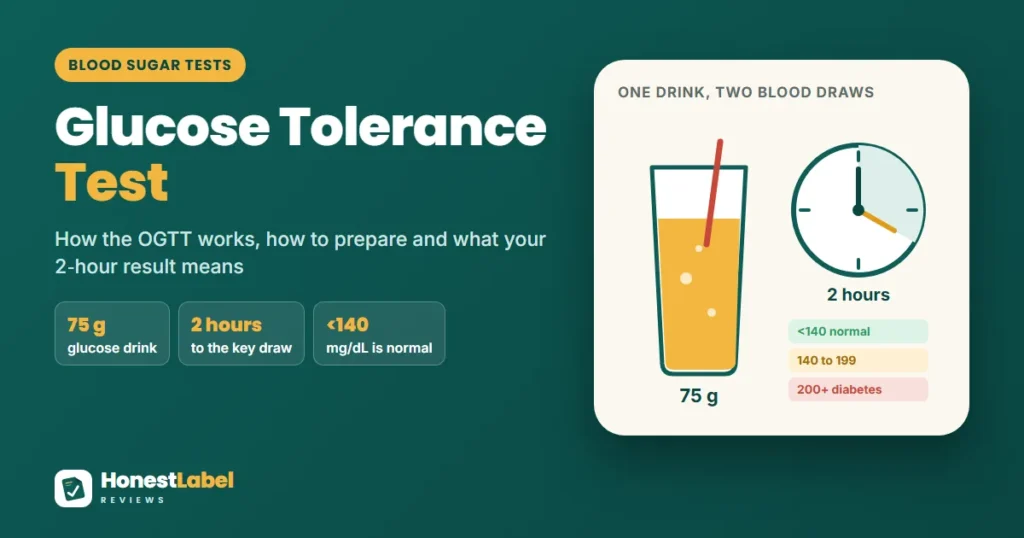
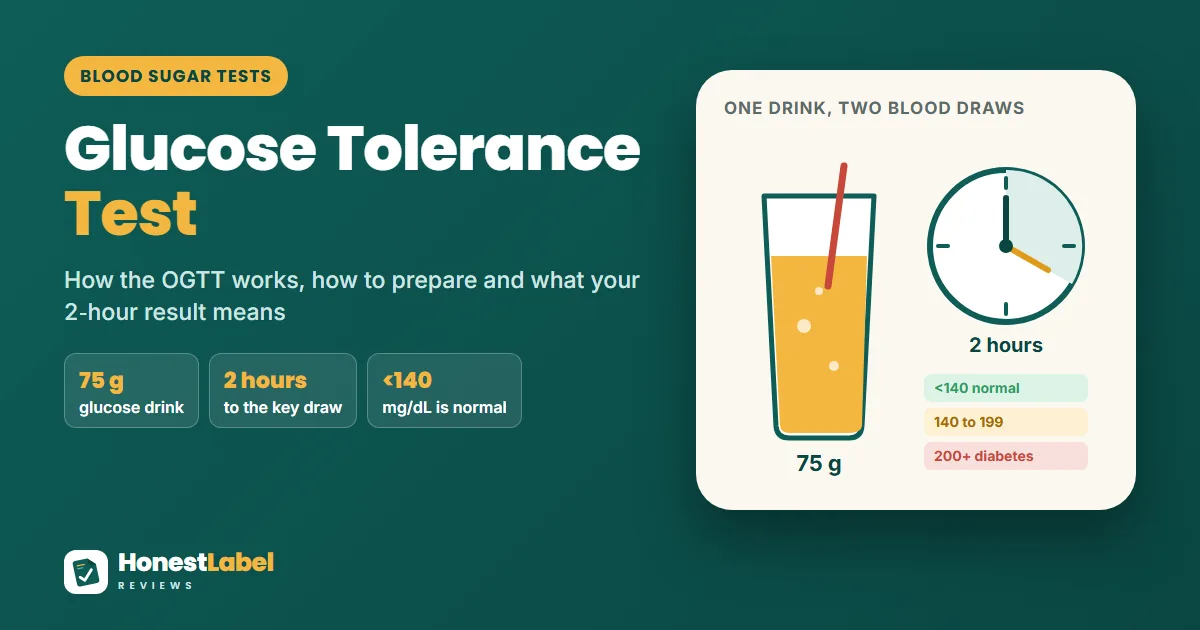
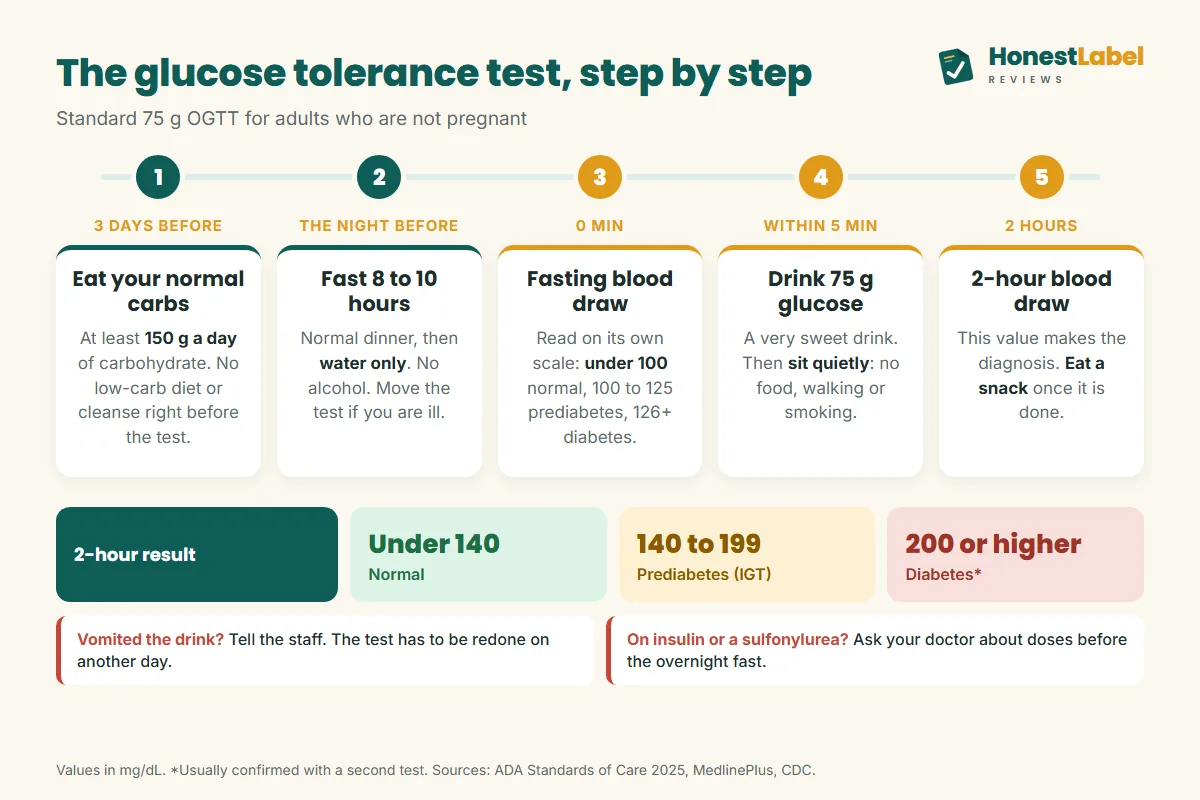
A glucose tolerance test checks how well your body clears sugar. After an 8 to 10 hour fast, you drink 75 grams of glucose and have blood taken two hours later. A 2-hour result under 140 mg/dL is normal, 140 to 199 mg/dL means prediabetes (impaired glucose tolerance), and 200 mg/dL or higher means diabetes.
The oral glucose tolerance test, or OGTT, takes a whole morning and the drink is very sweet. In return it shows what your blood sugar does when a large load of glucose arrives at once, which the other tests can’t. If you want the full picture of normal blood sugar ranges across every test, our main guide covers them. This page sticks to the OGTT itself.
What the glucose tolerance test measures
When glucose hits your bloodstream, the pancreas releases insulin, and insulin moves that sugar into muscle, liver and fat cells. In a healthy person the level rises for 30 to 60 minutes and then falls back below 140 mg/dL by the two-hour mark. If the cells resist insulin, or the pancreas can’t make enough of it, the sugar stays in the blood longer and the 2-hour number stays high.
That is why MedlinePlus describes abnormal glucose tolerance as an earlier sign of diabetes than an abnormal fasting glucose. A fasting blood sugar test looks at the resting state. The OGTT looks at the body under load.
The standard adult test uses 75 grams of glucose dissolved in water. That is roughly the sugar in two cans of regular soda. Children are given a smaller amount based on body weight.
How to prepare for a glucose tolerance test
Preparation matters more for this test than for almost any other blood test. It is necessary to plan a few days ahead, because the way you eat beforehand can push the result up or down.
The 3 days before
- Eat your normal carbohydrates. The ADA Standards of Care advise at least 150 grams of carbohydrate a day for the 3 days before the test. Most people get that without trying.
- Don’t start a low-carb diet or a cleanse right before. After a few days of very low carbs, the body is temporarily less ready to handle glucose, and a healthy person can get a falsely high 2-hour result.
- Keep your usual activity. Long bed rest beforehand can raise the result.
- Tell your doctor about your medicines. Steroids such as prednisone, some diuretics and some antipsychotics can raise the result. Don’t stop one on your own.
The night before
Eat a normal dinner, then stop eating 8 to 10 hours before your appointment. MedlinePlus says at least 8 hours, and pregnancy testing allows 8 to 14 hours. Plain water is fine. Skip alcohol that evening.
The morning of the test
- Have only water. No coffee, tea, juice, gum or mints.
- Don’t smoke, since nicotine can affect blood sugar.
- Bring something to do. You will be sitting for at least two hours, and you can’t eat until the last sample is taken.
- Bring a snack with some protein for afterwards.
- If you feel unwell with a cold, flu or fever, call and move the test. Illness raises blood sugar and can give a misleading result.
What happens during the test, step by step
- Fasting blood draw. A nurse or phlebotomist takes a first blood sample. This gives your fasting glucose.
- The glucose drink. You drink the 75 g solution, usually within 5 minutes. It tastes like very sweet flat soda.
- The wait. You stay seated in the clinic. Walking around, eating or smoking can change the numbers, so patients are asked to keep their activity to a minimum.
- The 2-hour draw. A second sample is taken two hours after you finished the drink. Some clinics also take one at 30 minutes or 1 hour.
Most people get home before lunch, and any nausea is usually gone by then or soon after. Results usually come back within a day or two, sometimes by tomorrow morning in a hospital lab.
Glucose tolerance test results: what the numbers mean
For adults who are not pregnant, the diagnosis rests on the 2-hour value. The cut-offs come from the American Diabetes Association and match those used by the CDC.
| Result at 2 hours | mmol/L | What it means |
|---|---|---|
| Under 140 mg/dL | Under 7.8 | Normal glucose tolerance |
| 140 to 199 mg/dL | 7.8 to 11.0 | Impaired glucose tolerance (prediabetes) |
| 200 mg/dL or higher | 11.1 or higher | Diabetes, usually confirmed with a second test |
The fasting sample from the start of the test is read on its own scale: under 100 mg/dL is normal, 100 to 125 is prediabetes and 126 or higher is diabetes. Someone might have a normal fasting number of 94 and a 2-hour number of 162, which would point to impaired glucose tolerance even though the fasting test alone looked fine.
Reading a result inside a range
A 2-hour value of 141 and one of 195 are both prediabetes, but a result near 200 deserves closer follow-up. If you were told you have prediabetes, our guide to what prediabetes means and how to reverse it covers the next steps.
Is one abnormal result enough for a diagnosis?
Usually not. The ADA asks for two abnormal results to confirm diabetes. That can be two different tests from the same blood sample (for example, a high fasting value and a high 2-hour value), or the same test repeated on a separate day. The exception is someone with classic symptoms, such as heavy thirst and frequent urination, plus a random glucose of 200 mg/dL or higher.
The glucose tolerance test in pregnancy
Pregnancy hormones make the body more insulin resistant, especially in the second half, and some women develop gestational diabetes. The NIDDK says testing usually happens at 24 to 28 weeks, or earlier if you have risk factors. There are two accepted approaches, and your clinic will pick one.
The one-step test (75 g, 2 hours)
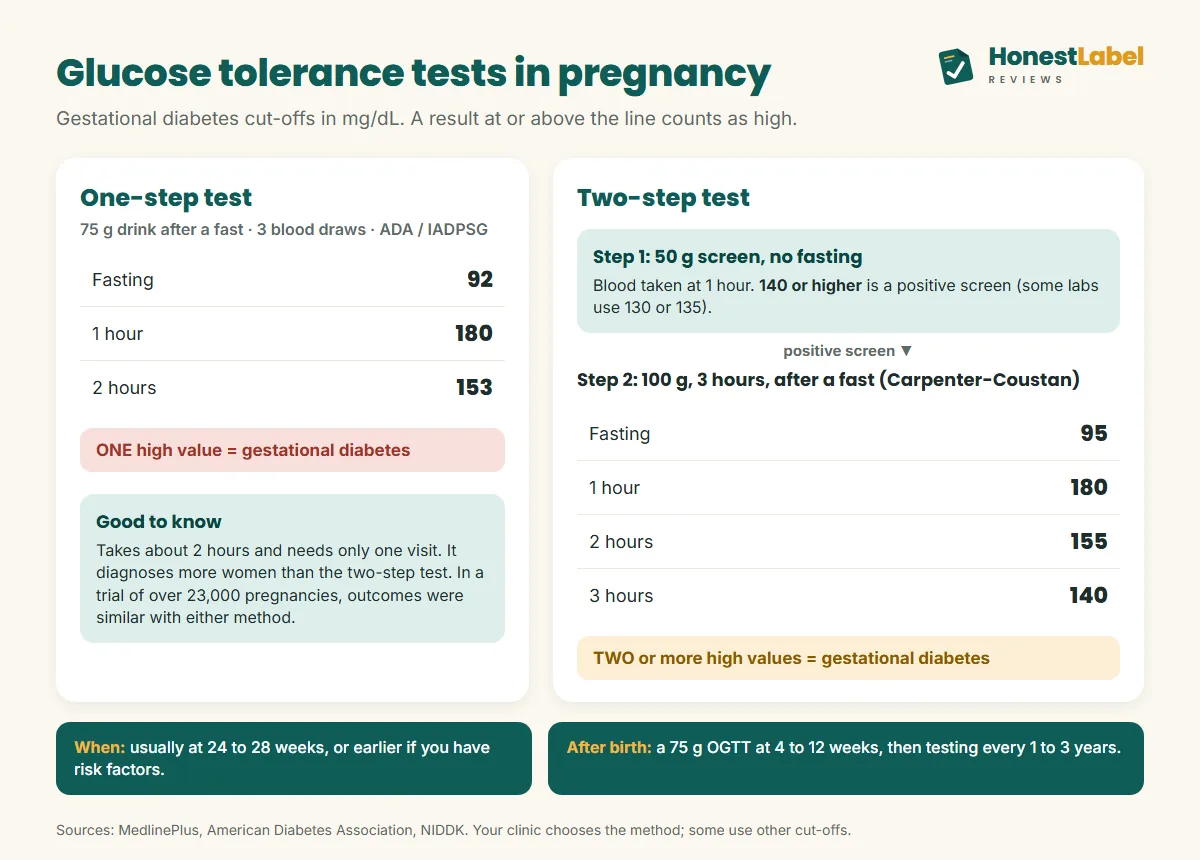
You fast, then drink 75 grams of glucose, and blood is taken fasting, at 1 hour and at 2 hours. The cut-offs, set by the IADPSG group and used by the ADA, are lower than for non-pregnant adults. According to MedlinePlus, gestational diabetes is diagnosed if any one value meets or exceeds:
- Fasting: 92 mg/dL (5.1 mmol/L)
- 1 hour: 180 mg/dL (10.0 mmol/L)
- 2 hours: 153 mg/dL (8.5 mmol/L)
These numbers came from the HAPO study of about 25,000 pregnant women, where the risk of problems such as a large baby rose steadily with blood sugar (HAPO Study Cooperative Research Group, 2008). An expert panel then set the cut-offs from that data (Metzger et al., 2010).
The two-step test (50 g, then 100 g)
Step one is a 50 g glucose challenge test. You don’t need to fast. You drink the solution and have blood taken 1 hour later. Most labs call 140 mg/dL or higher a positive screen, and some use a lower line of 130 or 135 mg/dL to catch more cases. A positive screen does not mean you have gestational diabetes. MedlinePlus notes that about 2 out of 3 women who go on to the second step turn out not to have it.
Step two is a 3-hour test with 100 g of glucose after an 8 to 14 hour fast, with four blood draws: fasting, 1 hour, 2 hours and 3 hours. Under the Carpenter-Coustan criteria, the thresholds are:
- Fasting: 95 mg/dL (5.3 mmol/L)
- 1 hour: 180 mg/dL (10.0 mmol/L)
- 2 hours: 155 mg/dL (8.6 mmol/L)
- 3 hours: 140 mg/dL (7.8 mmol/L)
Two or more values at or above these lines mean gestational diabetes. If only one value is high, MedlinePlus says your provider may suggest some food changes and test you again. Some clinics use an older, higher set of numbers called the NDDG criteria, so if your lab report shows different cut-offs, that is probably why.
Which one is better?
Neither has clearly won. The one-step test diagnoses more women, and critics say many of them have only mild changes. In a large US trial of more than 23,000 pregnant people, the one-step approach diagnosed about twice as many cases, but rates of complications such as large babies and high blood pressure in pregnancy were similar between the two groups (Hillier et al., 2021). The ADA accepts both. Many US obstetric practices use the two-step test.
After the baby arrives
Gestational diabetes usually clears after delivery, but it raises the risk of type 2 diabetes later. The ADA recommends another 75 g OGTT at 4 to 12 weeks after birth, then testing every 1 to 3 years for life. A1C is less reliable this soon after birth.
Side effects: how you might feel
Serious side effects are very uncommon. MedlinePlus lists the usual ones as:
- Nausea
- Feeling sweaty or lightheaded
- Rarely, feeling faint or short of breath
- A small bruise where the needle went in
A few people vomit the drink, usually near the beginning of the wait. If that happens, the test can’t be read and has to be redone on another day, so tell the staff straight away.
Some people feel shaky or tired soon after the test, becuase the big insulin response can make blood sugar dip briefly. That is one reason to bring a snack. For the same reason, the OGTT is a poor way to diagnose after-meal lows.
When doctors choose the OGTT instead of A1C
The A1C test is far easier: no fasting, one blood draw, any time of day. In some situations, though, A1C isn’t reliable or isn’t sensitive enough.
| Situation | Why the OGTT is used |
|---|---|
| Pregnancy | Red blood cell turnover changes, so A1C reads low; the OGTT is the standard test |
| Anemia, recent blood loss or transfusion | A1C depends on red blood cells and can be wrong |
| Some hemoglobin variants or sickle cell trait | Can interfere with some A1C methods |
| Kidney failure, some HIV medicines | Can shift A1C away from true average glucose |
| Borderline fasting or A1C results | The OGTT picks up impaired glucose tolerance that other tests miss |
| Cystic fibrosis and after an organ transplant | The ADA prefers the OGTT for screening in these groups |
| After gestational diabetes | Recommended 4 to 12 weeks after delivery |
The tests don’t always agree, and the gap can be noticeable. The OGTT tends to flag more people than A1C does, because some people with a normal A1C still handle a big sugar load poorly.
Safety: who should be careful
- People who have had weight-loss surgery. After gastric bypass or a sleeve, the sugary drink can cause dumping syndrome, with cramps, a racing heart and sometimes a sharp low afterwards. Doctors often choose a different test. Tell the clinic about any stomach surgery.
- People who already have diabetes. You normally don’t need this test, and the glucose load can push you very high. If you take insulin or a sulfonylurea and a test is still ordered, ask how to handle your doses, since the overnight fast can cause a low.
- Anyone who feels unwell during the test. Tell the staff if you feel faint, very sweaty or confused. They can check your blood sugar on the spot.
When to see a doctor
Ask your doctor about an OGTT, or another blood sugar test, if you:
- Had a fasting result of 100 to 125 mg/dL or an A1C of 5.7 to 6.4% and want a clearer answer
- Had gestational diabetes and haven’t been tested since
- Have strong risk factors, such as a family history, a large waist or PCOS
- Notice constant thirst, frequent urination or blurry vision
Get same-day care if you feel very unwell after the test, with vomiting that won’t stop, confusion or fainting. The numbers are large: the CDC estimates that 40.1 million people in the US have diabetes and more than 1 in 4 of them don’t know it, while 115.2 million adults have prediabetes and 8 in 10 of them are unaware. A test is the only way to find out which group you are in.
Frequently asked questions
How long does a glucose tolerance test take?
The standard adult test takes a litle over two hours from the first blood draw. The 3-hour pregnancy test takes just over three hours.
Can I drink water before a glucose tolerance test?
Yes. Plain water is fine during the fast and is often allowed in small sips during the test. Avoid anything else, including black coffee, tea, flavoured water and chewing gum, until the last blood sample has been taken.
What happens if I fail the 1-hour glucose test in pregnancy?
Failing the 50 g screen only means you need the longer 100 g test. Most women who go on to the 3-hour test turn out not to have gestational diabetes. If you do, it is usually managed with food changes and blood sugar checks, and some women also need medicine.
Is 150 mg/dL two hours after a glucose tolerance test bad?
For an adult who is not pregnant, 150 mg/dL at 2 hours falls in the impaired glucose tolerance range (140 to 199), which is a form of prediabetes. In pregnancy, on the one-step test, it is just under the 153 mg/dL cut-off. Either way, talk the result through with your doctor.
The bottom line
The glucose tolerance test shows how your body copes with a large dose of sugar, and it can catch problems before a fasting test or A1C does. Eat your usual carbs for 3 days, fast for 8 to 10 hours, sit quietly during the test and bring a snack for afterwards. For adults who are not pregnant, under 140 mg/dL at 2 hours is normal, 140 to 199 is prediabetes and 200 or higher points to diabetes. Pregnancy uses its own lower cut-offs, and those depend on whether your clinic runs the one-step or the two-step test. Go through any result with your doctor, since a single number is rarely the whole story.
Sources
- American Diabetes Association Professional Practice Committee. Diagnosis and classification of diabetes: Standards of Care in Diabetes 2025. Diabetes Care, 2025. PubMed.
- American Diabetes Association. Diagnosis; Gestational Diabetes.
- MedlinePlus (US National Library of Medicine). Glucose tolerance test: non-pregnant; Glucose screening tests during pregnancy.
- National Institute of Diabetes and Digestive and Kidney Diseases (NIH). Gestational Diabetes.
- Centers for Disease Control and Prevention. Diabetes Testing; National Diabetes Statistics Report.
- HAPO Study Cooperative Research Group. Hyperglycemia and adverse pregnancy outcomes. New England Journal of Medicine, 2008. PubMed.
- Metzger BE, et al. International Association of Diabetes and Pregnancy Study Groups recommendations on the diagnosis and classification of hyperglycemia in pregnancy. Diabetes Care, 2010. PubMed.
- Hillier TA, et al. A pragmatic, randomized clinical trial of gestational diabetes screening. New England Journal of Medicine, 2021. PubMed.
Medical disclaimer: This article is for general information and is not medical advice. It does not replace a diagnosis or treatment from your doctor. If you have diabetes or take medication that affects blood sugar, talk to your healthcare provider before changing your diet, exercise or supplements.