Last reviewed: November 2026 · Sources: American Diabetes Association, CDC, NIH (PubChem and MedlinePlus) and peer-reviewed papers on PubMed (listed at the end)
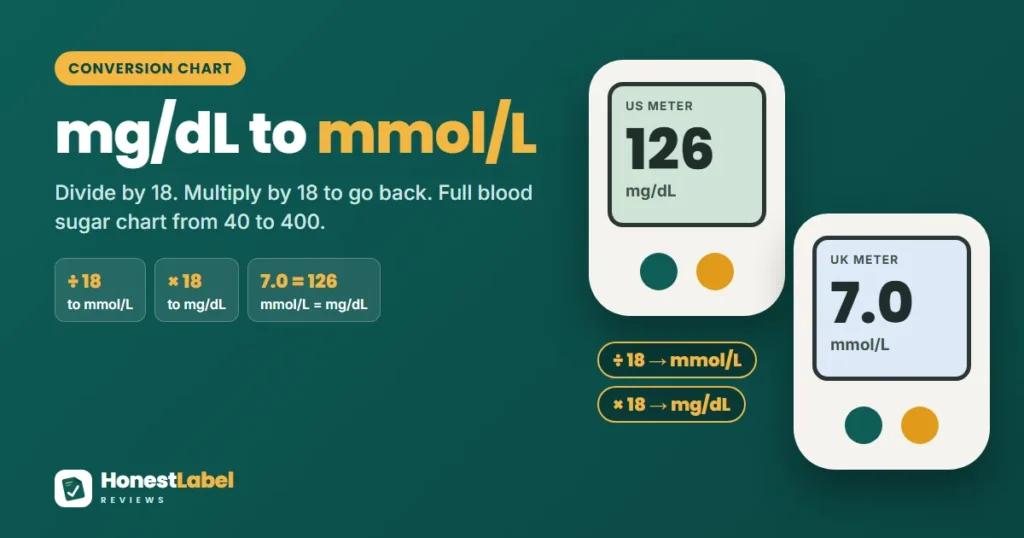
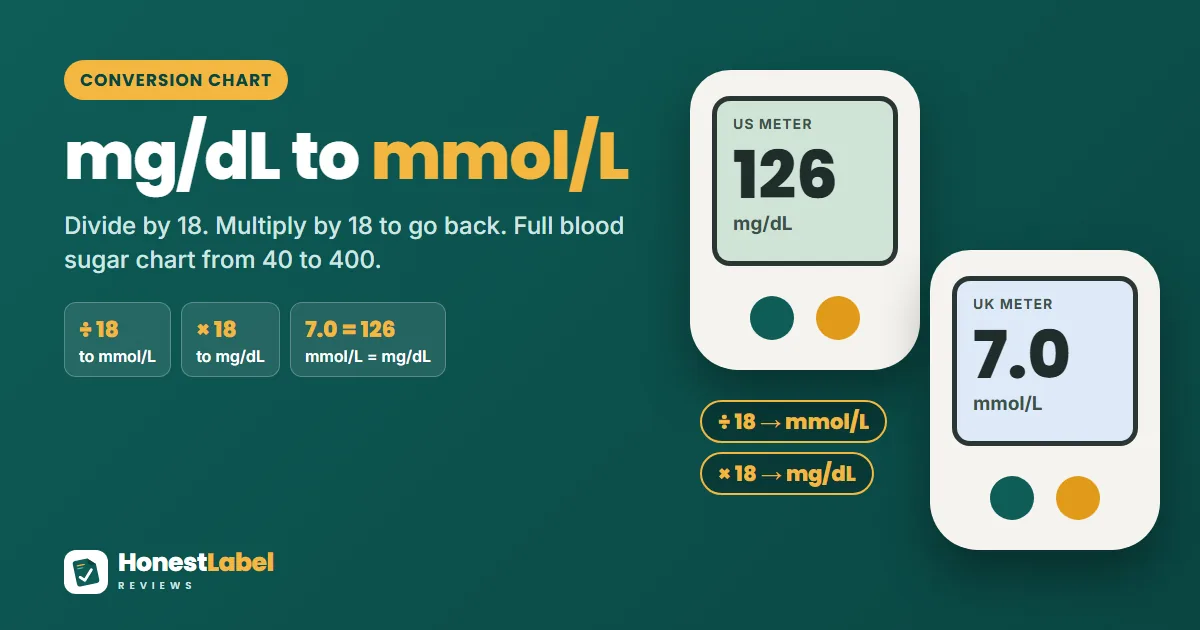
To convert blood sugar from mg/dL to mmol/L, divide by 18. To go from mmol/L to mg/dL, multiply by 18. So 100 mg/dL = 5.6 mmol/L, 126 mg/dL = 7.0 mmol/L and 180 mg/dL = 10.0 mmol/L. The US uses mg/dL, while the UK, Canada and Australia use mmol/L.
Both units measure the same thing, how much glucose is in your blood, and they are truly interchangeable. They just count it differently, a bit like miles and kilometres. If you read a guide written in the other unit, buy a meter abroad, or move between doctors in two countries, the numbers can look alarming or oddly low until you convert them. This page gives you the full chart, the quick mental shortcuts, the main diagnostic ranges in both units, and the separate unit change for the A1C test. For what the numbers mean, see our guide to normal blood sugar ranges.
Why the number 18?
mg/dL is a weight: milligrams of glucose in each decilitre (a tenth of a litre) of blood. mmol/L counts molecules: millimoles of glucose in each litre. To get from one to the other you need the weight of one mole of glucose, which is about 180.16 grams, according to the NIH PubChem record for glucose.
Here is the arithmetic. One mmol of glucose weighs 180.16 mg. A litre holds 10 decilitres, so 1 mmol/L equals 180.16 mg spread across 10 dL, or 18.016 mg/dL. Everyone rounds that to 18. The difference is under 0.1 percent, which is far smaller than the accuracy limits of any home meter, and it only occasionally changes the last decimal place.
The factor 18 only works for glucose. Cholesterol, triglycerides and other lab tests have different molecular weights, so they need their own conversion factors. Dont use 18 on a cholesterol result.
The formulas
- mg/dL to mmol/L: mmol/L = mg/dL ÷ 18. Example: 154 mg/dL ÷ 18 = 8.6 mmol/L.
- mmol/L to mg/dL: mg/dL = mmol/L × 18. Example: 6.5 mmol/L × 18 = 117 mg/dL.
Round mmol/L to one decimal place and mg/dL to a whole number. That matches what meters and lab reports show.
Shortcuts you can do in your head
- mg/dL to mmol/L: halve the number, then divide by 9. For 162 mg/dL, half is 81, and 81 ÷ 9 = 9.0 mmol/L.
- A rougher version: divide by 20, then add about 10 percent. For 200 mg/dL, 200 ÷ 20 = 10, plus 10 percent gives 11, close to the exact 11.1.
- mmol/L to mg/dL: multiply by 20, then take away twice the original number. For 7.5 mmol/L, 7.5 × 20 = 150, minus 15 gives 135 mg/dL.
The rough version is fine for a quick sense of where you are. For anything that affects a dose or a diagnosis, definitely use the exact chart below or let your meter do it.
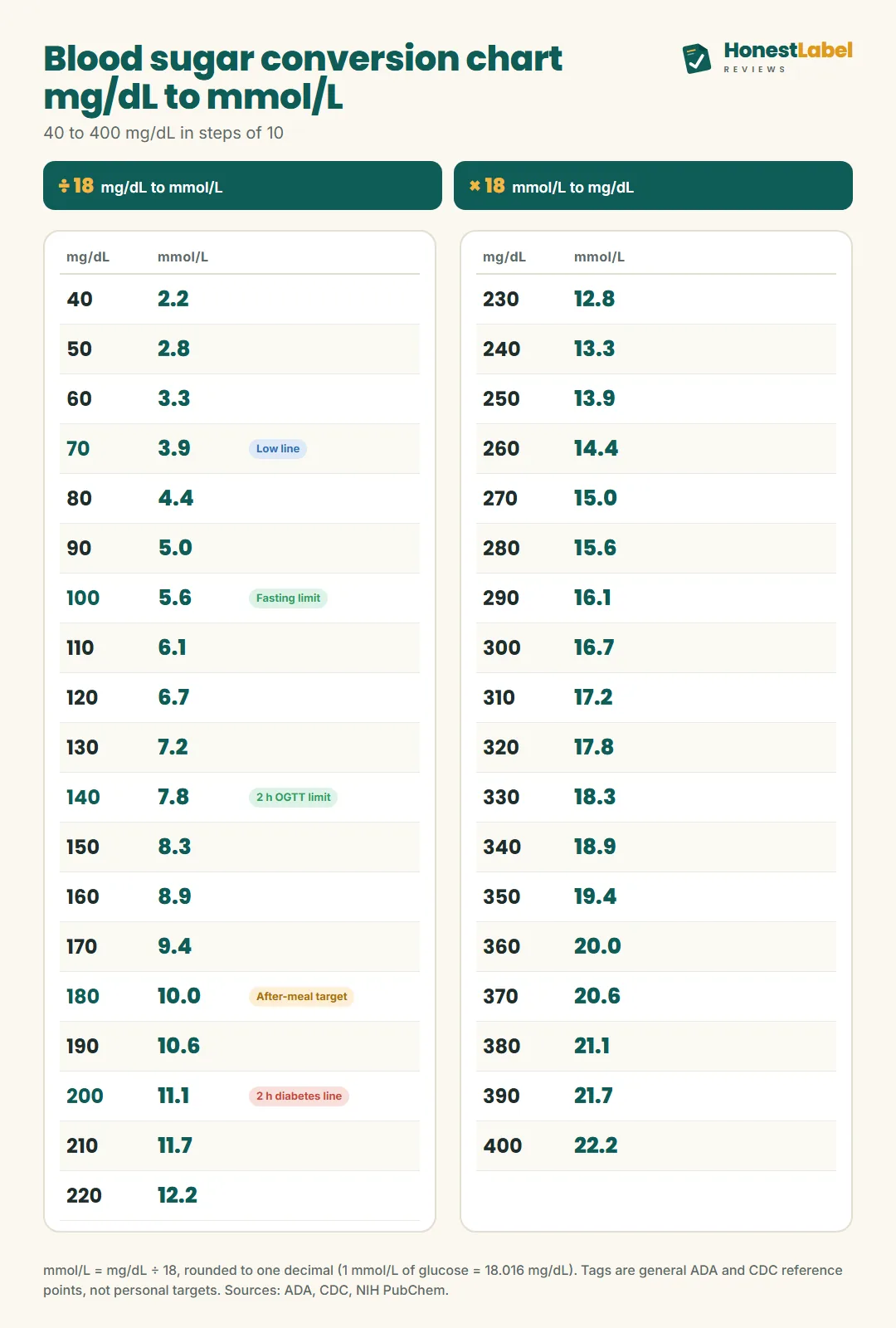
Blood sugar conversion chart: 40 to 400 mg/dL
Every value below is mg/dL divided by 18 and rounded to one decimal place. We calculated each row and checked it twice.
| mg/dL | mmol/L | mg/dL | mmol/L | mg/dL | mmol/L |
|---|---|---|---|---|---|
| 40 | 2.2 | 170 | 9.4 | 300 | 16.7 |
| 50 | 2.8 | 180 | 10.0 | 310 | 17.2 |
| 60 | 3.3 | 190 | 10.6 | 320 | 17.8 |
| 70 | 3.9 | 200 | 11.1 | 330 | 18.3 |
| 80 | 4.4 | 210 | 11.7 | 340 | 18.9 |
| 90 | 5.0 | 220 | 12.2 | 350 | 19.4 |
| 100 | 5.6 | 230 | 12.8 | 360 | 20.0 |
| 110 | 6.1 | 240 | 13.3 | 370 | 20.6 |
| 120 | 6.7 | 250 | 13.9 | 380 | 21.1 |
| 130 | 7.2 | 260 | 14.4 | 390 | 21.7 |
| 140 | 7.8 | 270 | 15.0 | 400 | 22.2 |
| 150 | 8.3 | 280 | 15.6 | ||
| 160 | 8.9 | 290 | 16.1 |
A few in-between values people search for often: 54 mg/dL = 3.0 mmol/L, 125 mg/dL = 6.9 mmol/L, 126 mg/dL = 7.0 mmol/L, and 199 mg/dL = 11.1 mmol/L (11.06 before rounding).
mmol/L to mg/dL: the reverse chart
If your meter, app or lab report shows mmol/L and you are reading a US guide, multiply by 18:
| mmol/L | mg/dL | mmol/L | mg/dL | mmol/L | mg/dL |
|---|---|---|---|---|---|
| 3 | 54 | 10 | 180 | 17 | 306 |
| 4 | 72 | 11 | 198 | 18 | 324 |
| 5 | 90 | 12 | 216 | 19 | 342 |
| 6 | 108 | 13 | 234 | 20 | 360 |
| 7 | 126 | 14 | 252 | 21 | 378 |
| 8 | 144 | 15 | 270 | 22 | 396 |
| 9 | 162 | 16 | 288 |
Key blood sugar ranges in both units
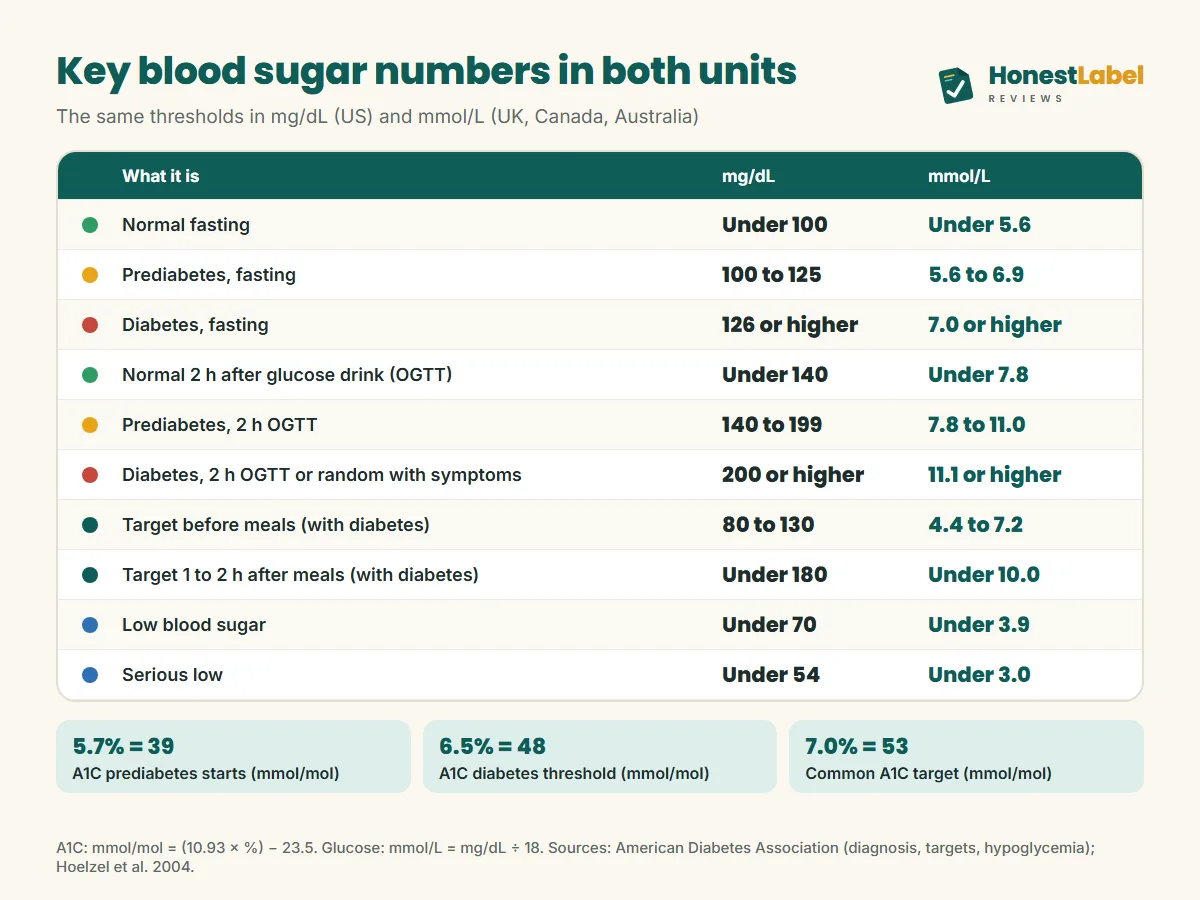
Diagnostic cut-offs are set in mg/dL in the US and in mmol/L elsewhere, and the two sets line up once you convert. The table uses the American Diabetes Association’s diagnostic criteria, its general targets for adults with diabetes and its low blood sugar levels.
| What it is | mg/dL | mmol/L |
|---|---|---|
| Normal fasting | Under 100 | Under 5.6 |
| Prediabetes, fasting | 100 to 125 | 5.6 to 6.9 |
| Diabetes, fasting | 126 or higher | 7.0 or higher |
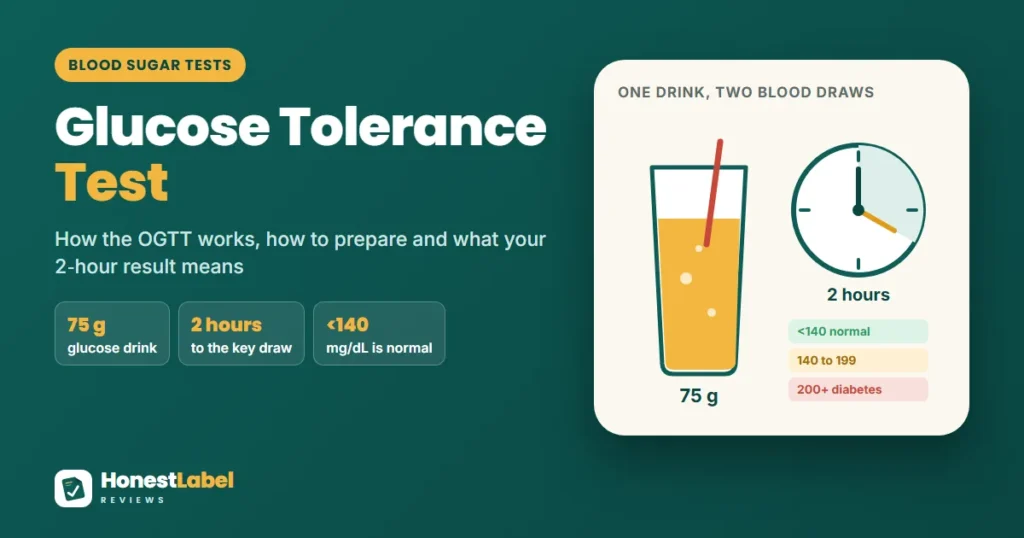
| Normal 2 hours after a glucose drink (OGTT) | Under 140 | Under 7.8 |
| Prediabetes, 2-hour OGTT | 140 to 199 | 7.8 to 11.0 |
| Diabetes, 2-hour OGTT or random with symptoms | 200 or higher | 11.1 or higher |
| Target before meals (most adults with diabetes) | 80 to 130 | 4.4 to 7.2 |
| Target 1 to 2 hours after a meal | Under 180 | Under 10.0 |
| Low blood sugar | Under 70 | Under 3.9 |
| Serious low | Under 54 | Under 3.0 |
Two rounding quirks are worth knowing. First, 100 mg/dL is 5.56 mmol/L, which rounds to 5.6, so “under 100” and “under 5.6” line up neatly. Second, 199 mg/dL works out to 11.06, which also rounds to 11.1. Guidelines written in mmol/L draw the line at 11.0 for prediabetes and 11.1 for diabetes, so a reading near that boundary is one to discuss with your doctor rather then settle with a calculator.
For after-meal numbers and how they change through the day, see what is normal after eating. If your fasting readings are the ones running high, why blood sugar is high in the morning explains the common causes.
Which countries use mg/dL and which use mmol/L?
There is no single official list, and practice can differ between labs and even between hospitals in the same country, but this is the common pattern:
| Mostly mg/dL | Mostly mmol/L |
|---|---|
| United States | United Kingdom and Ireland |
| Japan and South Korea | Canada |
| India | Australia and New Zealand |
| France, Italy, Spain, Belgium and Portugal | Netherlands and the Nordic countries |
| Much of Latin America, including Brazil and Mexico | China and Russia |
| Germany and Austria use both | South Africa |
Many international journals report glucose in mmol/L, often with mg/dL in brackets. US sources such as the CDC and the ADA quote mg/dL. If you aren’t sure which unit a number is in, the size gives it away: blood sugar in mmol/L is almost always a number under about 35, while in mg/dL it is usualy 50 or more. A “7” is mmol/L. A “126” is mg/dL.
Mixing up the units: why it matters
Reading a number in the wrong unit is more than a maths slip. A reading of 5.0 mmol/L (90 mg/dL) is a perfectly normal fasting level, but someone reading a US chart might think a “5” means a dangerous low. Going the other way, a US reader seeing a UK guide’s “target 4 to 7” might assume there 120 is wildly high. Both mistakes can lead to the wrong food or medicine decision.
- Check your meter’s unit at the beginning, on the screen next to the number. Some meters can be switched in the settings; others come locked to one unit for the country they were sold in.
- Buying a meter abroad? A meter bought in another country may display the other unit and use test strips that aren’t sold where you live. Check both before you buy.
- Using a CGM app? Most apps let you choose the unit. After a phone change or an app update, confirm it hasn’t reset.
- Insulin doses: correction factors and targets are written in one unit. If you switch units, ask your diabetes team to rewrite your plan in the new unit rather than converting it yourself.
- Moving country or seeing a new doctor: if you receive results from a lab abroad, or bring your own log, note which unit it uses. It saves a lot of confusion.
Home meters are for day-to-day tracking and are less precise than lab equipment, so a small gap between your meter and a lab result is normal in either unit. A diagnosis is made with a lab test.
A1C units: percent to mmol/mol
The A1C test, which shows your average blood sugar over the past two to three months, also comes in two units. The US reports it as a percentage, using the NGSP standard. The UK, Ireland, Australia, New Zealand and many European countries report it in mmol/mol, the unit of the International Federation of Clinical Chemistry (IFCC), often with the percentage alongside. In 2007 the ADA, the European diabetes association, the IFCC and the International Diabetes Federation agreed that labs worldwide should move toward reporting both (Consensus Committee, Diabetes Care 2007).
The two scales are linked by a fixed formula that grew out of a large method-comparison study (Hoelzel et al., Clinical Chemistry 2004):
- % to mmol/mol: IFCC (mmol/mol) = (10.93 × A1C %) − 23.5
- mmol/mol to %: A1C % = (mmol/mol + 23.5) ÷ 10.93
Example: an A1C of 7.0% gives 10.93 × 7.0 = 76.51, minus 23.5 = 53.01, so 53 mmol/mol. Going back, (53 + 23.5) ÷ 10.93 = 7.0%.
| A1C % | mmol/mol | What it means |
|---|---|---|
| 5.0 | 31 | Normal |
| 5.6 | 38 | Normal (upper end) |
| 5.7 | 39 | Start of the prediabetes range |
| 6.0 | 42 | Prediabetes |
| 6.4 | 46 | Top of the prediabetes range |
| 6.5 | 48 | Diabetes threshold |
| 7.0 | 53 | Common target for many adults with diabetes |
| 8.0 | 64 | Above most targets |
| 9.0 | 75 | High |
| 10.0 | 86 | Very high |
The cut-offs in the table follow the ADA: under 5.7% is normal, 5.7% to 6.4% is prediabetes and 6.5% or higher is diabetes. An A1C of 6.5% works out to 47.55, so it is reported as 48 mmol/mol. A1C is a separate test from a finger-prick reading, so the factor 18 does not apply to it. MedlinePlus also notes that anemia and some blood conditions can make A1C less accurate in either unit.
When to see a doctor
Converting a number does not change what it means, so the usual advice applies whatever unit you use. Book an appointment if:
- Your fasting reading is 100 mg/dL (5.6 mmol/L) or higher on more than one day
- Any reading is 200 mg/dL (11.1 mmol/L) or higher, especially with thirst, frequent urination or weight loss you can’t explain
- Your A1C is 5.7% (39 mmol/mol) or higher
- You use insulin and are switching meters, units or countries and need your plan rewritten
Get urgent help for a reading under 54 mg/dL (3.0 mmol/L) that doesnt respond to fast sugar, or a high reading with vomiting, deep fast breathing or confusion. Those signs point to a serious low or to diabetic ketoacidosis, and the CDC treats ketoacidosis as a medical emergency.
Frequently asked questions
How do I convert mmol/L to mg/dL?
Multiply by 18. For example, 6 mmol/L × 18 = 108 mg/dL, and 10 mmol/L × 18 = 180 mg/dL. Round to a whole number.
What is 100 mg/dL in mmol/L?
100 mg/dL is 5.6 mmol/L (5.56 before rounding). It is the upper limit of a normal fasting blood sugar under ADA criteria.
Is 7 mmol/L high for blood sugar?
7.0 mmol/L equals 126 mg/dL. As a fasting result, that is the diabetes threshold if it is confirmed on a second test. Two hours after a meal, 7.0 mmol/L is within the normal range of under 7.8.
Why does the US use mg/dL?
US labs kept the older weight-based unit, while most countries that adopted the International System of Units switched to mmol/L. Both are accurate. The only risk is mixing them up.
What is 6.5% A1C in mmol/mol?
6.5% equals 48 mmol/mol, using (10.93 × 6.5) − 23.5 = 47.55, rounded up. It is the A1C threshold for diagnosing diabetes.
The bottom line
Divide mg/dL by 18 to get mmol/L, and multiply mmol/L by 18 to get mg/dL. The chart above covers 40 to 400 mg/dL, and the key lines are easy to remember: 70 mg/dL is 3.9 mmol/L, 100 is 5.6, 126 is 7.0, 140 is 7.8, 180 is 10.0 and 200 is 11.1. A1C uses its own formula: multiply the percentage by 10.93 and subtract 23.5 to get mmol/mol. Allways check which unit your meter shows, and ask your care team to rewrite any insulin plan if you change units.
Sources
- American Diabetes Association. Diagnosis; Checking Your Blood Glucose; Hypoglycemia.
- Centers for Disease Control and Prevention. Diabetes Testing; Diabetic Ketoacidosis.
- National Library of Medicine (NIH). PubChem: Glucose.
- MedlinePlus. A1C Test.
- Consensus Committee. Consensus statement on the worldwide standardization of the hemoglobin A1C measurement. Diabetes Care, 2007. PubMed.
- Hoelzel W, et al. IFCC reference system for measurement of hemoglobin A1c in human blood and the national standardization schemes in the United States, Japan, and Sweden: a method-comparison study. Clinical Chemistry, 2004. PubMed.
Medical disclaimer: This article is for general information and is not medical advice. It does not replace a diagnosis or treatment from your doctor. If you have diabetes or take medication that affects blood sugar, talk to your healthcare provider before changing your diet, exercise or supplements.