Last reviewed: November 2026 · Sources: NIAMS (NIH), CDC, NCCIH, MedlinePlus, the American College of Rheumatology, the Arthritis Foundation and peer-reviewed studies (listed at the end)
Most joint pain in adults comes from wear and repair problems such as osteoarthritis, from inflammation such as rheumatoid arthritis or gout, or from injury and overuse. The treatments with the strongest evidence are cheap: regular exercise and, for anyone carrying extra weight, losing some of it. A hot, swollen joint with fever needs a doctor the same day.
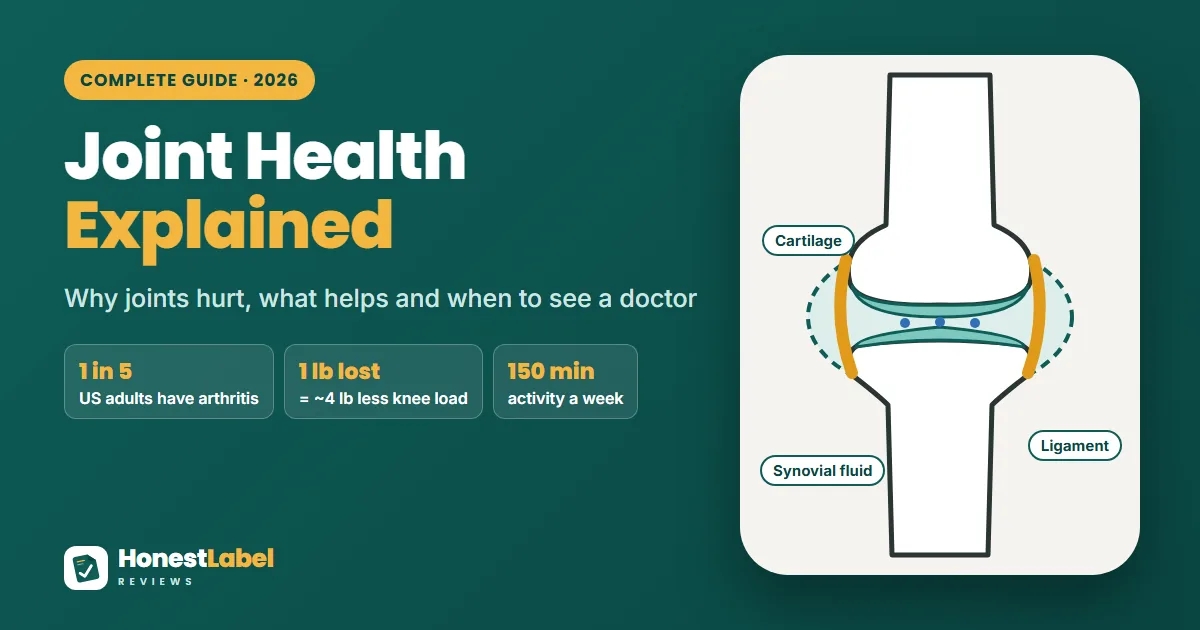
According to the CDC’s arthritis data, more than 53 million US adults, roughly 1 in 5, have been told by a doctor that they have some form of arthritis, and osteoarthritis alone affects more than 32 million.
This guide covers how a healthy joint works, why joints start to hurt, how to tell wear-and-tear arthritis from the inflammatory kind, and what the research says helps, including the joint supplements on pharmacy shelves. It ends with the warning signs that mean you should call a doctor.
How a healthy joint works
A joint is any place where two bones meet. The ones that cause most of the trouble are synovial joints: knees, hips, shoulders, fingers, ankles and the small joints of the spine. Each has a few parts with specific jobs.
Cartilage
The ends of the bones are capped with articular cartilage, a smooth, rubbery tissue that lets the surfaces glide over each other and spreads the load when you stand, walk or jump. It has no blood supply and no nerves, wich is why early cartilage damage often causes no pain at all and why cartilage heals so poorly once it is worn. It gets its nutrients from the fluid around it, squeezed in and out as the joint is loaded and unloaded, so regular movement is part of how cartilage stays fed.
Synovial membrane and fluid
The whole joint sits inside a capsule lined by a thin layer called the synovium. The synovium makes synovial fluid, a slippery liquid about the thickness of egg white. It lubricates the joint, cushions it and carries nutrients to the cartilage. Hyaluronic acid is one of the ingredients that gives the fluid its slickness. When the synovium becomes inflamed, as in rheumatoid arthritis, it thickens and makes extra fluid, and the joint swells.
Ligaments, tendons and muscles
Ligaments are tough bands that connect bone to bone and keep the joint stable. Tendons connect muscle to bone. Around each joint, the muscles do more than move it: they absorb shock and keep the bones lined up. Weak thigh muscles, for example, leave the knee to take more of the impact itself. Small fluid-filled sacs called bursae sit between tendons and bone to reduce friction. Pain usually means one of these parts is damaged, inflamed or overloaded faster than it can recover.
Why joints hurt: the common causes
“Joint pain” covers a long list of conditions, but five account for most cases in adults.
Osteoarthritis
Osteoarthritis (OA) is by far the most common type of arthritis. The National Institute of Arthritis and Musculoskeletal and Skin Diseases (NIAMS) describes it as a disease of the whole joint: the cartilage breaks down, the bone underneath changes and may grow small spurs, and the lining and ligaments are affected too. It most often hits the knees, hips, hands and spine.
People often call OA “wear and tear”, and the Arthritis Foundation explains why that label is too simple. Age, joint shape, past injuries, weight, muscle strength and genes all play a part, and low-grade inflammation is involved as well. The typical pattern is pain that gets worse with use and better with rest, short stiffness after sitting or first thing in the morning, and sometimes a grinding feeling.
Rheumatoid arthritis and other inflammatory types
Rheumatoid arthritis (RA) is an autoimmune disease. The immune system attacks the synovium, which becomes inflamed and, over time, can erode cartilage and bone. NIAMS notes that it usually affects the same joints on both sides of the body, often the small joints of the hands, wrists and feet, and it can cause tiredness, low fever and loss of appetite because the whole body is involved.
Psoriatic arthritis and ankylosing spondylitis are other inflammatory types. All of them need a rheumatologist, because modern medicines can stop the damage if started early.
Gout
Gout happens when uric acid builds up in the blood and forms needle-shaped crystals in a joint. An attack usually comes on fast, often overnight, with a joint that turns red, hot, swollen and so tender that a bedsheet hurts. The big toe is the classic spot, but ankles, knees, wrists and elbows can be affected too. NIAMS lists risk factors such as being male, obesity, high blood pressure, kidney disease, some diuretics, and diets heavy in alcohol, red meat, organ meats and sugary drinks. Gout is very treatable, and medicines that lower uric acid can prevent attacks.
Injury
Sprains, torn ligaments such as the ACL, a torn meniscus and fractures into a joint cause pain, swelling and sometimes a joint that gives way. An old injury also raises the chance of osteoarthritis in that joint years later.
Overuse
Doing the same movement over and over can irritate tendons and bursae around a joint. Tennis elbow, runner’s knee and hip bursitis are common examples, and they usually settle with rest, better technique and gradual strengthening.
Less common causes include joint infection (septic arthritis), Lyme disease, viral infections and thyroid problems. Some need fast treatment, so check the red flags near the end.
Osteoarthritis vs inflammatory arthritis: how to tell them apart
The single most useful question for sorting out stiff joints is how long the morning stiffness lasts. Stiffness from OA usually loosens up within about 30 minutes. Stiffness from inflammatory arthritis tends to last an hour or longer, and it often improves with movement through the day. The table below sums up the other differences.
| Feature | Osteoarthritis | Rheumatoid (inflammatory) arthritis |
|---|---|---|
| What is going on | Breakdown and remodelling of cartilage and bone | Immune system attacks the joint lining |
| Usual age at start | Mostly over 50 | Often 30 to 60, can start at any age |
| Morning stiffness | Usually under 30 minutes | Often over an hour |
| Pattern | One or a few joints, often one side more than the other | Same joints on both sides of the body |
| Typical joints | Knees, hips, base of the thumb, finger end joints, spine | Knuckles, middle finger joints, wrists, balls of the feet |
| Pain worse with | Use and activity | Rest and inactivity |
| Whole-body symptoms | No | Tiredness, low fever, feeling unwell |
| Blood tests | Usually normal | Often raised inflammation markers, RF or anti-CCP antibodies |
| Main treatment | Exercise, weight loss, pain relief, sometimes surgery | Disease-modifying drugs started early by a rheumatologist |
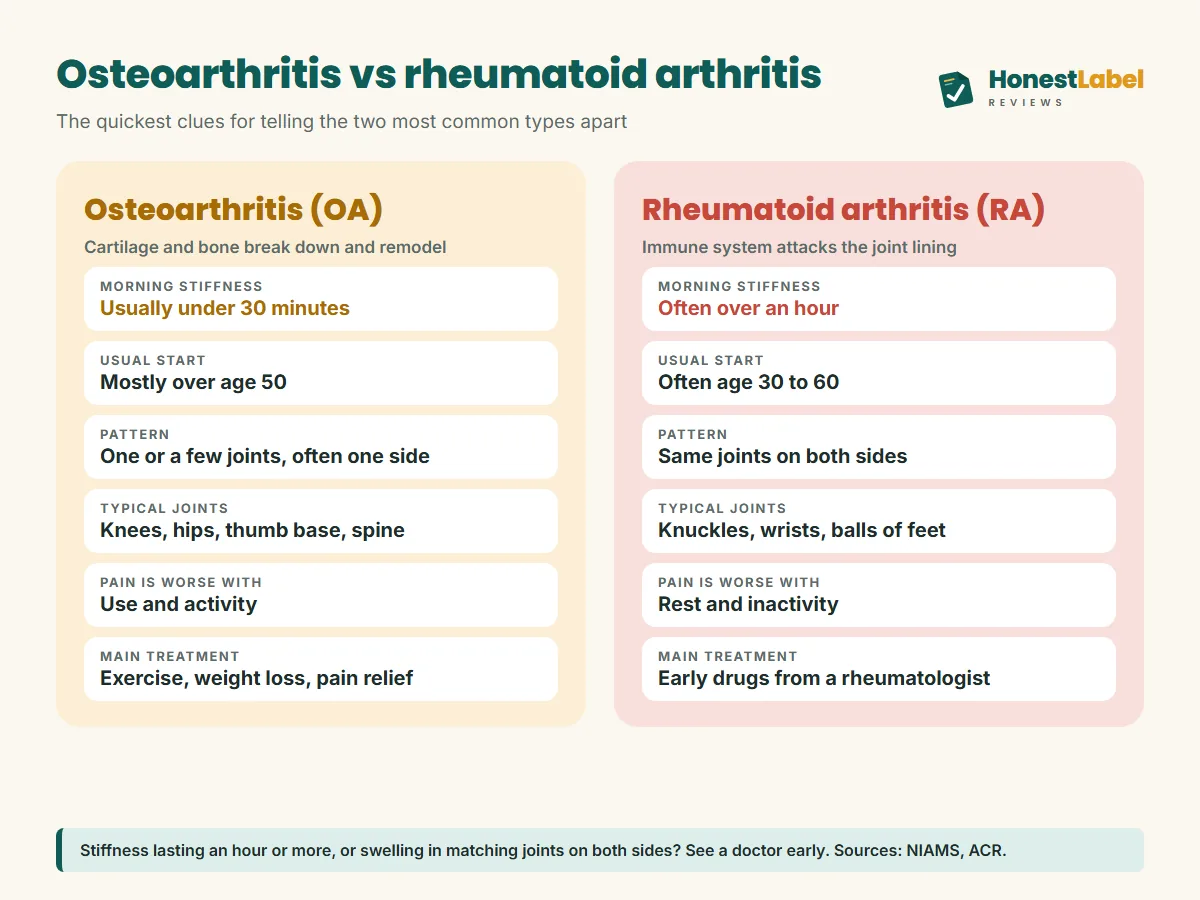
None of these clues is perfect. If your pattern looks more like the right-hand column, ask for a referral, because treatment does the most good in the first few months of inflammatory arthritis.
Risk factors for joint problems
Risks you cannot change
- Age. OA becomes much more common after 50 as cartilage loses some of its ability to repair.
- Sex. Women are more likely to develop OA, especially after menopause, and are two to three times more likely than men to get RA. Men are more likely to get gout.
- Genes and family history. OA in the hands and RA both run in families.
Risks you can change
- Body weight. Extra weight raises the load on the knees and hips with every step, and fat tissue also releases inflammatory substances that seem to affect joints, including the hands, which carry no body weight at all.
- Muscle weakness. Weak quadriceps are linked to knee pain and faster OA.
- Repetitive strain at work. Jobs with a lot of kneeling, squatting or heavy lifting raise the risk of knee and hip OA.
- Smoking. It is one of the strongest known risk factors for RA, and it makes RA medicines work less well.
- Diet and alcohol play a direct role in gout.
Weight and joint health also connect to metabolism. The same extra weight that loads the knees raises the risk of insulin resistance and type 2 diabetes, and the habits that help one usually help the other. If that applies to you, our guide to normal blood sugar levels covers the numbers to check.
What helps joint pain: exercise comes first
Exercise is the most effective treatment for osteoarthritis that does not involve a prescription, and it helps most other joint conditions too. The 2019 American College of Rheumatology and Arthritis Foundation guideline gives exercise its strongest recommendation for OA of the knee, hip and hand, alongside weight loss, self-management programs and tai chi.
Many people with sore joints avoid moving because they fear wearing the joint out, yet cartilage needs the squeeze and release of loading to stay nourished, and stronger muscles take load off the joint surface. The CDC suggests that adults with arthritis aim for about 150 minutes of moderate activity a week, the same target as other adults, plus muscle strengthening on two days. You can build up to that in small pieces.
The types of exercise that help
- Low-impact aerobic activity, such as walking, cycling, swimming or water aerobics. Water takes weight off the joints and is a good starting point for people with a lot of pain.
- Strength training. Building the thigh and hip muscles is one of the best things you can do for knee pain. Sit-to-stand from a chair, wall squats, step-ups and resistance bands all work.
- Balance and mind-body exercise. Tai chi has a strong recommendation in the ACR guideline, and yoga has a conditional one.
How to start without making things worse
Some discomfort during exercise is normal and does not mean you are causing harm. A simple rule many physical therapists use: pain during or after exercise is fine if it stays mild and settles within a day or so. If extra pain or swelling is still noticable the next day, cut back the amount, not the habit. Start with 10 minutes, add a few minutes each week, and keep at it untill the routine feels easy. A physical therapist can build a program around your joints, and it is worth asking your doctor for a referral if you do not know where to begin.
Weight loss: the second big lever
For knees and hips, weight loss has some of the clearest evidence there is. In a study of 142 overweight older adults with knee OA, each pound of weight lost was linked to about four pounds less load on the knee with every step (Messier et al., 2005). Over the thousands of steps you take a day, that adds up fast.
The larger IDEA trial followed 454 overweight and obese adults aged 55 and over with knee OA for 18 months. The group that combined diet and exercise lost an average of about 11 percent of their body weight and had less pain, better function and better quality of life than the group that only exercised (Messier et al., 2013). The diet groups also had lower levels of the inflammatory marker IL-6.
You do not need to reach a perfect weight. The ACR guideline notes that losing 5 percent or more of body weight starts to make a difference to pain and function, and that more loss brings more benefit. For a 200-pound person, 5 percent is 10 pounds.
Heat, ice and other home measures
Heat and cold are cheap, safe for most people and supported by a conditional recommendation in the ACR guideline under “thermal modalities”. They work best for short-term relief.
- Heat relaxes muscles and eases stiffness. A warm shower in the morning, a heat pack or a warm bath before exercise helps many people with OA. Keep it warm, not hot, and limit sessions to about 15 to 20 minutes.
- Cold numbs pain and reduces swelling. It is the better choice for a fresh injury or a flare where the joint is warm and puffy. Wrap the ice pack in a towel and use it for about 15 to 20 minutes at a time.
People with poor circulation, diabetes-related nerve damage or reduced skin feeling should be careful with both, since they may not notice a burn or cold injury.
The ACR also strongly recommends a cane (held in the hand opposite the sore knee or hip), certain knee braces, and splints for arthritis at the base of the thumb.
Sleep and joint pain
Pain and sleep feed each other. Joint pain makes it harder to sleep, and poor sleep lowers the threshold at which you feel pain. A research review in the Journal of Pain concluded that sleep problems may predict future pain more strongly than pain predicts sleep problems (Finan et al., 2013). Improving sleep is a reasonable part of any plan for chronic joint pain.
The basics apply: a regular sleep and wake time, a cool dark room, less caffeine after lunch and less alcohol in the evening. A pillow between the knees for side sleepers, or under the knees for back sleepers, takes pressure off sore hips and knees. If you snore heavily or wake up exhausted, ask about sleep apnea, because it is common in people with extra weight and it wrecks sleep quality.
Diet and joint health
No single food rebuilds cartilage, whatever social media says. Diet matters for joints in three main ways.
- Weight. As covered above, this is where diet has the biggest effect on knee and hip OA.
- Inflammation. A Mediterranean-style pattern, built on vegetables, fruit, beans, whole grains, olive oil, nuts and fish, is linked to lower inflammation markers and is a sensible choice for people with RA. It is not a substitute for RA medicine.
- Gout. Cutting back on beer and spirits, sugary drinks, organ meats and large portions of red meat and shellfish can lower uric acid. Drinking enough water helps too.
Adequate vitamin D and calcium support the bones around the joint, though vitamin D supplements have not been shown to slow OA. If you follow a restrictive diet, talk to your doctor about what is neccessary to cover the gaps.
Over-the-counter pain relievers: a safety overview
Pain relievers can make it easier to stay active, but they carry risks that are easy to overlook. We do not give doses here: follow the label, and ask your pharmacist or doctor if you take them often. MedlinePlus has a good overview of the main types.
Acetaminophen (paracetamol)
Acetaminophen is gentle on the stomach, but too much can seriously damage the liver. The risk rises with daily alcohol use, liver disease and taking more than one product that contains it. Many cold and flu remedies also contain it, so check every label. For OA, its benefit for pain is small, and the ACR guideline gives it only a conditional recommendation.
Oral NSAIDs (ibuprofen, naproxen and others)
NSAIDs reduce both pain and inflammation, and they work better than acetaminophen for most people with OA. They can also cause stomach ulcers and bleeding, raise blood pressure, harm the kidneys and increase the risk of heart attack and stroke, especially at higher doses and with long-term use. The risks are higher in older adults, people with heart, kidney or stomach problems, and anyone on blood thinners, steroids or certain blood pressure medicines. Do not combine two NSAIDs, and talk to a doctor before using them regularly.
Topical NSAIDs
NSAID gels and creams rubbed on the skin over the joint deliver much less of the drug to the rest of the body. The ACR guideline strongly recommends them for knee OA, and many doctors suggest trying them before pills, particularly for people over 75. They work best for joints close to the skin, such as knees and hands.
Your doctor may also discuss steroid injections, physical therapy, duloxetine and, for advanced OA that limits daily life, joint replacement surgery.
Do joint supplements work?
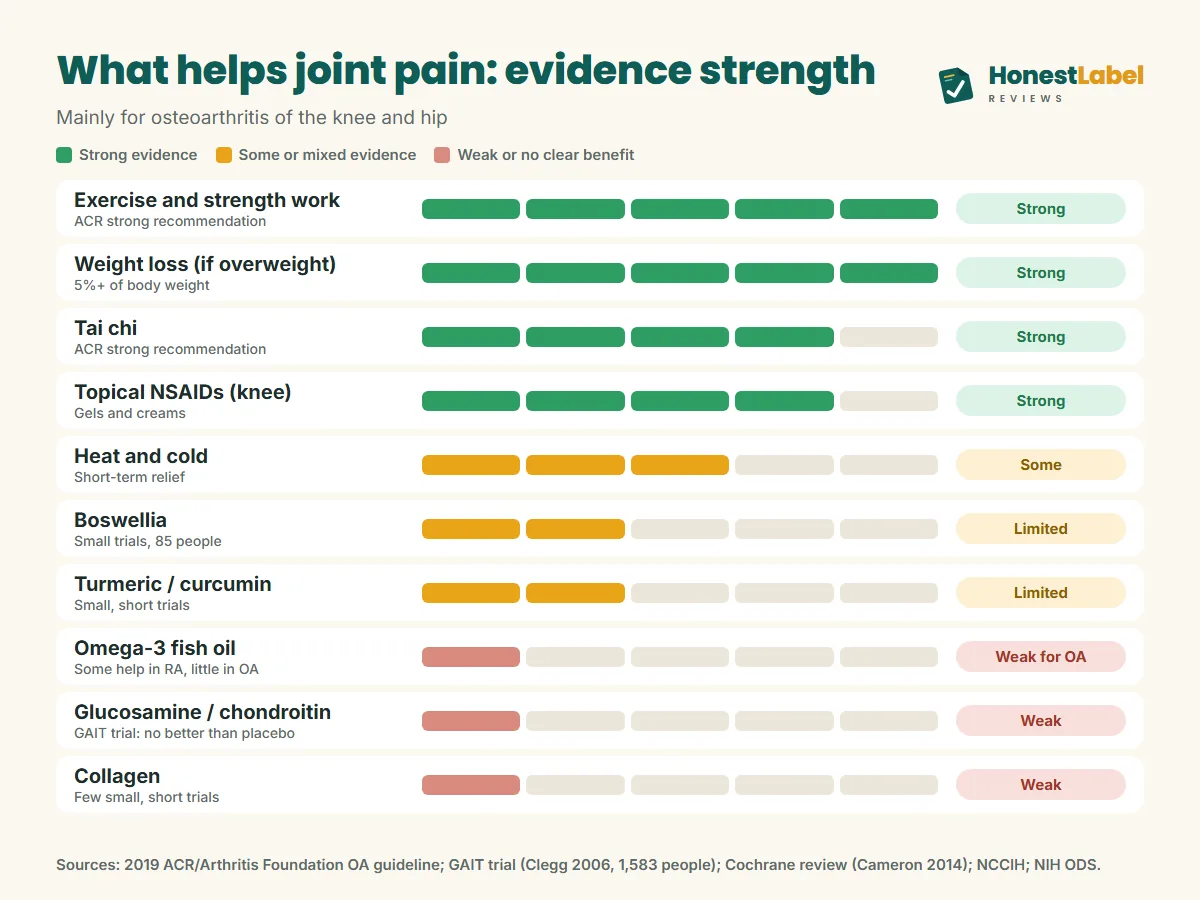
The evidence behind joint supplements is much thinner than the shelf space suggests. Here is what the research shows for the ingredients you will see most often. None of them can replace exercise, weight management or treatment for inflammatory arthritis.
Glucosamine and chondroitin
These are natural parts of cartilage, and the idea of swallowing them to rebuild cartilage is appealing. The best test of the idea was the US government-funded GAIT trial, which randomly assigned 1,583 people with knee OA to glucosamine (1,500 mg a day), chondroitin (1,200 mg a day), both together, the prescription NSAID celecoxib, or a placebo for 24 weeks (Clegg et al., 2006). Overall, neither supplement nor the combination worked significantly better than the placebo. The placebo response was high, at about 60 percent, while celecoxib did beat it. A small subgroup with moderate to severe pain seemed to benefit from the combination, but the authors called that finding exploratory, and later follow-up studies did not show that the supplements slowed joint damage.
NCCIH sums up the research as mixed, with some studies from Europe using a prescription form of glucosamine sulfate showing more benefit than US studies. The ACR guideline recommends against glucosamine for OA and against chondroitin for knee and hip OA, with a conditional recommendation for chondroitin in hand OA. Glucosamine may affect blood clotting in people taking warfarin, and some products are made from shellfish.
Turmeric and curcumin
Curcumin, the main active compound in turmeric, has anti-inflammatory effects in lab studies. A number of small trials in knee OA, most lasting a few weeks to a few months, suggest it may ease pain about as much as an NSAID in some people, but the studies are small and many are low quality. Curcumin is also poorly absorbed, so products often add black pepper extract (piperine) or use special formulations, which changes how much reaches the blood. NCCIH notes reports of liver injury linked to turmeric supplements, and turmeric may interact with blood thinners and some other drugs. Evidence: early and promising, still weak.
Omega-3 fatty acids (fish oil)
Fish oil has its best evidence in rheumatoid arthritis, where some trials found modest improvements in joint tenderness and morning stiffness and a lower need for NSAIDs. The NIH Office of Dietary Supplements describes the effect in RA as small. For osteoarthritis the evidence is weak, and the ACR guideline does not recommend fish oil for OA. High doses can raise bleeding risk with blood thinners. Eating oily fish twice a week is a reasonable food-first approach.
Collagen
Collagen supplements come in two main forms: hydrolysed collagen peptides and undenatured type II collagen, used in much smaller amounts. A handful of small trials, often funded by makers of the ingredient, have reported modest improvements in knee pain or stiffness. The studies are short, the forms and doses differ, and independent replication is limited. Evidence: weak. Collagen is generally safe, but it is not a proven way to rebuild cartilage.
Boswellia
Boswellia serrata, also called Indian frankincense, is a tree resin used in traditional medicine. A Cochrane review found that in two small trials with 85 people, an enriched boswellia extract taken for 90 days reduced OA pain by about 17 points on a 100-point scale compared with placebo (Cameron and Chrubasik, 2014). That is a meaningful effect, but it comes from very few people and from specific commercial extracts, so it may not apply to other products. The reviewers called for more research. It can cause stomach upset, and its safety in pregnancy has not been established. Evidence: limited but among the more encouraging.
What to look for on a label
If you decide to try a supplement, choose one with the exact amount of each ingredient listed (not hidden in a “proprietary blend”), a dose close to what was tested in studies, and third-party testing from a group such as USP or NSF. Give it a fair trial of two to three months, keep notes on your pain, and stop if you do not notice a clear difference. It is easy to keep paying for something out of habit, and you definately should not stay on a supplement just because the bottle says “supports joint health”.
Who should be careful
Talk to your doctor or pharmacist before you start a new supplement, a regular pain reliever or a hard exercise program if any of these apply:
- You take a blood thinner such as warfarin, apixaban or daily aspirin. Fish oil, turmeric, glucosamine and NSAIDs can all affect bleeding.
- You have kidney disease, heart disease, high blood pressure or a history of stomach ulcers. Oral NSAIDs can make each of these worse.
- You have liver disease or drink alcohol most days. That raises the risk from acetaminophen and possibly from turmeric.
- You are pregnant or breastfeeding. Most joint supplements have not been tested for safety in pregnancy, and NSAIDs are avoided in later pregnancy.
- You have a shellfish allergy. Many glucosamine products come from shellfish.
- You have inflammatory arthritis. Supplements should never delay or replace the drugs a rheumatologist prescribes.
When to see a doctor
Most joint aches settle with rest, gentle movement and time. These signs mean you should get medical help, and some of them are emergencies.
Go the same day or to urgent care
- A joint that is suddenly hot, red and swollen, especially with fever or chills. This can be septic arthritis, an infection that can destroy a joint within days. MedlinePlus lists it as a condition that needs prompt treatment.
- Sudden, severe joint pain without an obvious cause.
- A joint that looks deformed, or that you cannot move or put weight on after an injury.
- Joint pain with a new rash, fever and feeling generally unwell.
Book an appointment
- Joint pain that lasts more than a few weeks or keeps coming back.
- Morning stiffness that lasts an hour or more.
- Swelling in several joints, especially the same joints on both sides.
- Joint pain that wakes you at night or gets in the way of work, sleep or walking.
- Pain that has not improved after a few weeks of exercise and home care.
- A tick bite followed by joint pain, or joint pain after a recent infection.
Blood tests, X-rays and sometimes testing a little fluid from the joint help confirm the cause. Fluid testing is the surest way to tell gout from infection.
Frequently asked questions
Why do my joints hurt when it rains?
Many people with arthritis say they can feel the weather coming. Studies have given mixed results, and some large analyses found no clear link. The best approach is to keep moving and use heat on days that feel stiff.
Is walking good for knee osteoarthritis?
Yes, for most people. Walking is one of the simplest forms of exercise the ACR guideline supports. Start with short walks on flat ground, wear supportive shoes and build up slowly. If walking hurts a lot, cycling or water exercise can be a gentler start.
Can damaged cartilage grow back?
Adult cartilage has very limited ability to repair itself because it has no blood supply. No pill or supplement has been shown to regrow it. Exercise, weight loss and treatment can still reduce pain a great deal, even when an X-ray shows wear.
What is the best supplement for joint pain?
No supplement has strong evidence. Enriched boswellia extracts and curcumin have the more encouraging small trials, fish oil has modest evidence for rheumatoid arthritis, and glucosamine and chondroitin did not beat placebo overall in the large GAIT trial. Talk to your doctor first if you take other medicines.
At what age do joint problems usually start?
Osteoarthritis usually shows up after 50, though people with past injuries can get it much earlier. Rheumatoid arthritis often starts between 30 and 60. Joint pain at any age that lasts for weeks deserves a check.
The bottom line
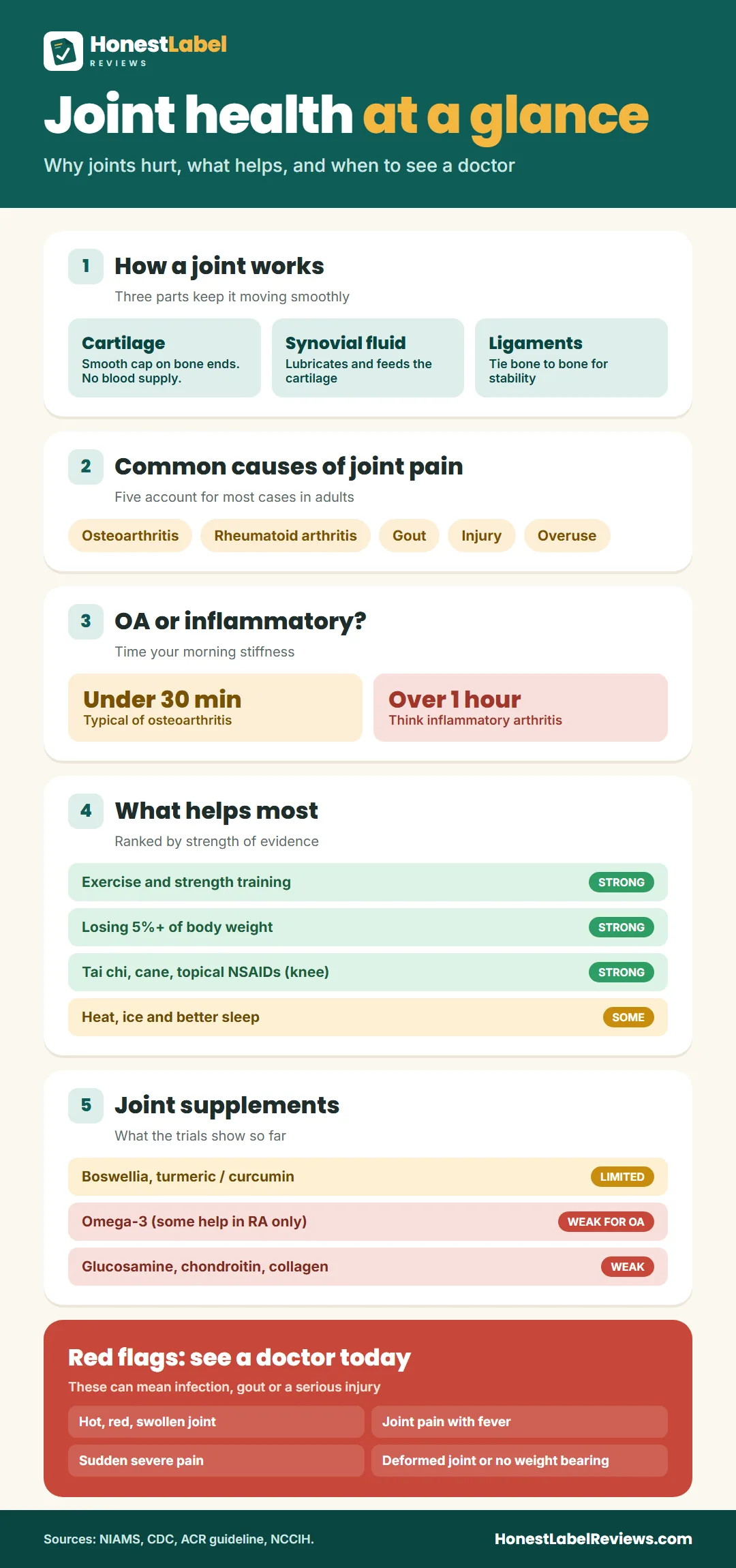
Good joint health depends on cartilage, fluid, ligaments and muscles working together, and most joint pain comes from osteoarthritis, inflammatory arthritis, gout, injury or overuse. The treatments with the best evidence cost little: regular exercise, strength work and, if you carry extra weight, losing even 5 to 10 percent of it. Heat, ice, good sleep and careful use of pain relievers help on top of that. Joint supplements have weak or mixed evidence at best. Morning stiffness that lasts over an hour, swelling in several joints, or a hot swollen joint with fever all need a doctor, and the last one needs one today.
In the coming weeks we will publish detailed guides on knee pain, morning stiffness, osteoarthritis exercises, gout and each of the main joint supplement ingredients, so you can recieve the full detail on whichever question brought you here.
Sources
- National Institute of Arthritis and Musculoskeletal and Skin Diseases (NIH). Osteoarthritis; Rheumatoid Arthritis; Gout.
- Centers for Disease Control and Prevention. Arthritis Facts and Figures.
- Arthritis Foundation. Osteoarthritis.
- National Center for Complementary and Integrative Health (NIH). Glucosamine and Chondroitin for Osteoarthritis; Turmeric.
- NIH Office of Dietary Supplements. Omega-3 Fatty Acids Fact Sheet for Health Professionals.
- MedlinePlus (US National Library of Medicine). Pain Relievers; Septic arthritis.
- Kolasinski SL, et al. 2019 American College of Rheumatology/Arthritis Foundation Guideline for the Management of Osteoarthritis of the Hand, Hip, and Knee. Arthritis Care & Research, 2020. PubMed.
- Clegg DO, et al. Glucosamine, chondroitin sulfate, and the two in combination for painful knee osteoarthritis. New England Journal of Medicine, 2006. PubMed.
- Messier SP, et al. Weight loss reduces knee-joint loads in overweight and obese older adults with knee osteoarthritis. Arthritis & Rheumatism, 2005. PubMed.
- Messier SP, et al. Effects of intensive diet and exercise on knee joint loads, inflammation, and clinical outcomes among overweight and obese adults with knee osteoarthritis: the IDEA randomized clinical trial. JAMA, 2013. PubMed.
- Cameron M, Chrubasik S. Oral herbal therapies for treating osteoarthritis. Cochrane Database of Systematic Reviews, 2014. PubMed.
- Finan PH, Goodin BR, Smith MT. The association of sleep and pain: an update and a path forward. Journal of Pain, 2013. PubMed.
Medical disclaimer: This article is for general information and is not medical advice. It does not replace a diagnosis or treatment from your doctor. If you have arthritis or take medication for pain or another condition, talk to your healthcare provider before changing your diet, exercise, pain relievers or supplements.