Last reviewed: November 2026 · Sources: CDC, NIH (NHLBI, NCCIH, Office of Dietary Supplements), American Academy of Sleep Medicine, American College of Physicians and peer-reviewed studies (listed at the end)
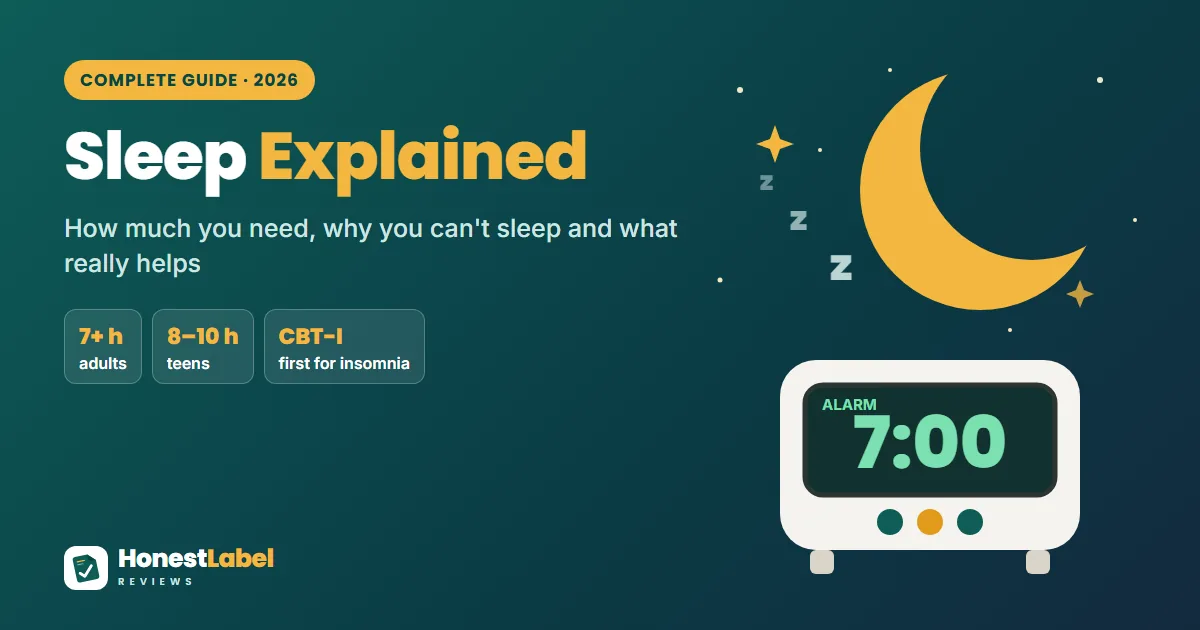
Most adults need 7 or more hours of sleep a night, and teenagers need 8 to 10. If you can’t sleep, the usual causes are stress, caffeine late in the day, alcohol, evening light and an irregular schedule. Steady habits help most people, and for insomnia lasting 3 months or more, a talking therapy called CBT-I works better long term than pills.
Sleep is one of those things nobody thinks about until it goes wrong, and then it is all you think about at 3 a.m. This guide covers how much sleep you need at each age, what happens overnight, the common reasons people can’t fall or stay asleep, the habits and treatments with real research behind them, and an honest look at sleep supplements.
If you have a diagnosed sleep disorder or take medication, use this page as background and talk to your doctor before changing anything.
How much sleep do I need?
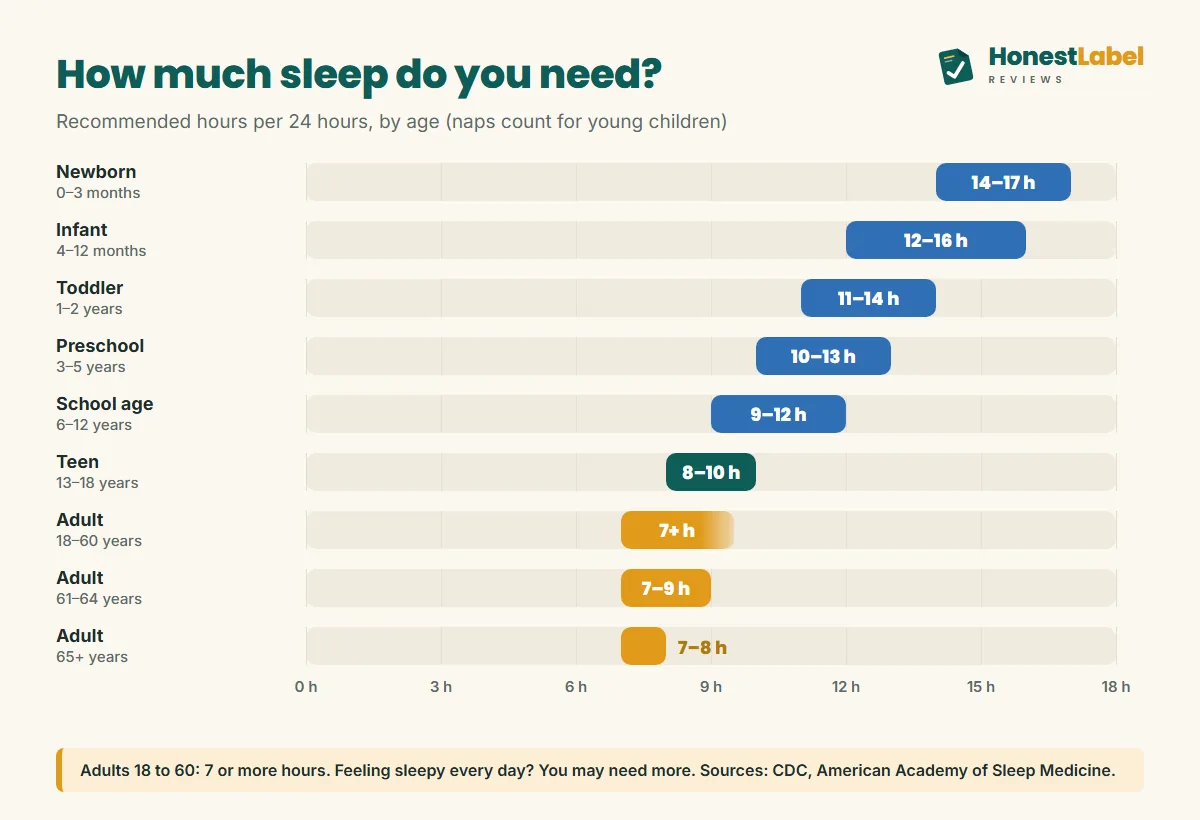
The amount changes a lot over a lifetime. The table uses the age ranges published by the CDC, based on recommendations from the American Academy of Sleep Medicine (AASM) and other sleep groups.
| Age group | Recommended sleep per 24 hours |
|---|---|
| Newborn (0 to 3 months) | 14 to 17 hours |
| Infant (4 to 12 months) | 12 to 16 hours, including naps |
| Toddler (1 to 2 years) | 11 to 14 hours, including naps |
| Preschool (3 to 5 years) | 10 to 13 hours, including naps |
| School age (6 to 12 years) | 9 to 12 hours |
| Teen (13 to 18 years) | 8 to 10 hours |
| Adult (18 to 60 years) | 7 or more hours |
| Adult (61 to 64 years) | 7 to 9 hours |
| Adult (65 and older) | 7 to 8 hours |
The adult figure comes from a 2015 consensus statement by the AASM and the Sleep Research Society. A panel of 15 sleep experts reviewed the research and concluded that adults should regularly sleep 7 or more hours a night, because less was linked with weight gain, diabetes, high blood pressure, heart disease, depression and more accidents (Watson et al., 2015). CDC surveys have found that about a third of US adults regularly get less then that.
How to tell if you are getting enough
How you feel during the day is a good check. If you wake without an alarm on days off and stay alert through the afternoon, you are probably getting enough. If you need an alarm every day, sleep two extra hours at weekends, or doze off in front of the TV, you are likely running a sleep debt.
What happens while you sleep
According to the National Heart, Lung, and Blood Institute (NHLBI), you move through two kinds of sleep, non-REM and REM, in cycles that repeat every 80 to 100 minutes, usually four to six times a night. Brief wake-ups between cycles are normal and mostly forgotten.
- Stage 1 (light sleep). The short shift from waking to sleep. You wake easily, and sudden muscle jerks are common.
- Stage 2. You are properly asleep. Heart rate and breathing slow and body temperature drops.
- Stage 3 (deep or slow-wave sleep). The hardest stage to wake from, concentrated in the first half of the night and tied to physical recovery.
- REM sleep. The brain becomes almost as active as when awake and most vivid dreams happen, while your muscles go limp. REM periods get longer toward morning.
So when you cut a night short by waking early, you mostly lose REM sleep, because it is packed into the last cycles.
Your body clock and sleep pressure
Two systems decide when you feel sleepy. The first is sleep pressure: from the moment you wake, a chemical called adenosine builds up in the brain, and sleep clears it again.
The second is the circadian rhythm, an internal clock of roughly 24 hours that takes its timing mainly from light. Bright morning light pulls it earlier. As light fades in the evening, the brain releases melatonin to signal that night has begun, and bright light late in the evening delays that signal.
When the two systems line up, falling asleep is easy. When they don’t, as with jet lag, shift work or a late weekend before an early Monday, you can feel tired and wired at the same time.
Why can’t I sleep? The most common reasons
Insomnia means trouble falling asleep, staying asleep or getting good quality sleep even when you have the time and a decent place to sleep. The NHLBI separates short-term insomnia, which lasts days or weeks and usually follows stress or a change in routine, from chronic insomnia, which happens 3 or more nights a week for more than 3 months. These are the most common causes.
Stress and a busy mind
Cortisol and adrenaline keep you alert, and worry about work, money or family keeps them flowing at bedtime. After a few bad nights, worry about sleep itself joins in. That second worry drives a lot of chronic insomnia, because the body learns to switch on as soon as you lie down.
Caffeine, and how long it really lasts
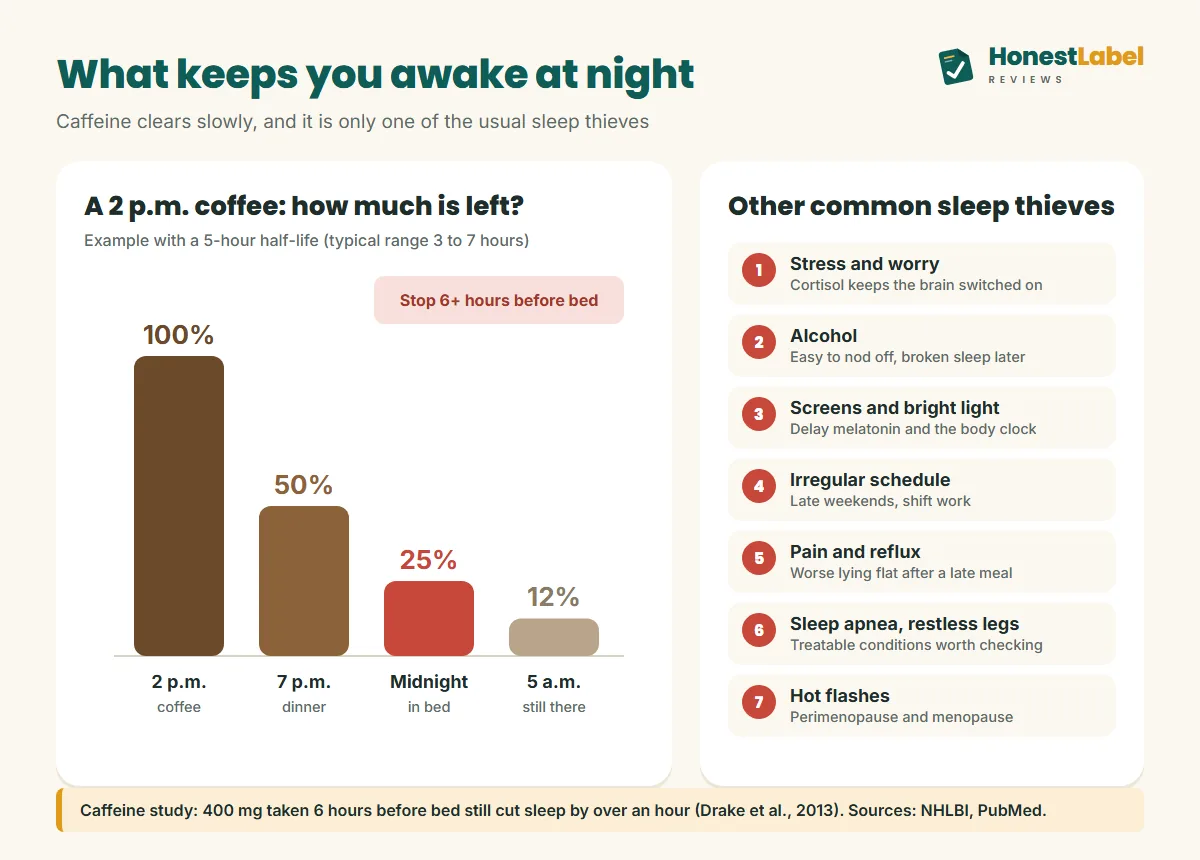
Caffeine blocks adenosine, the sleep pressure chemical, and it clears slowly. Its half-life in healthy adults is roughly 3 to 7 hours, so a good part of a 3 p.m. coffee can still be active at bedtime. Pregnancy and some medicines slow clearance further.
In a small lab study, 12 healthy sleepers took 400 mg of caffeine (about four cups of brewed coffee) at bedtime, 3 hours before or 6 hours before. Even the dose taken 6 hours before bed cut measured sleep by more than an hour (Drake et al., 2013). Tea, cola, energy drinks and pre-workout powders count too.
Alcohol
A nightcap helps some people nod off faster. Later in the night, as the body breaks the alcohol down, sleep becomes lighter and more broken and people tend to wake in the small hours. Alcohol also relaxes the throat muscles, which makes snoring and sleep apnea worse.
Screens and light at night
Bright evening light delays melatonin and pushes your body clock later. Phones and tablets add to this because they sit close to your face, and scrolling or answering work email keeps the brain switched on.
An irregular schedule
Going to bed at 11 p.m. on weeknights and 2 a.m. on Saturdays gives your body clock a small jet lag every week. Shift work is the extreme version. Sleeping in to catch up lowers sleep pressure for the next night and makes Sunday night insomnia more likely.
Pain, reflux and other health problems
Back pain, arthritis and headaches break sleep, and acid reflux gets worse when you lie flat after a late meal. Needing to pee at night, asthma, an overactive thyroid, depression and anxiety can all play a part, as can some medicines, including certain antidepressants, steroids and decongestants. If your sleep changed after you started a new medicine, ask your pharmacist.
Sleep apnea
In obstructive sleep apnea, the airway closes again and again during sleep, so breathing stops for short spells and the brain briefly wakes you to restart it. Most people sleep through it and never know it occurred. The NHLBI lists the main signs: loud snoring, gasping or choking, breathing pauses a partner notices, morning headaches and heavy daytime sleepiness. Untreated, it is linked with high blood pressure, heart disease, stroke and type 2 diabetes. It is very treatable, most often with a CPAP machine, an oral device or weight loss.
Restless legs syndrome
Restless legs syndrome causes a crawling or pulling feeling in the legs and a strong urge to move them, mostly in the evening and when you lie down. MedlinePlus notes it can run in families and is more common with iron deficiency, pregnancy and kidney failure, so ask your doctor to check your iron levels.
Menopause and hormone changes
Hot flashes and night sweats wake many women during perimenopause and menopause, and sleep apnea becomes more likely after menopause. There are hormonal and non-hormonal treatments worth discussing with your doctor.
Your bedroom
A sleep environment that is too warm, noisy or bright makes it harder to stay asleep. So does a snoring partner or a phone that lights up with every notification.
What short sleep does to your body
The body copes with the odd short night. The trouble comes from months and years of too little sleep. The NHLBI notes that chronic insomnia raises the risk of high blood pressure, coronary heart disease, diabetes and cancer, and affects memory and concentration. Research also links regular short sleep with these problems:
- Blood sugar. Even a few short nights make the body less sensitive to insulin, so blood sugar runs higher after meals, and regular short sleep is linked with type 2 diabetes. Our guide to normal blood sugar levels explains how insulin works.
- Heart and blood pressure. Blood pressure normally dips at night, and short or broken sleep blunts that dip.
- Weight and appetite. Sleep loss shifts the hunger hormones ghrelin and leptin, so you feel hungrier and crave high-calorie food the next day.
- Mood. Poor sleep and depression or anxiety feed each other, and treating insomnia can improve mood.
- Immune system. People who sleep less tend to catch more colds.
- Thinking and safety. Short sleep slows reaction time, and drowsy drivers are often poor judges of how impaired they are.
Most of this research is observational, so it shows that short sleep and these problems occur together rather than proving cause. Lab studies that cut sleep on purpose do show changes in blood sugar and appetite within days.
How to sleep better: habits with research behind them
Doctors call these habits sleep hygiene. On their own they rarely cure long-standing insomnia, but they help most people and make other treatments work better. Start with the two or three that fit your problem.
1. Keep the same wake-up time every day
If you change only one thing, change this. A fixed wake-up time, weekends included, anchors your body clock, and sleep pressure will then make you tired at roughly the right hour each night.
2. Get bright light in the morning and dim light at night
Go outside within an hour or so of waking, even on a cloudy day, becuase outdoor light is far brighter than indoor lighting. In the last hour or two before bed, switch to lamps and dim the screens.
3. Set a caffeine cut-off
Stop caffeine at least 6 hours before bed, or by noon if you are sensitive. Give it a week or two before judging.
4. Go easy on alcohol, especially late
If you drink, keep it moderate and finish a few hours before bed. It is worth noticing how you sleep on the nights you skip it.
5. Build a wind-down routine
Give yourself 30 to 60 minutes of quieter time before bed: a warm shower, reading or light stretching. Writing tomorrow’s to-do list earlier in the evening stops some people running through it in bed.
6. Make the bedroom cool, dark and quiet
A slightly cool room suits most people, because body temperature needs to fall a little to start sleep. Blackout curtains, an eye mask, earplugs or a fan all help. Turn off phone notifications.
7. If you can’t sleep, get up
If you have been lying awake for what feels like 20 minutes, get up, go to another room and do something calm in dim light until you feel sleepy, then go back to bed. Don’t check the clock. This retrains the brain to link the bed with sleep, and it is a core part of CBT-I.
8. Move during the day
Regular physical activity helps people fall asleep faster and sleep more deeply. Hard exercise right before bed keeps some people awake, so earlier in the day is safer.
9. Watch late meals and naps
Try to finish dinner two to three hours before bed to avoid reflux. If you nap, keep it to 20 to 30 minutes and before mid-afternoon.
10. Use the bed for sleep
Working, scrolling and worrying in bed teach the brain that bed is a place to be awake. It sounds weird at first, but keeping the bed for sleep and sex is part of the most effective insomnia treatment we have.
CBT-I: the first treatment for chronic insomnia
If you have had trouble sleeping at least 3 nights a week for 3 months or more, the recommended first step is cognitive behavioral therapy for insomnia, or CBT-I.
The American College of Physicians guideline recommends CBT-I as the initial treatment for all adults with chronic insomnia, ahead of sleeping pills (Qaseem et al., 2016). Its reviewers found that CBT-I helped people fall asleep faster, spend less time awake at night and rate their sleep better, with few side effects, and the benefits tend to last after therapy ends.
CBT-I usually runs 4 to 8 sessions with a trained therapist, in a group, by video or through a digital program. It normally includes:
- A sleep diary to track bedtimes, wake-ups and how long you sleep.
- Stimulus control, the “use the bed only for sleep” and “get up if you can’t sleep” rules above.
- Sleep restriction, which limits time in bed to roughly the hours you actually sleep, then adds time back step by step as sleep becomes deeper and more solid.
- Cognitive work on beliefs that keep insomnia going, such as “if I don’t get 8 hours, tomorrow is ruined”.
- Relaxation skills and sleep hygiene advice.
Sleep restriction can make you more tired for the first week or two, so it is best done with guidance, and people with bipolar disorder, seizures or safety-critical jobs need a plan made with their clinician. Ask your doctor for a referral.
When are sleeping pills used?
The ACP guideline says doctors should discuss sleep medicines, weighing benefits, harms and costs, when CBT-I alone has not worked, and generally for short-term use. We keep to the general picture here. Any decision about starting or stopping a medicine belongs with your doctor or pharmacist.
The main prescription groups are:
- “Z-drugs” such as zolpidem and eszopiclone, which can cause next-day drowsiness and, rarely, complex sleep behaviors such as sleep driving, the subject of an FDA boxed warning in 2019.
- Orexin receptor blockers such as suvorexant and lemborexant, which block a brain signal that keeps you awake.
- Benzodiazepines, now used less for sleep because of dependence and falls.
- Other options such as low-dose doxepin and ramelteon, which acts on melatonin receptors.
The AASM’s 2017 guideline on sleep medicines found that most have modest benefits, smaller than many people expect (Sateia et al., 2017). It also suggested against over-the-counter diphenhydramine, common in “PM” products, for chronic insomnia, because of next-day grogginess and confusion, especially in older adults.
Never mix any sleep medicine with alcohol or opioids, and don’t drive if you still feel drowsy the next morning.
Do sleep supplements work?
None of the sleep supplements come close to CBT-I for chronic insomnia, and the AASM guideline above suggested against melatonin and valerian for that purpose. Some have a small effect for some people, and melatonin has a clear use for body clock problems. Quality is a real issue too, because supplements are not tested for content before they are sold.
Melatonin
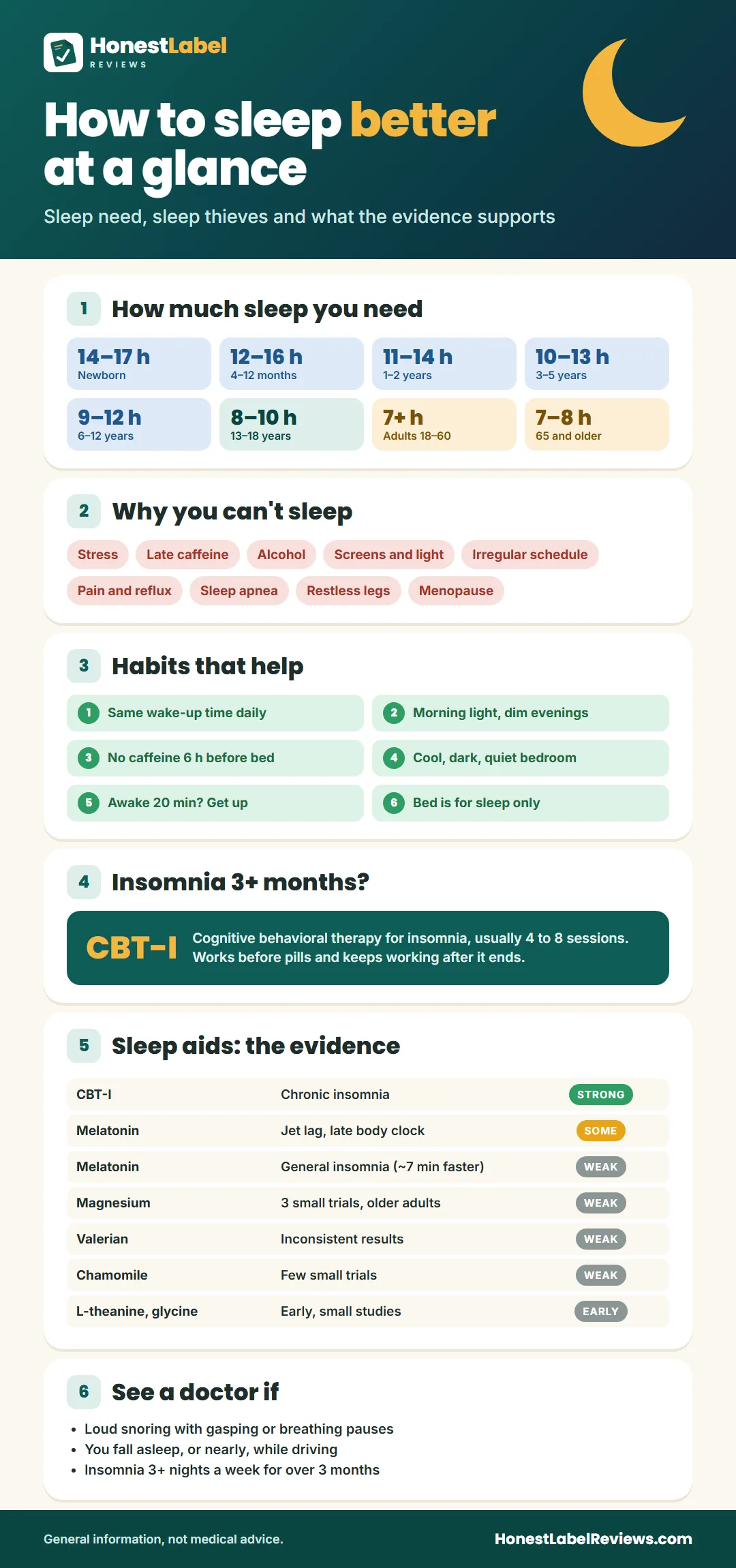
Melatonin is the hormone your brain releases at night. According to the NIH’s National Center for Complementary and Integrative Health (NCCIH), it may help with jet lag and with delayed sleep-wake phase disorder, where the body clock runs much later than needed. For ordinary insomnia the benefit is small: a meta-analysis of 19 studies with 1,683 people found it helped people fall asleep about 7 minutes faster and sleep about 8 minutes longer than placebo (Ferracioli-Oda et al., 2013).
More is not better. Studies have often used 0.5 mg to about 5 mg, and timing matters more than amount for shifting the body clock, yet many products contain 10 mg or more.
The bigger problem is what is in the bottle. When Canadian researchers tested 31 melatonin supplements, the real content ranged from 83 percent less to 478 percent more than the label said, and about a quarter also contained serotonin (Erland and Saxena, 2017). Melatonin is generally considered safe short term in adults, with headache, dizziness, nausea and next-day sleepiness the usual side effects. Long-term safety is less studied. Keep gummies out of reach of children and ask a pediatrician before giving it to a child.
Magnesium
Magnesium is involved in nerve and muscle function, but the sleep evidence is thin. A 2021 review found three small trials with 151 older adults in total. Magnesium shortened the time to fall asleep by about 17 minutes compared with placebo, but the authors rated the evidence low quality (Mah and Pitre, 2021).
It may help most in people who get too little from food such as nuts, seeds, beans and leafy greens. The NIH Office of Dietary Supplements sets the upper limit for supplemental magnesium at 350 mg a day for adults, because more often causes diarrhea. People with kidney disease need medical advice first, and it can block some antibiotics and osteoporosis drugs taken at the same time.
Valerian
Valerian root has been tested in a fair number of trials with inconsistent results, and the studies vary a lot in dose and preparation. The NCCIH says the evidence is not strong enough to support it for insomnia. It seems safe for a few weeks in most adults, though headaches and stomach upset happen and there are rare reports of liver problems. Don’t combine it with alcohol or sedatives.
Chamomile
A cup of chamomile tea is a pleasant, caffeine-free part of a wind-down routine. As a treatment, the research is limited to a few small trials with mixed results, and the NCCIH says there isn’t enough evidence that it helps insomnia. People allergic to ragweed can react to it, and it may interact with blood thinners such as warfarin.
L-theanine
L-theanine is an amino acid from tea leaves. In one 4-week trial in 30 healthy adults, 200 mg a day improved self-rated sleep scores compared with placebo (Hidese et al., 2019). One small study in healthy people tells us litle about insomnia. It appears well tolerated.
Glycine
Glycine is another amino acid. A few small studies, mostly from Japan, gave it before bed and found people felt they slept better and were less tired the next day. The groups were small and the results self-reported, so glycine truly sits in the “interesting, not proven” group.
How to think about sleep supplements
If you want to try one, pick a single ingredient, use it for a set time such as two weeks, and keep a sleep diary so you can tell if it works. Look for testing by an independent group such as USP or NSF, which checks that the label matches the contents.
Who should be careful
Talk to a doctor or pharmacist before trying any sleep supplement or over-the-counter sleep aid if you:
- Are pregnant or breastfeeding, or want to give one to a child
- Are over 65, because sedating products raise the risk of falls, confusion and next-day drowsiness
- Take prescription sleep medicine, opioids, benzodiazepines, antidepressants, blood thinners or seizure medicine
- Have kidney or liver disease
- Have depression, bipolar disorder or another mental health condition
- Might have sleep apnea, because sedatives can make breathing pauses worse
- Drive for a living or operate machinery
Many sleep formulas combine three or four sedating ingredients, and stacking them with alcohol or a prescription pill adds up.
When to see a doctor
Most bad nights are not a medical problem. See a doctor or ask for a referral to a sleep specialist if you notice any of these red flags:
- Loud snoring with gasping, choking or pauses in breathing that someone else has seen
- Falling asleep while driving, or nearly doing so, or dozing off during conversations or meals
- Insomnia on 3 or more nights a week that has lasted more than 3 months
- Strong urges to move your legs at night that keep you from sleeping
- Acting out dreams, such as kicking, punching or shouting during sleep
- Sudden muscle weakness when you laugh or feel strong emotion, or sudden sleep attacks during the day
- Sleep problems along with low mood, loss of interest in things you used to enjoy, or thoughts of harming yourself
- Sleep that changed after you started a new medicine
If you have thoughts of harming yourself, get help right away. In the US you can call or text 988 at any time. Don’t wait for a routine appointment.
A doctor may ask for a two-week sleep diary and may arrange a sleep study, in a lab or with a home kit. Notes from a bed partner about snoring help. Many people only receive a sleep apnea diagnosis after years of feeling tired, because nobody asked about their snoring.
Frequently asked questions
Is 6 hours of sleep enough?
For most adults, no. The AASM and Sleep Research Society recommend 7 or more hours, and regularly sleeping 6 is linked with weight gain, high blood pressure and other problems. A few people seem to do well on less, but many who think so are simply used to feeling tired.
Why do I wake up at 3 a.m. every night?
Brief wake-ups between cycles are normal. Waking fully and staying awake is often linked to stress, evening alcohol, needing to pee, reflux, hot flashes or sleep apnea, and sleep gets lighter toward morning. Getting up for a while usually works better than lying there watching the clock.
Can you catch up on lost sleep at the weekend?
Partly. A longer sleep after a short week helps you feel better, but it doesn’t fully undo a week of short nights, and sleeping in late makes Sunday night harder. Enough sleep on a regular schedule works better.
How long before bed should I stop using my phone?
There is no exact number, but 30 to 60 minutes is a sensible target. What you do on the phone matters as much as the light, so swap scrolling and work email for something calm.
Is it safe to take melatonin every night?
Melatonin appears safe short term for most adults, but there is less research on years of nightly use. If you feel you need something every night, ask your doctor about the causes and about CBT-I.
The bottom line
Most adults need at least 7 hours of sleep, and teenagers need 8 to 10. If you can’t sleep, look first at stress, late caffeine, alcohol, evening screens and an irregular schedule. A fixed wake-up time, morning light and a dark, cool bedroom help most people within a few weeks. For insomnia lasting 3 months or more, CBT-I is the recommended first treatment. Melatonin helps with jet lag, while other sleep supplements have small or mixed evidence. Loud snoring with gasping, or nodding off at the wheel, needs a doctor.
This guide is the beginning of our sleep section. Over the coming weeks we will publish detailed guides on insomnia, sleep apnea, melatonin, magnesium and bedtime routines.
Sources
- Centers for Disease Control and Prevention. About Sleep.
- National Heart, Lung, and Blood Institute (NIH). Sleep Phases and Stages; Insomnia; Sleep Apnea.
- MedlinePlus (US National Library of Medicine). Restless Legs.
- National Center for Complementary and Integrative Health (NIH). Melatonin: What You Need To Know; Sleep Disorders and Complementary Health Approaches.
- NIH Office of Dietary Supplements. Magnesium Fact Sheet for Health Professionals.
- Watson NF, et al. Recommended amount of sleep for a healthy adult: a joint consensus statement of the American Academy of Sleep Medicine and Sleep Research Society. Sleep, 2015. PubMed.
- Qaseem A, et al. Management of chronic insomnia disorder in adults: a clinical practice guideline from the American College of Physicians. Annals of Internal Medicine, 2016. PubMed.
- Sateia MJ, et al. Clinical practice guideline for the pharmacologic treatment of chronic insomnia in adults: an American Academy of Sleep Medicine clinical practice guideline. Journal of Clinical Sleep Medicine, 2017. PubMed.
- Drake C, et al. Caffeine effects on sleep taken 0, 3, or 6 hours before going to bed. Journal of Clinical Sleep Medicine, 2013. PubMed.
- Ferracioli-Oda E, et al. Meta-analysis: melatonin for the treatment of primary sleep disorders. PLoS One, 2013. PubMed.
- Erland LA, Saxena PK. Melatonin natural health products and supplements: presence of serotonin and significant variability of melatonin content. Journal of Clinical Sleep Medicine, 2017. PubMed.
- Mah J, Pitre T. Oral magnesium supplementation for insomnia in older adults: a systematic review and meta-analysis. BMC Complementary Medicine and Therapies, 2021. PubMed.
- Hidese S, et al. Effects of L-theanine administration on stress-related symptoms and cognitive functions in healthy adults: a randomized controlled trial. Nutrients, 2019. PubMed.
Medical disclaimer: This article is for general information and is not medical advice. It does not replace a diagnosis or treatment from your doctor. If you have a sleep disorder or take medication that affects sleep, talk to your healthcare provider before changing your routine, medicines or supplements.