Last reviewed: November 2026 · Sources: NHLBI, CDC, MedlinePlus, American Heart Association, NCCIH, the 2018 ACC/AHA cholesterol guideline and peer-reviewed studies (listed at the end)
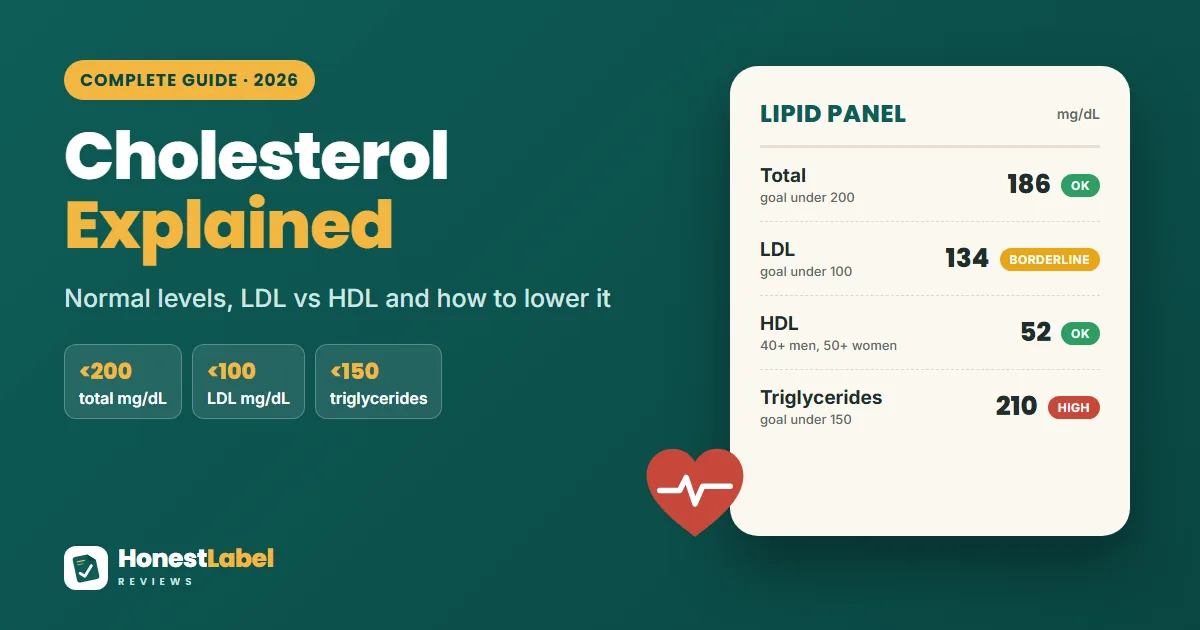
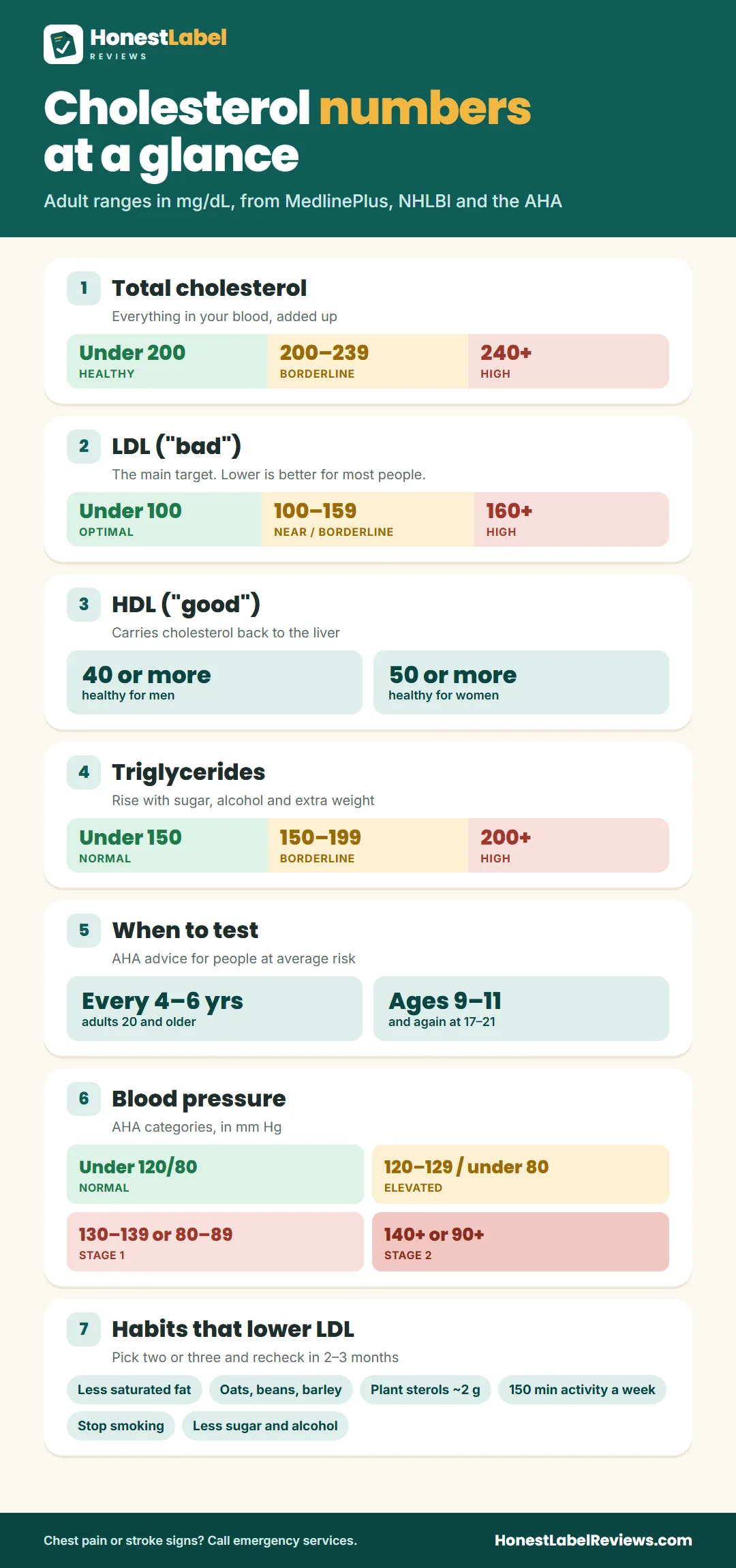
For most adults, healthy cholesterol levels are a total cholesterol under 200 mg/dL, LDL (“bad”) cholesterol under 100 mg/dL, HDL (“good”) cholesterol of at least 40 mg/dL in men and 50 mg/dL in women, and triglycerides under 150 mg/dL. High cholesterol causes no symptoms, so a simple blood test is the only way to know your numbers.
Those four numbers come from a standard blood test called a lipid panel. LDL does the most damage over time, HDL helps clear cholesterol away, and triglycerides are a separate fat that rises with sugar, alcohol and extra weight.
This guide covers the full chart of normal ranges, what pushes the numbers up, the habits with evidence for bringing them down, statins and supplements. If you allready take cholesterol medication, read this as background and talk to your doctor before you change anything.
What is cholesterol?
Cholesterol is a waxy, fat-like substance that every cell in your body uses. You need it to build cell walls and to make hormones, vitamin D and the bile acids that help you digest fat. The problem is having too much of it in the wrong place.
Your liver makes most of the cholesterol in your blood. The rest comes from animal foods like meat, eggs, butter and cheese, since plants contain none. This is why two people can eat the same diet and end up with very different numbers.
Cholesterol cannot dissolve in blood, so the body packs it into tiny particles called lipoproteins. The type of lipoprotein decides where the cholesterol goes, and that is where the “good” and “bad” labels come from.
LDL vs HDL: the “bad” and “good” cholesterol
LDL (low-density lipoprotein) carries cholesterol out from the liver to the rest of the body. When there is more LDL in the blood than the body needs, the particles slip into the walls of arteries, get trapped and set off inflammation. Over years this builds into plaque that narrows the artery, and if a plaque cracks, a clot can form and block blood flow to the heart or brain. That is how most heart attacks and many strokes happen.
HDL (high-density lipoprotein) works in the other direction. It picks up spare cholesterol from tissues and artery walls and carries it back to the liver, which can then get rid of it. So higher HDL has long been linked with lower heart risk.
There is a catch with HDL that a lot of people find weird at first. Drugs that raise HDL have mostly failed to prevent heart attacks in trials, and very high HDL does not seem to add extra protection. Doctors now treat low HDL mainly as a warning sign. The main treatment target is still LDL.
Triglycerides and VLDL
Triglycerides are the most common type of fat in the body, a store of spare energy from food, and they travel in another lipoprotein called VLDL (very-low-density lipoprotein). High triglycerides often go together with low HDL, a large waist and high blood sugar. Very high triglycerides, above 500 mg/dL, also raise the risk of pancreatitis, a painful and sometimes dangerous inflammation of the pancreas.
Normal cholesterol levels: the full chart
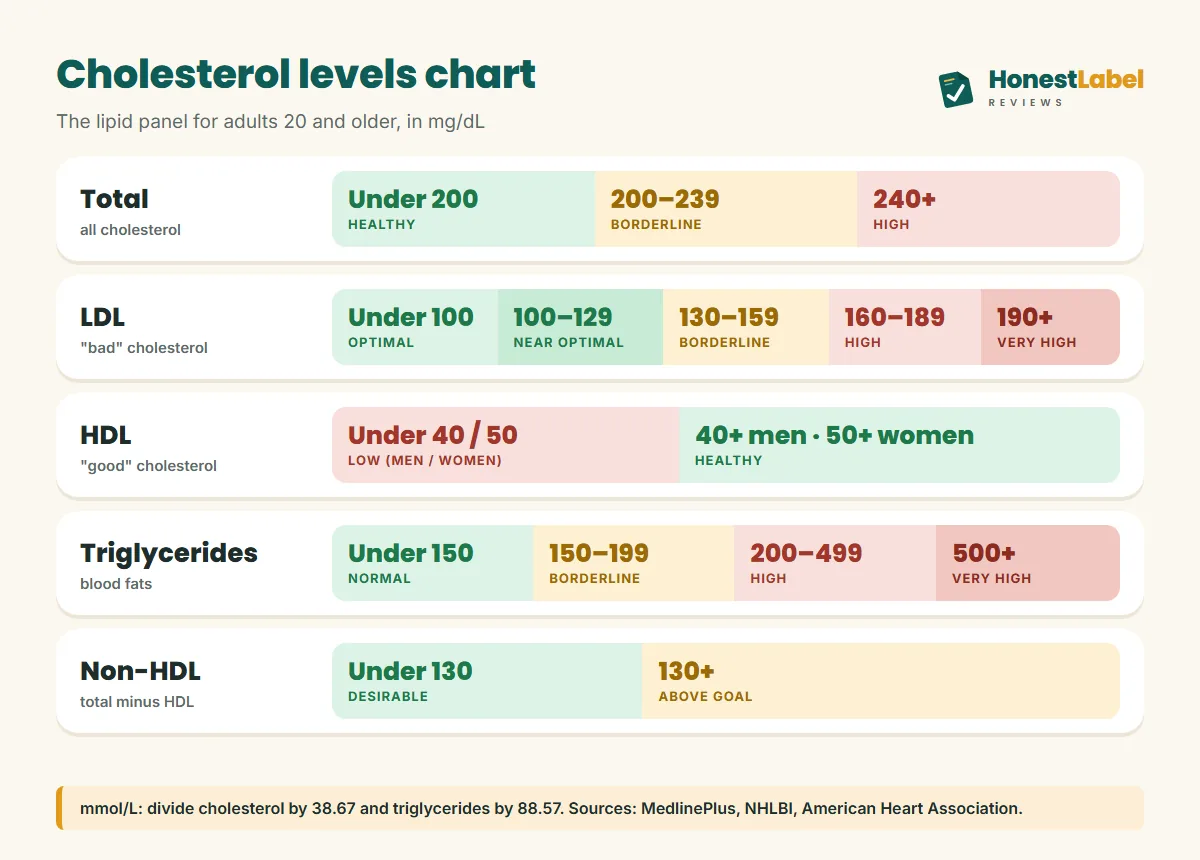
The ranges below are for adults age 20 and older and come from MedlinePlus and the National Heart, Lung, and Blood Institute (NHLBI). Numbers are in mg/dL.
| Measure | Healthy | Borderline | High |
|---|---|---|---|
| Total cholesterol | Under 200 | 200 to 239 | 240 or higher |
| LDL cholesterol | Under 100 (optimal); 100 to 129 (near optimal) | 130 to 159 | 160 to 189 (high); 190 or higher (very high) |
| HDL cholesterol | 40 or higher (men); 50 or higher (women) | Below those numbers is low | No upper limit is set |
| Triglycerides | Under 150 | 150 to 199 | 200 to 499 (high); 500 or higher (very high) |
| Non-HDL cholesterol | Under 130 | 130 or higher is above the goal; your doctor reads it with your other numbers | |
For children and teens up to age 19, the healthy ranges listed by MedlinePlus are lower: total cholesterol under 170, LDL under 110, HDL over 45 and non-HDL under 120 mg/dL.
What is non-HDL cholesterol?
Non-HDL cholesterol is your total cholesterol minus your HDL. It counts the cholesterol in every particle that can clog arteries, LDL and VLDL included. A total of 210 with an HDL of 50 gives a non-HDL of 160.
Doctors like it because it does not need fasting and still works when triglycerides are high, when the standard LDL calculation gets less reliable.
Converting to mmol/L
Outside the US, results are usually given in mmol/L. To convert cholesterol (total, LDL, HDL or non-HDL) from mg/dL, divide by 38.67. For triglycerides, divide by 88.57. So a total of 200 mg/dL is about 5.2 mmol/L, an LDL of 100 is about 2.6, an HDL of 40 is about 1.0, and triglycerides of 150 are about 1.7 mmol/L.
Is lower LDL always better?
For people at high risk, mostly yes. The 2018 AHA/ACC cholesterol guideline sets lower goals once someone has already had a heart attack or stroke, often aiming for LDL under 70 mg/dL, and some people with very high risk go lower still. The “under 100” line is a general target for the average adult. Your own goal depends on your total risk, which your doctor works out from your age, blood pressure, smoking, diabetes and family history.
How common is high cholesterol?
According to the CDC, about 86 million US adults age 20 and older have a total cholesterol above 200 mg/dL, and nearly 25 million have levels above 240 mg/dL. High cholesterol has no symptoms of its own, and the first sign can be a heart attack or stroke.
A few people get visible clues, such as yellowish fatty bumps around the eyes or lumps on the tendons of the hands or heels. Those point to very high cholesterol and are worth showing a doctor.
How often should you get your cholesterol checked?
The American Heart Association recommends that adults age 20 and older at average risk have their cholesterol checked every 4 to 6 years. People with heart disease, diabetes, high blood pressure, a strong family history or ongoing treatment need tests more often. Children should be checked once between ages 9 and 11 and again between 17 and 21, and earlier if a parent has very high cholesterol or early heart disease.
The test is a standard blood draw. You may be asked to fast for 9 to 12 hours, although many labs now accept a non-fasting sample, since a recent meal mostly affects triglycerides.
What causes high cholesterol?
Usually it is a mix of genes, lifestyle and other conditions, as the NHLBI explains.
Diet
Saturated fat raises LDL more than anything else you eat. It is found in fatty and processed meat, butter, cheese, full-fat dairy, coconut and palm oil, and many baked and fried foods. Trans fats raise LDL and lower HDL at the same time, though artificial trans fats are now largely gone from US food. Cholesterol in eggs and shellfish matters less for most people than was once thought.
Genetics and familial hypercholesterolemia
Familial hypercholesterolemia (FH) is an inherited condition in which the liver cannot clear LDL from the blood properly. People with FH often have an LDL of 190 mg/dL or higher even with a healthy lifestyle, and without treatment they can have heart attacks in their 30s, 40s or 50s. It is one of the most common inherited disorders, and most people who have it do not know it.
Clues include an LDL of 190 or more and heart attacks in close relatives before age 55 in men or 65 in women. FH needs medication, and a diagnosis in one person is a reason to test their children and siblings.
Other health conditions
- An underactive thyroid (hypothyroidism). Low thyroid hormone slows the clearing of LDL, so doctors often check the thyroid when cholesterol comes back high.
- Type 2 diabetes and insulin resistance. These raise triglycerides, lower HDL and make LDL particles smaller and more harmful. More on this below.
- Some medicines. Certain steroids, diuretics, HIV drugs and retinoids can raise cholesterol or triglycerides.
- Pregnancy and menopause. Cholesterol rises naturally in pregnancy. After menopause, LDL tends to climb as estrogen falls.
Weight, activity, smoking and alcohol
Extra weight, especially around the waist, raises triglycerides and LDL and lowers HDL. Sitting most of the day lowers HDL. Heavy drinking pushes triglycerides up sharply, and cholesterol tends to rise with age.
Cholesterol and diabetes: why they travel together
People with type 2 diabetes very often have a typical lipid pattern: high triglycerides, low HDL and LDL that may look normal on paper but is made of smaller, denser particles that get into artery walls more easily.
Insulin resistance is at the root of it. When the body stops responding well to insulin, the liver makes more triglyceride-rich VLDL and HDL drops. This is also why the 2018 guideline recommends that most adults with diabetes between ages 40 and 75 consider a statin, even when their LDL looks fine. If you have prediabetes or diabetes, keeping your blood sugar in range helps your cholesterol as well, and our guide to normal blood sugar levels explains the numbers to watch.
Blood pressure: the other number to know
High cholesterol and high blood pressure often show up together, and the pair raises heart risk more then either alone. The American Heart Association uses these categories for adults:
| Category | Top number (systolic) | Bottom number (diastolic) | |
|---|---|---|---|
| Normal | Under 120 | and | Under 80 |
| Elevated | 120 to 129 | and | Under 80 |
| Stage 1 high blood pressure | 130 to 139 | or | 80 to 89 |
| Stage 2 high blood pressure | 140 or higher | or | 90 or higher |
| Severe, needs urgent care | Higher than 180 | and/or | Higher than 120 |
Recheck a reading above 180/120 after a few minutes. If it stays that high, or comes with chest pain, shortness of breath, weakness, vision changes or trouble speaking, call emergency services. Most habits that lower cholesterol also lower blood pressure.
How to lower cholesterol: habits with evidence behind them
Lifestyle changes come first for almost everyone, and they still matter for people on medication. Each one lowers LDL by a modest amount, and several together can be enough for someone who is borderline. With FH or very high LDL they will not be enough on there own.
1. Cut back on saturated fat
This is the biggest single food change. The NHLBI and the AHA both advise swapping saturated fat for unsaturated fat, and the AHA suggests that people who need to lower their LDL keep saturated fat to about 5 to 6 percent of daily calories. On a 2,000-calorie diet, that is roughly 11 to 13 grams a day. For reference, the US government’s Dietary Guidelines set a general limit of under 10 percent for everyone.
In practice that means leaner meat, more fish and poultry, less butter and cheese, and cooking with olive, canola or sunflower oil. Swapping saturated fat for white bread and sugary snacks does little, so what you eat instead matters too.
2. Eat more soluble fiber
Soluble fiber forms a gel in your gut that traps bile acids, which are made from cholesterol. Your liver then pulls more cholesterol from the blood to make new bile. Oats, barley, beans, lentils, apples and citrus fruit are good sources. The NHLBI’s cholesterol diet plan suggests 10 to 25 grams of soluble fiber a day.
3. Add plant sterols and stanols
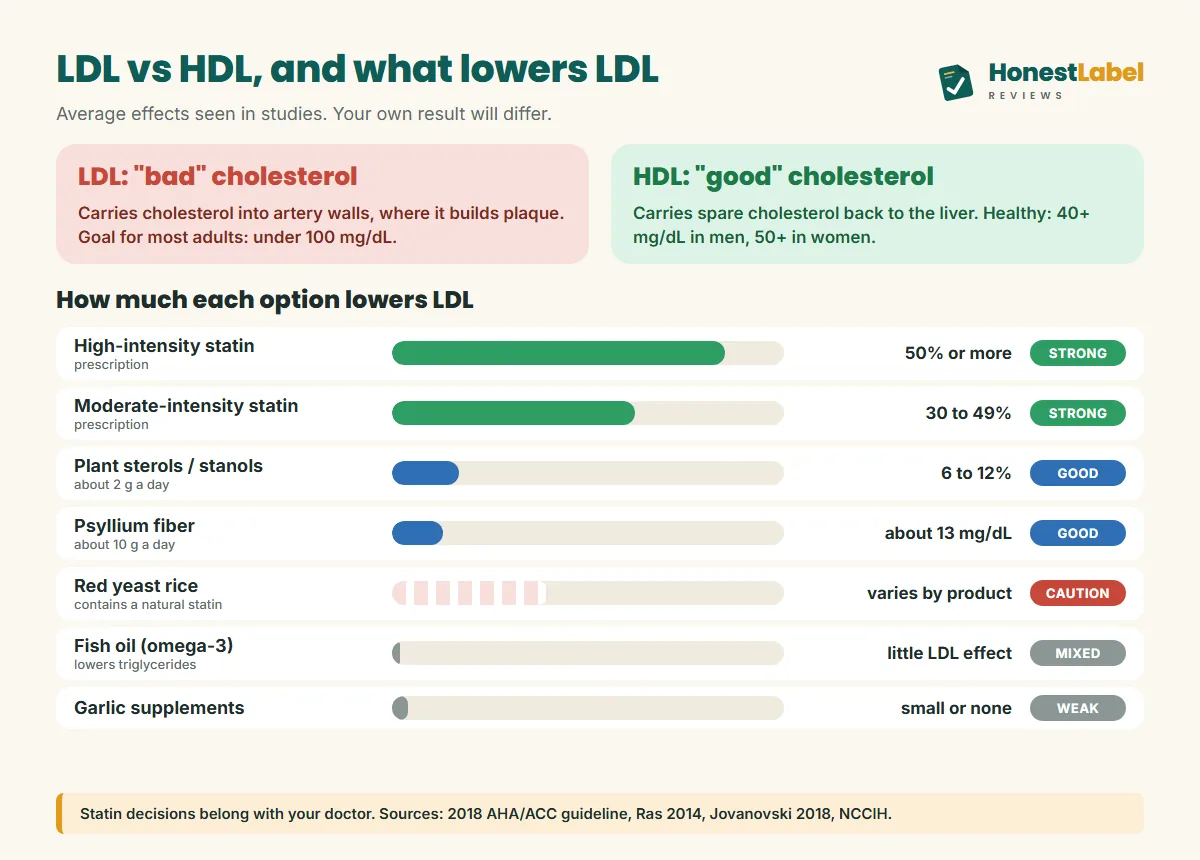
Plant sterols and stanols occur in small amounts in nuts, seeds, oils and whole grains, and they block some cholesterol from being absorbed. Getting about 2 grams a day usually means eating fortified foods such as certain spreads or yogurt drinks. A meta-analysis of 124 studies found that intakes of roughly 0.6 to 3.3 grams a day lowered LDL by about 6 to 12 percent, with bigger drops at higher doses (Ras et al., 2014).
4. Move most days
Exercise has a modest effect on LDL but a clear effect on triglycerides and HDL. It also helps weight, blood pressure and blood sugar. The usual target is at least 150 minutes a week of moderate activity, like brisk walking, plus some strength work twice a week.
5. Lose some weight if you carry extra
You do not need to reach an ideal weight. Even a modest loss, the kind you can see on the scale over a few months, tends to lower triglycerides first and can improve LDL and HDL as well.
6. Stop smoking
Smoking lowers HDL and damages the lining of your arteries, making it easier for LDL to get in. Quitting tends to raise HDL, and your heart attack risk keeps falling the longer you stay smoke free.
7. Go easy on alcohol and sugar
Both raise triglycerides. Cutting back on sweet drinks, sweets, white bread and alcohol often brings high triglycerides down faster than any other change. For triglycerides above 500 mg/dL, doctors usually advise stopping alcohol completely.
Several food changes stack, because each works in a different way. A realistic plan is to pick two or three, keep them up for two or three months, then recheck your lipid panel.
Statins and other cholesterol medicines
When lifestyle changes are not enough, or risk is high, doctors usually turn to statins. This section is general education only. Decisions about starting, stopping or changing a medicine belong with your doctor or pharmacist.
How statins work
Statins block a liver enzyme (HMG-CoA reductase) needed to make cholesterol, so liver cells pull more LDL out of the blood instead. Common generic names include atorvastatin, rosuvastatin, simvastatin, pravastatin, lovastatin, pitavastatin and fluvastatin.
The 2018 guideline groups statins by how hard they push LDL down. Moderate-intensity treatment lowers LDL by about 30 to 49 percent, and high-intensity treatment by about 50 percent or more (Grundy et al., 2018). They are among the best-proven drugs for preventing heart attacks and strokes.
Who is usually offered a statin
The guideline describes four main groups who tend to benefit:
- People who have already had a heart attack, stroke or other artery disease
- Adults with an LDL of 190 mg/dL or higher
- Adults age 40 to 75 with diabetes
- Adults age 40 to 75 whose estimated 10-year risk of heart disease or stroke is high enough after a risk discussion with their doctor
When the choice is unclear, doctors may weigh extras such as early heart disease in the family, a high lipoprotein(a) level or a coronary calcium scan.
Side effects and other options
Most people take statins without trouble. Muscle aches are the most common complaint and often ease with a different statin or dose. Serious muscle damage is rare. Statins can raise blood sugar slightly, though the heart benefit is judged to outweigh that for people who need them. Some interact with grapefruit and other drugs, so tell your pharmacist everything you take.
Other options include ezetimibe, bempedoic acid and injectable PCSK9 inhibitors, plus fibrates or prescription omega-3 for very high triglycerides. Never stop a cholesterol medicine on your own becuase your numbers improved, since the medicine is usually why they did.
Do cholesterol supplements work?
Here is the research on the most common ingredients, strongest evidence first. None of them replaces a statin for someone who needs one, and US supplements are not checked for quality or effectiveness before they are sold.
Psyllium: good evidence for a modest drop
Psyllium husk is a soluble fiber. A meta-analysis of 28 trials found that around 10 grams a day lowered LDL by about 13 mg/dL on average (Jovanovski et al., 2018). Take it with plenty of water, start low to limit bloating, and keep it two hours apart from medicines.
Plant sterols and stanols: good evidence
As covered above, about 2 grams a day lowers LDL by roughly 6 to 12 percent, mostly in studies of fortified foods. People with a rare inherited condition called sitosterolemia should avoid them. No large trial has yet tested whether sterols cut heart attacks the way statins do.
Red yeast rice: works, because it contains a statin
Red yeast rice is rice fermented with a mold that produces monacolin K. NCCIH notes that monacolin K is chemically identical to lovastatin, a prescription statin. Products with meaningful amounts can lower LDL, and they carry the same risks as a statin, including muscle problems and drug interactions.
The amount of monacolin K varies hugely between products, and some contain citrinin, a toxin that can damage the kidneys. In 2024, Japanese health authorities recalled red yeast rice supplements from one maker after reports of kidney disease and deaths. Do not combine it with a statin or use it in pregnancy. A prescription statin gives you a known dose with medical follow-up.
Omega-3 and fish oil: lowers triglycerides, the heart benefit is complicated
Fish oil lowers triglycerides but does little for LDL. Whether it prevents heart attacks is still argued about. The REDUCE-IT trial gave 8,179 people with high triglycerides who were already on statins either 4 grams a day of a purified prescription form of EPA (icosapent ethyl) or a placebo. Over about five years, major heart events fell by around 25 percent in relative terms in the EPA group (Bhatt et al., 2019). Some experts believe part of that gap came from the mineral oil placebo, which seemed to raise LDL in the comparison group. A later trial of a mixed EPA and DHA prescription product at the same dose, compared with corn oil, was stopped early after finding no benefit (Nicholls et al., 2020).
Those results came from a prescription drug at 4 grams a day, far more than one or two ordinary capsules. There is also a safety signal. A pooled analysis of seven trials with more than 81,000 people found that omega-3 supplements raised the risk of atrial fibrillation, an irregular heart rhythm, by about 25 percent, with a higher risk at doses above 1 gram a day (Gencer et al., 2021). Eating fatty fish twice a week is still sound advice.
Garlic: small effects at best
NCCIH says some studies suggest garlic may slightly lower total and LDL cholesterol, while others found no effect. The garlic products tested vary a lot. Garlic can raise bleeding risk with blood thinners and interacts with some HIV medicines.
Niacin: lowers numbers, did not prevent heart attacks
High-dose niacin (vitamin B3) lowers LDL and triglycerides and raises HDL, so on paper it looks ideal. The HPS2-THRIVE trial, with 25,673 high-risk adults, found no drop in major heart events from extended-release niacin added to a statin, plus more serious side effects such as blood sugar problems, infections and bleeding (HPS2-THRIVE Collaborative Group, 2014). High doses also cause flushing and can harm the liver, so do not take them without a doctor.
CoQ10: for statin muscle aches, the evidence is split
Coenzyme Q10 does not lower cholesterol. Statins reduce the body’s CoQ10 levels, so some people take it hoping to ease statin muscle aches. Meta-analyses of the small trials disagree, with one finding no benefit and a later one finding some improvement in muscle symptoms (PubMed: CoQ10 and statin myopathy). It is generally well tolerated but may make warfarin less effective. If statin aches bother you, tell your doctor first, since a diffrent statin or dose often helps more.
Many cholesterol formulas use doses far below what was tested, or hide the amounts inside a “proprietary blend”. If the label does not say how many grams of sterols or fiber you get, you cannot compare it with the research.
Who should be careful
Check with your doctor or pharmacist before adding supplements or making big diet changes if:
- You take a statin or other cholesterol drug. Red yeast rice doubles up on the same drug.
- You take a blood thinner such as warfarin, or antiplatelet drugs. Fish oil and garlic can raise bleeding risk, and CoQ10 can weaken warfarin.
- You are pregnant, trying to get pregnant or breastfeeding. Statins and red yeast rice are not used in pregnancy.
- You have liver or kidney disease. These change how drugs and supplements are cleared.
- You have an irregular heartbeat or have had atrial fibrillation, given the link with high-dose omega-3.
- You have trouble swallowing or a narrowed gut. Dry psyllium can cause a blockage.
It is also necessary to give any change enough time. LDL takes weeks to settle, so the 2018 guideline suggests rechecking a lipid panel about 4 to 12 weeks after starting a statin or making a change.
When to see a doctor
Book an appointment if you:
- Are over 20 and have never had your cholesterol checked, or it has been more than 4 to 6 years
- Have an LDL of 190 mg/dL or higher, or triglycerides of 500 mg/dL or higher
- Have a parent or sibling with very high cholesterol, or who had a heart attack or stroke at a young age
- Notice fatty yellow bumps on the eyelids or lumps on the tendons
- Get muscle pain, weakness or dark urine after starting a cholesterol medicine
Heart attack and stroke warning signs: call emergency services
Call 911 or your local emergency number right away, and do not drive yourself, for signs of a heart attack. The American Heart Association lists these:
- Chest pain, pressure, squeezing or fullness that lasts more than a few minutes or goes away and comes back
- Pain or discomfort in one or both arms, the back, neck, jaw or stomach
- Shortness of breath, with or without chest discomfort
- A cold sweat, nausea or lightheadedness
Women, older adults and people with diabetes more often have the less typical signs, such as breathlessness, nausea or jaw pain, without strong chest pain.
For a stroke, think F.A.S.T.: Face drooping, Arm weakness, Speech difficulty, Time to call emergency services. Sudden confusion, trouble seeing or a severe unexplained headache are warning signs too. Note when symptoms started, since some stroke treatments only work within hours. Do not wait to see if it gets better by tomorrow.
Frequently asked questions
What is a normal cholesterol level for my age?
For adults 20 and older, the healthy ranges are the same at every age: total cholesterol under 200 mg/dL, LDL under 100, HDL of 40 or more for men and 50 or more for women, and triglycerides under 150. Children have lower ranges. What changes with age is your overall risk, which is why your doctor may treat the same LDL differently at 35 and at 65.
Is a cholesterol level of 240 bad?
A total cholesterol of 240 mg/dL or higher is classed as high. Your doctor will look at how much of it is LDL versus HDL, your triglycerides and your other risk factors before deciding if you need more than lifestyle changes.
Which is more important, LDL or HDL?
LDL. It is the main cause of plaque in the arteries, and lowering it is proven to cut heart attacks and strokes. Low HDL is a useful warning sign, but raising HDL with drugs has not been shown to prevent heart disease.
How fast can you lower cholesterol?
Diet changes and statins both start working within a few weeks, and LDL usually reaches its new level in 4 to 12 weeks. Triglycerides can drop within days once you cut back on alcohol and sugar.
Can you have high cholesterol if you are thin and active?
Yes. Genes play a big part, and familial hypercholesterolemia can cause very high LDL in people who eat well and exercise. That is why every adult should get tested, whatever they weigh. Occasionally a thin, fit person is surprised to find an LDL of 190 or more.
The bottom line
Healthy adult cholesterol levels are a total under 200 mg/dL, LDL under 100, HDL of at least 40 for men and 50 for women, and triglycerides under 150. Since high cholesterol has no symptoms, a lipid panel every 4 to 6 years is the only way to know. Less saturated fat, more soluble fiber and plant sterols, daily movement and not smoking all lower LDL. Psyllium and sterols have decent evidence, red yeast rice is an unregulated statin, and fish oil mainly lowers triglycerides. If your risk is high, a statin is usualy the most effective option, and that is a decision to make with your doctor.
In the coming weeks we will publish detailed guides on triglycerides, foods that lower cholesterol, blood pressure and the research on each popular heart supplement ingredient.
Sources
- MedlinePlus (US National Library of Medicine). Cholesterol Levels.
- National Heart, Lung, and Blood Institute (NIH). Blood Cholesterol.
- Centers for Disease Control and Prevention. High Cholesterol Facts.
- American Heart Association. What Your Cholesterol Levels Mean; Understanding Blood Pressure Readings; Warning Signs of a Heart Attack.
- National Center for Complementary and Integrative Health (NIH). Red Yeast Rice; Garlic.
- Grundy SM, et al. 2018 AHA/ACC guideline on the management of blood cholesterol. Circulation, 2019. PubMed.
- Ras RT, et al. LDL-lowering effect of plant sterols and stanols across dose ranges: a meta-analysis. British Journal of Nutrition, 2014. PubMed.
- Jovanovski E, et al. Effect of psyllium fiber on LDL cholesterol: a meta-analysis. American Journal of Clinical Nutrition, 2018. PubMed.
- Bhatt DL, et al. Cardiovascular risk reduction with icosapent ethyl for hypertriglyceridemia (REDUCE-IT). New England Journal of Medicine, 2019. PubMed.
- Nicholls SJ, et al. High-dose omega-3 fatty acids vs corn oil in high-risk patients (STRENGTH). JAMA, 2020. PubMed.
- Gencer B, et al. Marine omega-3 supplementation and the risk of atrial fibrillation. Circulation, 2021. PubMed.
- HPS2-THRIVE Collaborative Group. Effects of extended-release niacin with laropiprant in high-risk patients. New England Journal of Medicine, 2014. PubMed.
- Banach M, et al., 2015, and Qu H, et al., 2018. Meta-analyses of coenzyme Q10 for statin muscle symptoms. PubMed.
Medical disclaimer: This article is for general information and is not medical advice. It does not replace a diagnosis or treatment from your doctor. If you have high cholesterol, heart disease or take medication that affects your heart, cholesterol or blood pressure, talk to your healthcare provider before changing your diet, exercise or supplements.