Last reviewed: November 2026 · Sources: NIH (NCCIH), American Diabetes Association, NEJM and peer-reviewed studies on PubMed (listed at the end)
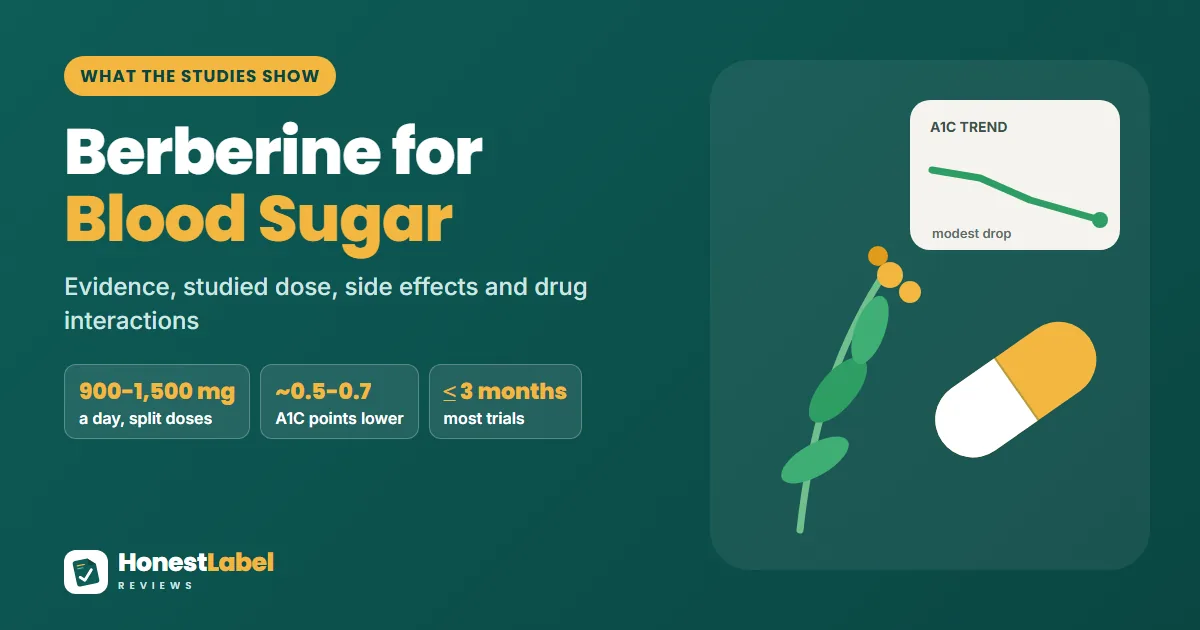
Berberine does lower blood sugar in studies, but modestly. In people with type 2 diabetes, trials using about 900 to 1,500 mg a day in divided doses show lower fasting glucose and an A1C drop of roughly 0.5 to 0.7 points on average. Most trials were small, short and run in China, and berberine interacts with several drugs.
Berberine is a bitter yellow compound found in plants such as goldenseal, barberry, Oregon grape and Chinese goldthread. It has been used in traditional Chinese and Ayurvedic medicine for a long time, mostly for diarrhea and infections. Over the last 20 years it has become the most studied plant compound for blood sugar, and lately social media has started calling it “nature’s Ozempic”.
This guide looks at what the research actually found, how much was used, who should avoid it, and how it compares with metformin. If you want the basics first, start with our guide to normal blood sugar ranges.
How does berberine lower blood sugar?
The best-known mechanism is an enzyme called AMPK, a sort of fuel sensor inside cells. When AMPK switches on, cells take up more glucose and burn more fat, and the liver makes less new glucose. A 2006 study in the journal Diabetes showed that berberine activates AMPK in muscle and fat cells and improved glucose handling in obese, insulin-resistant animals (Lee et al., 2006). Metformin also works partly through AMPK, which is why the two get compared so often.
Researchers have proposed other effects as well, such as changes in gut bacteria, slower carbohydrate absorption in the gut and more insulin receptors on cells. Most of that comes from lab and animal work, so it is less certain than the human blood sugar results below.
One more detail matters for dosing. Berberine is poorly absorbed and does not stay in the body for long, which is why studies split the daily amount into two or three doses with meals.
What the human studies show
The early trials
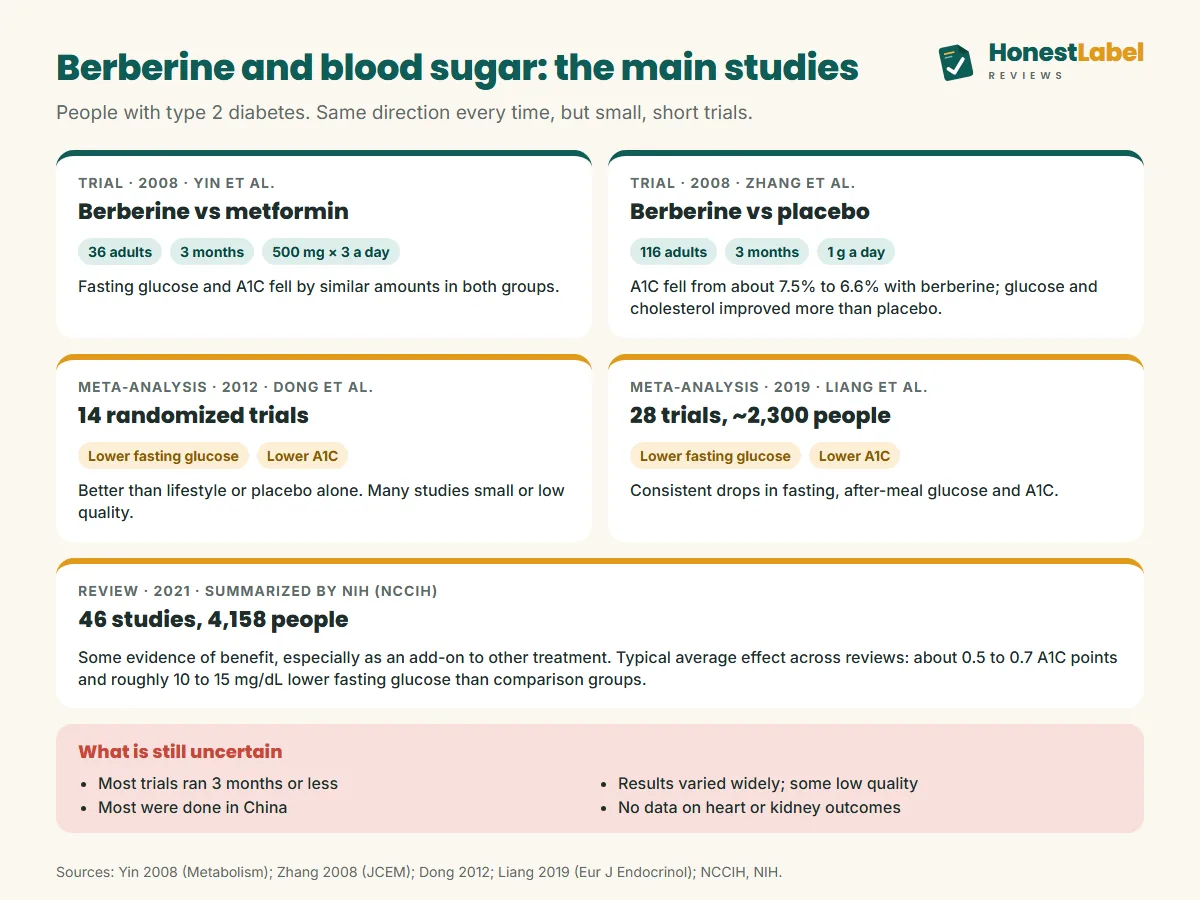
Two small 2008 trials started the interest:
- Yin et al., 2008 (Metabolism). 36 adults with newly diagnosed type 2 diabetes took either berberine 500 mg or metformin 500 mg three times a day for three months. Fasting glucose and A1C fell by similar amounts in both groups (Yin et al., 2008).
- Zhang et al., 2008 (Journal of Clinical Endocrinology & Metabolism). 116 adults with type 2 diabetes and high cholesterol took 1 g of berberine a day or placebo for three months. In the berberine group A1C fell from about 7.5% to 6.6%, and fasting glucose and cholesterol also improved more than with placebo (Zhang et al., 2008).
These are real, published, placebo or drug-controlled trials. They are also small and only three months long, which is why the pooled analyses matter more.
The meta-analyses
Several groups have pooled the trials since then:
- A 2012 meta-analysis of 14 randomized trials found that berberine lowered fasting glucose, after-meal glucose and A1C more than lifestyle change or placebo, and worked about as well as some oral diabetes drugs in head-to-head trials. The authors flagged the small size and quality of many studies (Dong et al., 2012).
- A 2019 review in the European Journal of Endocrinology pooled 28 trials with about 2,300 people and again found lower fasting glucose, after-meal glucose and A1C (Liang et al., 2019).
- A 2021 review of 46 studies with 4,158 people, summarized by the NIH’s National Center for Complementary and Integrative Health (NCCIH), found some evidence of benefit, especially as an add-on to other treatment. NCCIH also points out that most studies were done in China, results varied widely and some studies were of poor quality.
Across these reviews, the average effect versus comparison groups is in the range of about 0.5 to 0.7 percentage points of A1C and roughly 10 to 15 mg/dL of fasting glucose (Dong et al.; Liang et al.). Treat those as rough figures. They come from many short trials with different doses, and in some the people were also taking diabetes drugs.
What we still do not know
- Long-term effects. Most trials ran 3 months or less. Nobody has tested whether berberine lowers heart attacks, kidney disease or other diabetes complications.
- People without diabetes. There is much less data on prediabetes or normal blood sugar, so the effect there is unclear.
- Product quality. Supplements are not checked by the FDA for dose before sale, so what is in a capsule may not match the trials. Our guide on how to read a blood sugar supplement label covers what to look for.
Berberine dosage used in studies
| Item | What the research used |
|---|---|
| Daily total | Usually 900 to 1,500 mg |
| How it was split | 2 or 3 doses a day, for example 500 mg three times a day |
| Timing | With or just before meals |
| Trial length | Mostly 8 to 12 weeks |
That matches what the NCCIH describes as the clinically used range (200 to 1,000 mg two or three times a day). Starting with one 500 mg dose a day with a meal and building up over a week or two gives the stomach time to accomodate it. Anyone on medication should agree on a dose with thier doctor first, for reasons covered below.
Berberine side effects
The most common side effects are in the gut. NCCIH lists nausea, diarrhea, bloating and constipation, usually mild to moderate. If they have occured after a dose increase, stepping back down or splitting the dose often helps, and so does taking it with food.
When combined with diabetes drugs, berberine can also push blood sugar too low. The ADA defines low blood sugar as under 70 mg/dL and a serious low as under 54 mg/dL. Shakiness, sweating, a pounding heart and confusion are warning signs.
Drug interactions: the part people skip
This is where berberine needs the most care, and it is often left out of social media posts.
- Liver enzymes (CYP). In a small two-week study in healthy men, berberine (300 mg three times a day) reduced the activity of the liver enzymes CYP2D6, CYP2C9 and CYP3A4 (Guo et al., 2012). Those enzymes clear alot of common medicines, including some blood thinners, statins, antidepressants and heart drugs, so their levels could rise.
- Cyclosporine. In kidney transplant patients, berberine raised blood levels of the anti-rejection drug cyclosporine (Wu et al., 2005). Anyone on cyclosporine or a similar transplant drug should not take berberine without the transplant team’s approval.
- Metformin and other glucose-lowering drugs. Adding berberine to insulin, sulfonylureas or other diabetes drugs can stack the effects and cause lows. NCCIH also reports that goldenseal, a berberine-containing herb, lowered metformin levels by about 25 percent in healthy adults (NCCIH goldenseal fact sheet), so the combination can move in either direction.
If you take any prescription drug, show your pharmacist the supplement before you start. It takes a few minutes and is the simplest way to catch a problem.
Who should not take berberine
- Pregnant or breastfeeding women. NCCIH says berberine should not be used during pregnancy or breastfeeding, or given to infants, because it has been linked to a harmful buildup of bilirubin in newborns that can cause brain damage.
- Infants and young children. For the same reason.
- People on cyclosporine or other drugs with a narrow safe range, unless a doctor approves it.
- People on insulin or sulfonylureas without a plan from their doctor for checking blood sugar and adjusting doses.
- People with liver disease or several daily medicines, because of the enzyme effects.
Berberine vs metformin
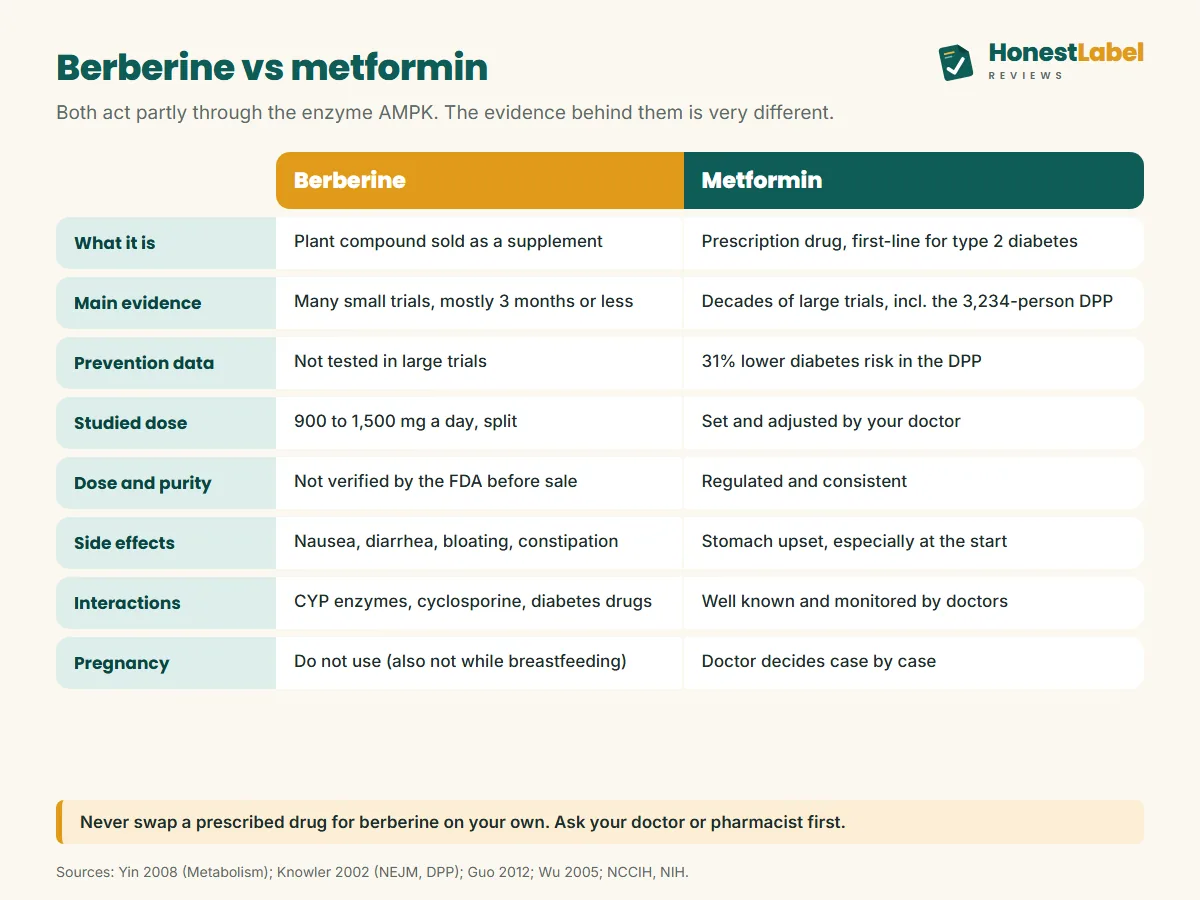
The comparison comes up because both act on AMPK and because the Yin trial found similar three-month results. That one small trial does not make them equal. Here is how they stack up on the evidence we have.
| Berberine | Metformin | |
|---|---|---|
| What it is | Plant compound sold as a supplement | Prescription drug, first-line treatment for type 2 diabetes |
| Main evidence | Many small trials, mostly 3 months or less | Decades of large trials, including the 3,234-person Diabetes Prevention Program |
| Diabetes prevention | Not tested in large trials | Cut diabetes risk by 31% in the DPP |
| Dose and purity | Not verified before sale | Regulated and consistent |
| Common side effects | Stomach upset | Stomach upset |
| Interactions | CYP enzymes, cyclosporine, diabetes drugs | Well mapped; doctors know how to monitor |
The DPP figure comes from the Diabetes Prevention Program in NEJM. Our honest read: berberine is a reasonable thing to ask a doctor about for someone with mild high blood sugar who wants to avoid medication or who could not tolerate metformin. It is no replacement for a prescribed drug, and nobody should switch from metformin to berberine on their own. For the habits that work alongside either, see our guide to lowering blood sugar naturally.
Is berberine really “nature’s Ozempic”?
No study supports that claim. Ozempic is semaglutide, a GLP-1 drug. In the STEP 1 trial, 1,961 adults with obesity lost an average of 14.9 percent of body weight on weekly semaglutide over 68 weeks, compared with 2.4 percent on placebo (Wilding et al., NEJM 2021).
Berberine has never been tested head to head with a GLP-1 drug. Some lab and animal studies suggest it may nudge GLP-1 release, but the weight changes seen in berberine trials are small, and nothing in the human data comes close to the results of semaglutide or similar drugs. It is truely a different category of treatment. If weight loss is the goal, it is worth asking a doctor whether a GLP-1 medicine or another proven option fits you.
When to see a doctor
- Before you start berberine, if you take any prescription medicine, are pregnant, breastfeeding or planning a pregnancy, or have liver or kidney disease
- If you get a reading under 70 mg/dL, or symptoms of a low such as shaking, sweating or confusion
- If you have not been diagnosed but get a fasting reading of 126 mg/dL or higher, which is in the diabetes range
- If stomach side effects last more than a week or two, or you notice yellowing of the skin or eyes
- If your blood sugar stays high after three months on berberine. It may be neccessary to start or change medication.
Frequently asked questions
How much does berberine lower blood sugar?
In meta-analyses of people with type 2 diabetes, berberine lowered A1C by about 0.5 to 0.7 points and fasting glucose by roughly 10 to 15 mg/dL compared with control groups. Results vary a lot between studies, and most lasted three months or less.
How long does it take for berberine to work?
Most trials measured results after 8 to 12 weeks. Fasting readings may change sooner, but A1C reflects about three months of blood sugar, so that is the fair point to judge it.
Can I take berberine with metformin?
Only with your doctor’s agreement. Both lower blood sugar, berberine affects how the body handles several drugs, and the herb goldenseal lowered metformin levels in one NIH-funded study. Your doctor may want you to check your blood sugar more often.
Is it safe to take berberine every day?
At studied doses it appears safe for most adults over a few months, with stomach upset as the main side effect. Long-term safety beyond that is not well studied, and it is not safe in pregnancy, while breastfeeding or for infants.
Does berberine help with weight loss?
Any effect seen so far is small. Berberine has not been shown to match GLP-1 drugs such as semaglutide.
The bottom line
Berberine has the most research of any blood sugar supplement, and the trials point the same way: modestly lower fasting glucose and A1C in people with type 2 diabetes, at about 900 to 1,500 mg a day in divided doses. The trials are small and short, it upsets many stomachs, and it interacts with medicines from cyclosporine to diabetes drugs. It does not replace metformin and it is not a natural Ozempic. If you want to try it, bring it to your doctor or pharmacist first.
Sources
- National Center for Complementary and Integrative Health (NIH). Diabetes and Dietary Supplements: What You Need To Know; Goldenseal: Usefulness and Safety.
- American Diabetes Association. Hypoglycemia.
- Knowler WC, et al. Reduction in the incidence of type 2 diabetes with lifestyle intervention or metformin. NEJM, 2002.
- Lee YS, et al. Berberine, a natural plant product, activates AMP-activated protein kinase with beneficial metabolic effects. Diabetes, 2006. PubMed.
- Yin J, Xing H, Ye J. Efficacy of berberine in patients with type 2 diabetes mellitus. Metabolism, 2008. PubMed.
- Zhang Y, et al. Treatment of type 2 diabetes and dyslipidemia with the natural plant alkaloid berberine. J Clin Endocrinol Metab, 2008. PubMed.
- Dong H, et al. Berberine in the treatment of type 2 diabetes mellitus: a systemic review and meta-analysis. Evid Based Complement Alternat Med, 2012. PubMed.
- Liang Y, et al. Effects of berberine on blood glucose in patients with type 2 diabetes mellitus: a systematic literature review and a meta-analysis. Eur J Endocrinol, 2019. PubMed.
- Guo Y, et al. Repeated administration of berberine inhibits cytochromes P450 in humans. Eur J Clin Pharmacol, 2012. PubMed.
- Wu X, et al. Effects of berberine on the blood concentration of cyclosporin A in renal transplanted recipients. Eur J Clin Pharmacol, 2005. PubMed.
- Wilding JPH, et al. Once-weekly semaglutide in adults with overweight or obesity. NEJM, 2021. PubMed.
Medical disclaimer: This article is for general information and is not medical advice. It does not replace a diagnosis or treatment from your doctor. If you have diabetes or take medication that affects blood sugar, talk to your healthcare provider before changing your diet, exercise or supplements.