Last reviewed: November 2026 · Sources: US Food and Drug Administration, NIH Office of Dietary Supplements and peer-reviewed studies (listed at the end)
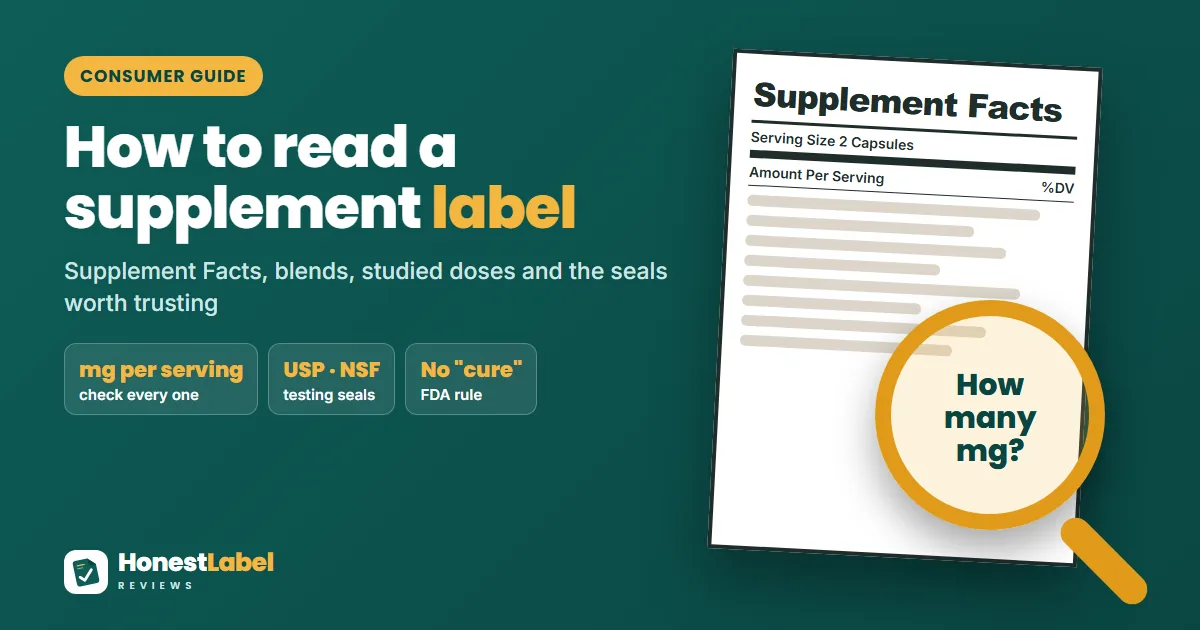
Start with the Supplement Facts panel and find the exact milligrams of each ingredient per serving. Compare them with the doses used in studies, for example 900 to 1,500 mg of berberine or 600 mg of alpha-lipoic acid a day. Be wary of proprietary blends, look for a USP or NSF seal, and walk away from any “cure” claim.
Blood sugar supplement labels can look almost identical, with a list of plant extracts, a mineral or two and a promise about “healthy glucose levels”. The differences sit in the small print: how much of each ingredient you get, whether that matches the research, and whether anyone outside the company checked it. This guide walks through a label from top to bottom so you can judge any product yourself. For the numbers these products claim to help with, our main guide covers normal blood sugar ranges.
One point before we start. In the US, a supplement can reach the shelf without the FDA reviewing whether it works. Under the Dietary Supplement Health and Education Act of 1994 (DSHEA), the company is responsible for making sure its product is safe and labeled truthfully, and the FDA steps in after a problem shows up.
Step 1: Read the Supplement Facts panel
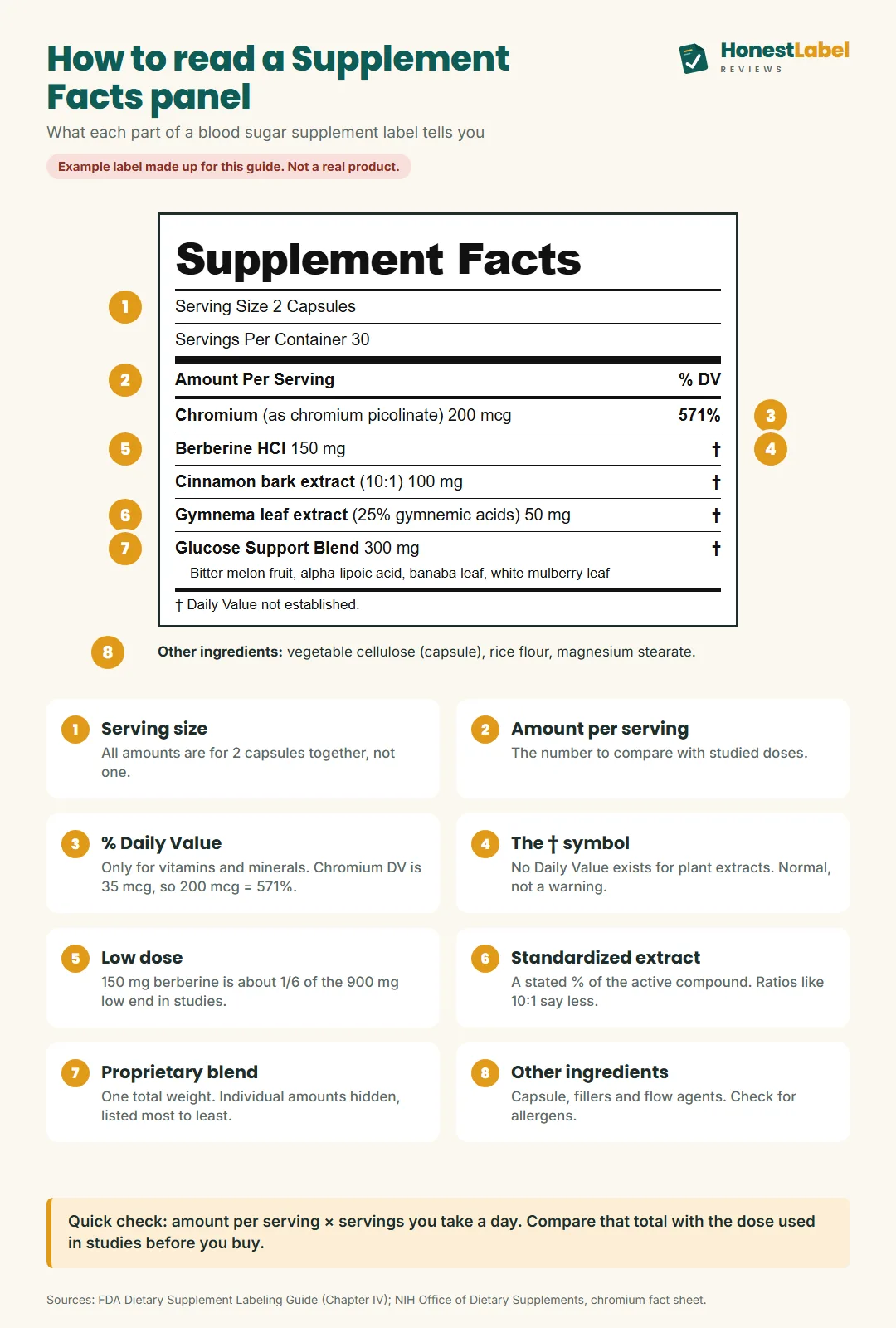
US supplements must carry a “Supplement Facts” box, with a few exemptions for very small companies. The FDA sets its format in the Dietary Supplement Labeling Guide. Here is what each part tells you.
Serving size
Look here first, becuase every number below it depends on it. Under FDA rules, one serving is the largest amount the label recommends taking at one time. If the serving size is “3 capsules”, the amounts listed are for three capsules together. At two servings a day, a 90-capsule bottle lasts only 15 days.
A panel listing 500 mg of berberine looks generous until you notice the serving is four capsules. Take one capsule and you get a quarter of that.
Amount per serving
This column shows the weight of each ingredient in one serving, usualy in milligrams (mg) or micrograms (mcg). One milligram is 1,000 micrograms, a difference that matters for chromium, which is dosed in micrograms. Write it down for each ingredient you care about.
% Daily Value
The %DV column only applies to nutrients with an official Daily Value, such as vitamins and minerals. Chromium has one: the Daily Value is 35 mcg, according to the NIH Office of Dietary Supplements. So a label with 200 mcg of chromium will show about 571% DV. That amount sits inside the range used in studies.
Plant extracts like berberine, cinnamon and gymnema have no Daily Value. Next to them you will see a symbol pointing to a footnote that says “Daily Value not established”.
Other ingredients
Below the panel, a separate list names the things that are not active ingredients: the capsule shell (gelatin or a plant cellulose), fillers like rice flour or microcrystalline cellulose, and flow agents like magnesium stearate or silicon dioxide. Check it if you avoid gelatin, gluten, soy or dyes.
Step 2: Watch out for proprietary blends
A proprietary blend is a group of ingredients listed together under a made-up name, such as “Glucose Support Matrix”, with one total weight for the whole group. FDA rules let companies list the blend’s total weight and the ingredients in it, in descending order by weight, without giving each ingredient’s amount (FDA Labeling Guide, Chapter IV).
Imagine a 600 mg blend that lists berberine, cinnamon, gymnema, bitter melon, banaba and white mulberry. Berberine is named first, so it is the largest ingredient, but it could be 110 mg or 590 mg. The other five could be a few milligrams each, a practice called “fairy dusting”.
You can still learn something from a blend:
- Divide the total by the number of ingredients. A 500 mg blend with ten ingredients averages 50 mg each, far below most studied doses.
- Check the order. Ingredients are listed from most to least by weight, so anything near the end is probably present in small amounts.
- Compare the total with one studied dose. If the whole blend weighs less than the studied dose of its first ingredient, no single ingredient can be at a studied dose.
Companies often say blends protect their formula from copycats. Whatever the reason, you cannot check the dose, so a label that lists every amount is easier to judge.
Step 3: Compare label doses with studied doses
An ingredient can only be expected to do what it did in research if you take roughly the amount tested, in a similar form. Here are typical daily amounts from human studies for five common ingredients. They are not recommendations, and the evidence varies a lot.
| Ingredient | Typical daily amount in studies | Form studied | Strength of evidence |
|---|---|---|---|
| Berberine | 900 to 1,500 mg, split into 2 or 3 doses | Berberine hydrochloride | Moderate: several meta-analyses |
| Cinnamon | 1 to 6 g (1,000 to 6,000 mg) | Mostly cassia powder | Mixed: trials disagree |
| Chromium | 200 to 1,000 mcg | Mostly chromium picolinate | Inconsistent, per NIH |
| Gymnema | About 400 mg | Standardized leaf extract | Low: few small trials |
| Alpha-lipoic acid | 600 mg | Oral ALA | Better for nerve symptoms than glucose |
Sources for the table: berberine from meta-analyses of randomized trials (PubMed); cinnamon from the trials pooled by Allen et al., 2013; chromium from the NIH chromium fact sheet; gymnema from Baskaran et al., 1990; alpha-lipoic acid from the SYDNEY 2 trial. Each ingredient has its own guide on this site: berberine research, cinnamon and blood sugar, and gymnema, bitter melon and ALA.
A worked example
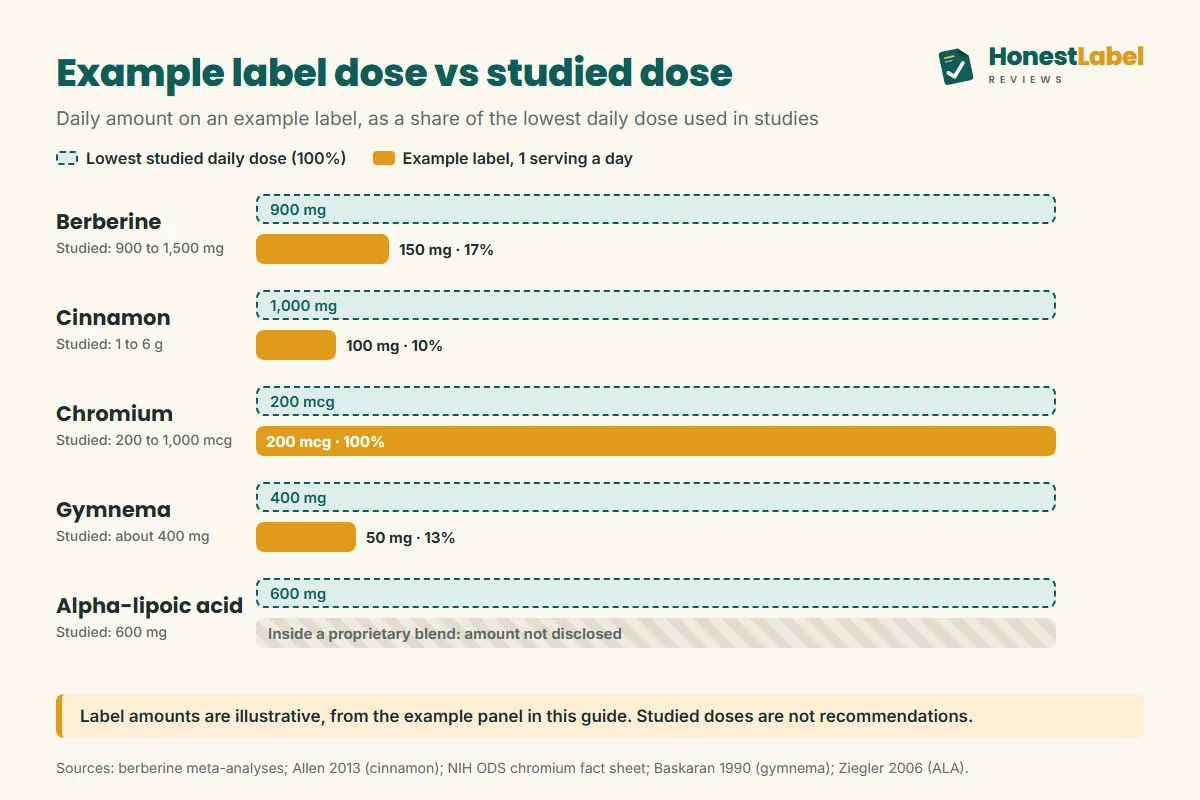
Say a label lists 150 mg of berberine, 100 mg of cinnamon bark and 50 mg of gymnema per two-capsule serving, taken once a day. Against the table:
- Berberine: 150 mg is about one sixth of the lowest studied daily amount of 900 mg.
- Cinnamon: 100 mg is a tenth of the 1 g at the bottom of the studied range.
- Gymnema: 50 mg is about an eighth of the 400 mg used in the best-known trial.
At those levels there is litle reason to expect the effects seen in studies. Going far above the studied range is no better: it adds side effects without proven benefit, and cassia cinnamon’s coumarin carries real risk at high intakes.
Step 4: Check extract standardization
Plant ingredients come in very diffrent strengths. “Gymnema leaf 400 mg” could be ground dried leaf or a concentrated extract, and the two are not the same.
A standardized extract states how much of the active compound it contains, for example “gymnema extract (standardized to 25% gymnemic acids)” or “berberine HCl 97%”. That tells you the strength is controlled from batch to batch, and lets you match it to the form used in a study.
Ratio extracts are trickier. “Cinnamon 10:1 extract, 100 mg” means 10 parts of raw cinnamon made 1 part of extract, and some labels then call it “equivalent to 1,000 mg”. The ratio says nothing about which compounds survived, so treat those numbers with caution. Plain herb powder has no standardization at all.
Step 5: Look for third-party testing seals
Since nobody checks a supplement before it goes on sale, independent testing is the best sign that what is on the label is in the bottle. The NIH Office of Dietary Supplements notes that a few independent organizations offer quality testing and let products that pass display a seal. A seal tells you the product was made properly and contains what it says. It says nothing about whether the ingredients work.
- USP Verified. The US Pharmacopeia checks that the product contains the listed ingredients in the declared amounts, does not contain harmful levels of certain contaminants, breaks down properly, and is made under good manufacturing practices.
- NSF Certified for Sport. NSF tests that the label matches the contents and screens for contaminants and for substances banned in sport.
- ConsumerLab. This is an independent company that buys supplements, tests them and publishes the results, mostly for subscribers. Products that pass may carry its seal.
Seals can be copied. If a label shows one, you can look the product up on the certifier’s website to confirm it is realy listed. You can also compare labels across many products in the NIH’s free Dietary Supplement Label Database.
Step 6: Spot red-flag claims
The FDA is clear that no dietary supplement can treat or cure diabetes. Any label, website or ad that says otherwise is breaking the rules. Be wary of claims like these:
- “Cures diabetes” or “reverses diabetes in 30 days”
- “Replace your medication” or “no more insulin”
- “Doctors hate this” or “the secret Big Pharma doesn’t want you to know”
- “100% natural, so no side effects”
- Before and after photos, or glucose meter screenshots, as proof
The FDA’s own lab testing has found hidden prescription diabetes drugs, such as glyburide and metformin, in some products sold as natural supplements, and one product contained phenformin, a drug the US took off the market in 1978 because of a dangerous side effect called lactic acidosis (FDA). Hidden drugs like these can push blood sugar dangerously low, especially if you already take medication. In 2021 the FDA and the Federal Trade Commission sent warning letters to 10 companies selling supplements that claimed to treat diabetes. That problem has occurred again and again, so treat a “cure” claim as a reason to walk away.
What the FDA does and does not do
Many people assume the government has checked every supplement on the shelf. It has not.
No approval before sale
Under DSHEA, supplements do not need FDA approval for safety or effectiveness before they are sold (FDA). Companies must follow manufacturing rules, and the FDA usually acts only after problems are reported.
Structure/function claims and the disclaimer
Supplements may make “structure/function” claims, which describe how an ingredient affects normal body function, such as “supports healthy glucose metabolism”. They may not claim to diagnose, treat, cure or prevent a disease. A company that makes a structure/function claim must notify the FDA within 30 days of marketing the product, and the label must carry this exact disclaimer (FDA Labeling Guide, Chapter VI):
“This statement has not been evaluated by the Food and Drug Administration. This product is not intended to diagnose, treat, cure, or prevent any disease.”
The existence of that disclaimer is your reminder that “supports healthy blood sugar” has not been checked by anyone. A product that drops the disclaimer and promises to lower your A1C or replace metformin is being sold as an unapproved drug.
Safety: who should be careful
Talk to your doctor or pharmacist before starting any blood sugar supplement if you:
- Take insulin, a sulfonylurea (glipizide, glyburide, glimepiride) or any other diabetes medicine. Adding a glucose-lowering ingredient can push you below 70 mg/dL.
- Are pregnant, trying to conceive or breastfeeding. Several common ingredients, including berberine and bitter melon, should be avoided.
- Have kidney or liver disease. Chromium, gymnema and high-dose cassia cinnamon have been linked to rare kidney or liver problems.
- Take several medicines. Berberine in particular can change how the body handles other drugs.
If you start a new supplement, check your blood sugar more often for the first few weeks and keep a log. Never cut a prescribed medicine on your own because of a supplement.
When to see a doctor
Stop the supplement and get medical advice if you notice:
- Readings under 70 mg/dL, or repeated lows you cannot explain
- Shakiness, sweating, a pounding heart or confusion after starting a product
- Yellow skin or eyes, dark urine or pain under the right ribs
- A new rash, swelling or trouble breathing (call emergency services for this one)
- Fasting readings that stay at 126 mg/dL or higher despite the supplement
Bring the bottle to your appointment so your doctor can check the full label against your medicines, rather than guessing tomorrow from memory.
Frequently asked questions
What does “proprietary blend” mean on a supplement label?
It means several ingredients are listed together under one name with a single total weight. The company must list the ingredients in order from most to least, but it does not have to say how much of each one is in the blend. That makes it impossible to compare the doses with research.
Are supplements with a USP or NSF seal safe?
A seal means an independent group checked that the product contains what the label says and is free of certain contaminants. It does not mean the ingredients work or that they are safe for you, especially if you take diabetes medicine.
Can a supplement label say it lowers blood sugar?
Labels may say things like “supports healthy blood sugar levels allready within the normal range”, with the FDA disclaimer. They may not claim to treat diabetes or replace medication. If a label does, the FDA considers the product an unapproved drug.
How do I know if a dose is too low?
Multiply the amount per serving by the number of servings you would take a day, then compare it with the studied range in the table above. If the total is far below the lowest studied amount, the ingredient is unlikely to have the effect seen in research.
The bottom line
Find the serving size, note the amount per serving of each ingredient, and compare the daily total with the doses used in studies. Treat a proprietary blend as a dose you cannot check, prefer standardized extracts, and look for a USP or NSF seal you can verify. Walk away from any product that promises to cure diabetes or replace medicine. It may feel weird to study a supplement label this closely, but no regulator checks it before you swallow the capsule. If you take medication for blood sugar, involve your doctor or pharmacist from the beginning.
Sources
- US Food and Drug Administration. Dietary Supplements.
- US Food and Drug Administration. Dietary Supplement Labeling Guide: Chapter IV, Nutrition Labeling; Chapter VI, Claims.
- US Food and Drug Administration. Illegally Sold Diabetes Treatments.
- US Food and Drug Administration. FDA, FTC Warn 10 Companies Illegally Selling Dietary Supplements Claiming to Treat Diabetes, 2021.
- NIH Office of Dietary Supplements. Dietary Supplements: What You Need to Know; Chromium Fact Sheet for Health Professionals; Dietary Supplement Label Database.
- Meta-analyses of berberine in type 2 diabetes. PubMed search.
- Allen RW, et al. Cinnamon use in type 2 diabetes: an updated systematic review and meta-analysis. Annals of Family Medicine, 2013. PubMed.
- Baskaran K, et al. Antidiabetic effect of a leaf extract from Gymnema sylvestre in non-insulin-dependent diabetes mellitus patients. Journal of Ethnopharmacology, 1990. PubMed.
- Ziegler D, et al. Oral treatment with alpha-lipoic acid improves symptomatic diabetic polyneuropathy: the SYDNEY 2 trial. Diabetes Care, 2006. PubMed.
Medical disclaimer: This article is for general information and is not medical advice. It does not replace a diagnosis or treatment from your doctor. If you have diabetes or take medication that affects blood sugar, talk to your healthcare provider before changing your diet, exercise or supplements.