Last reviewed: November 2026 · Sources: NIH (NIDDK), American Diabetes Association, MedlinePlus and peer-reviewed studies on PubMed (listed at the end)
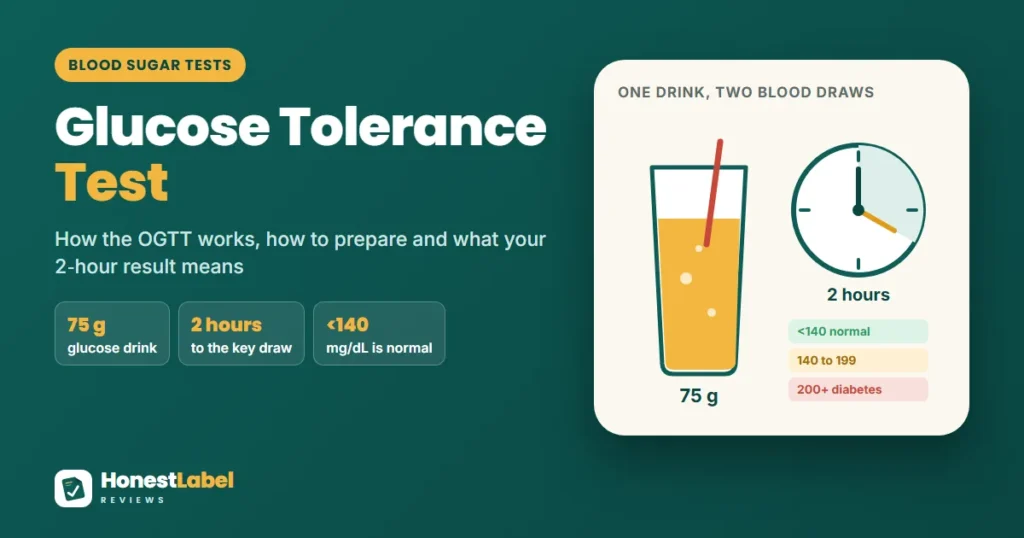
The A1C test shows your average blood sugar over the past 2 to 3 months. An A1C under 5.7% is normal, 5.7% to 6.4% is prediabetes, and 6.5% or higher on two tests points to diabetes. Many adults with diabetes aim for under 7%. Anemia, some hemoglobin variants, pregnancy and kidney disease can skew the result.
A1C is one of the few blood tests most people hear about by name, yet the number itself is easy to misread. This guide explains what the percentage actualy measures, how to read it on a chart, how often to repeat it, and the situations where the result can mislead you and your doctor. For finger-prick and after-meal numbers, see our guide to normal blood sugar ranges.
What the A1C test measures
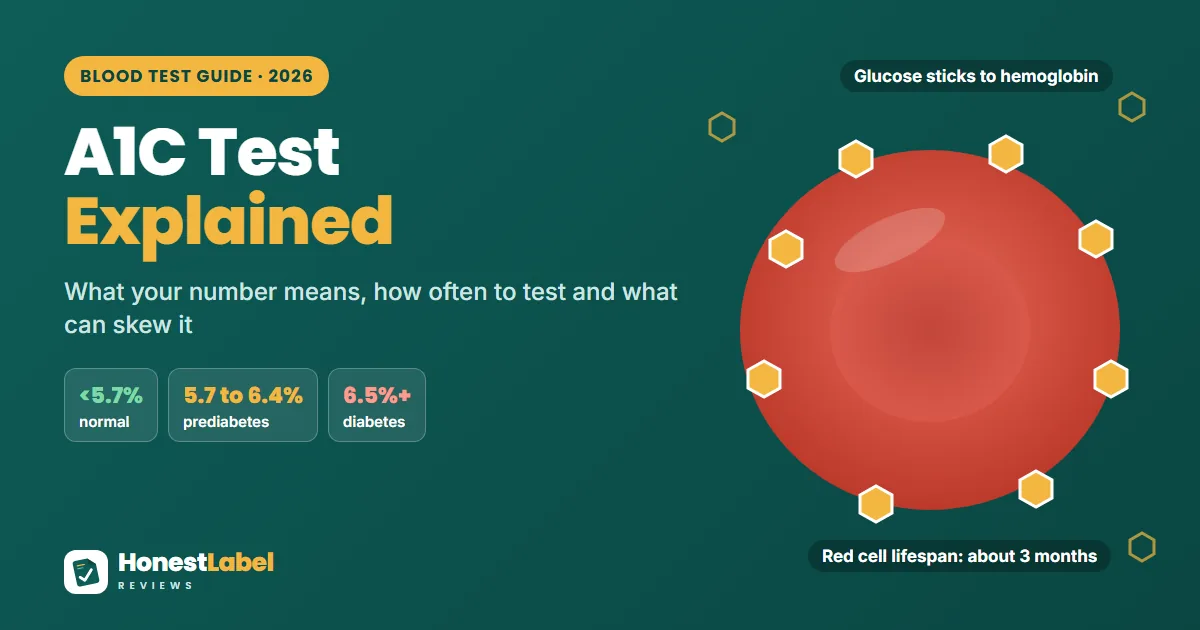
Hemoglobin is the protein inside red blood cells that carries oxygen. Glucose in the blood sticks to it, slowly and permanently, in a process called glycation. Once a glucose molecule has attached, it stays for the life of that red cell. The more glucose in your blood over the weeks, the larger the share of hemoglobin that ends up coated. Hemoglobin A1c is the main glycated form, and the test reports it as a percentage of all your hemoglobin.
Red blood cells live for roughly three months (about 120 days). At any moment your blood holds a mix of new cells and old ones, so the A1C reflects a blended average of that whole period. According to the NIDDK, it reflects your average blood glucose over about the past 3 months, and the value depends on how long your red cells survive. Recent weeks count for more than older ones, because younger cells are still in circulation and older ones have already been removed.
That design explains both the strength and the weak spot of the test. A single high-carb dinner or a stressful morning barely moves it, and you do not need to fast. Anything that shortens or lengthens red cell life will push the number in the wrong direction, even if your blood sugar has not changed.
A1C levels chart: what your number means
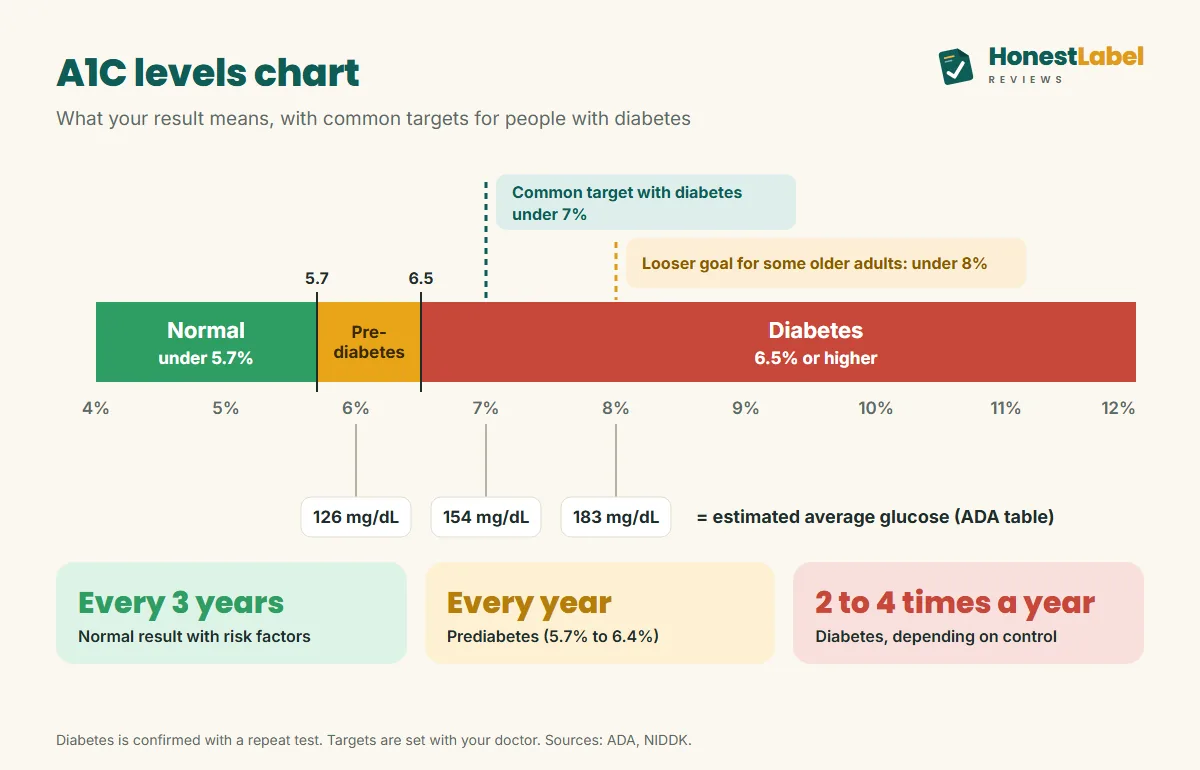
These are the diagnostic ranges used by the American Diabetes Association and the NIDDK, plus the common treatment targets for people who allready have diabetes.
| A1C result | What it means | Usual next step |
|---|---|---|
| Under 5.7% | Normal | Retest about every 3 years if you have risk factors |
| 5.7% to 6.4% | Prediabetes | Lifestyle changes, retest every year |
| 6.5% or higher | Diabetes (confirmed by a repeat test) | Treatment plan with your doctor |
| Under 7% | Common target for adults with diabetes | Test at least twice a year |
| Under 8% | Looser target sometimes set for older adults or people with frequent lows | Agree on the goal with your doctor |
A result in the diabetes range usually needs confirming with a second test on a separate day, unless you also have clear symptoms or a very high glucose reading, as the NIDDK explains.
Reading a number inside a range
The ranges are cut-offs on a smooth scale, so the risk does not jump at 5.7%. An A1C of 5.6% is technically normal but close to the line, and a 6.3% is near the diabetes threshold. If yours sits at the top of the normal band, our article on the early signs of insulin resistance explains what else to look for.
The target if you have diabetes
The ADA recommends an A1C target of 7% or less for most people with diabetes, with higher or lower goals depending on age and risk of low blood sugar. A tighter goal may suit a younger, healthy adult who can reach it without lows. A looser one, often under 8%, may suit an older adult with other illnesses, because the danger of a severe low then outweighs the gain from a lower number.
Why does a point matter? In the UK Prospective Diabetes Study, each 1 percentage point lower A1C was linked to about 37 percent fewer eye, kidney and nerve complications and 21 percent fewer diabetes-related deaths (Stratton et al., BMJ 2000). That was an observational analysis, but it fits the trial evidence. In type 1 diabetes, the DCCT trial found that tighter control cut the risk of eye, kidney and nerve damage substantially (DCCT Research Group, NEJM 1993).
A1C and average glucose, briefly
Some lab reports add an estimated average glucose (eAG) in mg/dL next to the A1C. The ADA’s conversion table puts an A1C of 6% at about 126 mg/dL, 7% at about 154 mg/dL and 8% at about 183 mg/dL (ADA). The formula comes from the ADAG study, which compared A1C with frequent glucose readings in 507 adults (Nathan et al., Diabetes Care 2008). It is an average, so it will not match any single meter reading.
How often should you get an A1C test?
| Your situation | How often |
|---|---|
| Normal result, with risk factors or age 35+ | About every 3 years |
| Prediabetes | Every year |
| Diabetes, stable and at goal | At least twice a year |
| Diabetes, treatment just changed or not at goal | About every 3 months |
The ADA and the NIDDK both advise at least two tests a year for people with diabetes, and more often when the treatment plan changes or is not working. Testing more often than every three months rarely helps, because the test cannot show the full effect of a change until the red cells have turned over.
Practical tips for test day:
- You do not need to fast for an A1C alone, but ask whether other tests are being drawn at the same time.
- Keep your results in one place with the date and the lab. Small differences can come from the lab rather than your body, so look at the trend over several tests.
- Tell the person ordering the test about recent blood loss, a transfusion, iron treatment, pregnancy or kidney problems, since these change how the result should be read.
What can make your A1C wrong
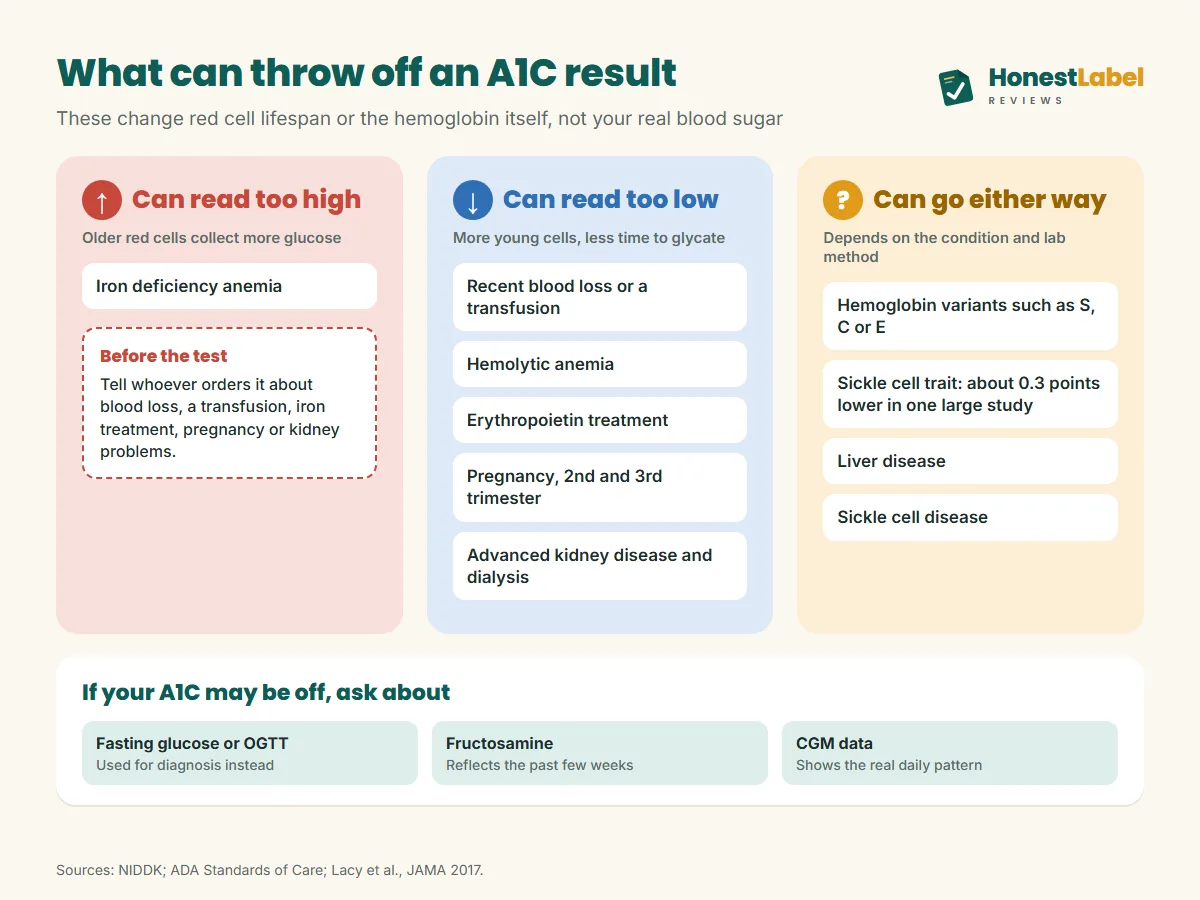
Becuase A1C depends on red cell lifespan and on the hemoglobin molecule itself, a few conditions can make it read higher or lower than your true average. The NIDDK and the ADA list the main ones.
Anemia and blood loss
- Iron deficiency anemia can make A1C read falsely high, because red cells live longer and have more time to collect glucose. The NIDDK notes this in people who are very low in iron.
- Recent blood loss, a transfusion, hemolytic anemia or treatment with erythropoietin can make it read falsely low, because the blood suddenly holds more young cells that have had less time to glycate.
Hemoglobin variants
Some people inherit a diffrent form of hemoglobin, such as sickle cell trait (hemoglobin S), hemoglobin C or hemoglobin E. These are more common in people with African, Mediterranean or Southeast Asian ancestry, and many carriers never know they have one. Depending on the lab method, a variant can make the A1C unreliable for diagnosing or monitoring diabetes. In a large study of African American adults, those with sickle cell trait had A1C values about 0.3 percentage points lower than those without it at similar glucose levels (Lacy et al., JAMA 2017). A difference that size could move someone across a cut-off.
If your A1C and your glucose readings never seem to match, ask whether a hemoglobin variant could be the reason and whether the lab uses a method that is not affected by it.
Pregnancy
It can seem weird that pregnancy lowers the number, but red cell turnover speeds up while you are pregnant, so A1C tends to run lower, especially in the second and third trimesters. The ADA advises against using A1C alone to diagnose diabetes in these conditions, and gestational diabetes is checked with a glucose tolerance test, usualy at 24 to 28 weeks (NIDDK). For women who already have diabetes, the ADA’s pregnancy target is under 6% if that can be reached without lows, and under 7% if needed to avoid them (ADA Standards of Care). Your prenatal team will rely more on meter or CGM readings.
Kidney disease and other conditions
Advanced kidney disease, and especialy dialysis, shortens red cell life and is often treated with erythropoietin, so A1C can underestimate true glucose. The NIDDK also names liver disease and sickle cell disease among conditions that can skew results. The ADA’s diagnosis standards say that when red cell turnover is altered, diabetes should be diagnosed with plasma glucose tests instead.
What doctors use instead
- Fasting plasma glucose or an oral glucose tolerance test for diagnosis.
- Fructosamine, which reflects a shorter period of a few weeks and does not depend on red cell lifespan.
- Continuous glucose monitor data, which shows the actual pattern and time in range over days and weeks.
Point-of-care and home A1C tests
Many clinics now run A1C on a small machine from a finger-prick sample, with a result in a few minutes. These point-of-care tests are handy for monitoring diabetes during a visit. For diagnosis, the rules are stricter. The NIDDK says point-of-care results should not be used to diagnose diabetes and that diagnostic samples should go to a lab using a method certified by the NGSP, the program that standardizes A1C tests. The ADA’s standards allow point-of-care A1C for diagnosis only on FDA-approved devices in certified labs with trained staff.
Home A1C kits are also sold. Some give a result on a small reader, others ask you to mail a dried blood spot to a lab. They can be useful for tracking between visits, but they are not a substitute for a lab test when a diagnosis is being made, and results can differ from your clinic’s. If an unexpected home result has occurred, repeat the test through your doctor before changing anything.
How to lower a high A1C
Because the test reflects about three months, A1C moves slowly. The same habits that lower everyday glucose lower A1C over time: modest weight loss, regular activity, walking after meals, more fiber and fewer sugary drinks. Our guide on how to lower blood sugar naturally covers each of these with the research behind it. Medication changes, when needed, are your doctor’s call. Expect to wait about three months before a retest shows the full effect, though a noticeable change sometimes appears sooner.
Safety: who should be careful
- Insulin or sulfonylureas: pushing hard for a lower A1C raises the risk of lows under 70 mg/dL. The ADA treats anything under 54 mg/dL as serious. If your A1C is falling but you keep having lows, tell your doctor, because the treatment may need to change.
- Older adults: a looser target is often safer.
- Pregnancy, anemia, kidney disease or a known hemoglobin variant: ask how your result should be interpreted and whether another test is necessary.
When to see a doctor
- Your A1C is 5.7% or higher and you have no plan for follow-up
- Your A1C is 6.5% or higher, or you have thirst, frequent urination, blurred vision or unexplained weight loss
- Your A1C and your meter or CGM readings disagree a lot
- Your A1C is at target but you have frequent lows
- Readings over 250 mg/dL with vomiting, deep fast breathing or confusion: get urgent care
Frequently asked questions
What is a normal A1C level?
For adults without diabetes, a normal A1C is under 5.7%, according to MedlinePlus and the ADA. The same cut-off applies at every adult age.
Do you need to fast for an A1C test?
No. A1C reflects the past few months, so a recent meal does not change it. You may be asked to fast if a fasting glucose or cholesterol test is drawn at the same time.
Is an A1C of 6.5 diabetes?
An A1C of 6.5% is the cut-off for diabetes. Doctors normally confirm it with a second test on another day, unless your symptoms or glucose readings already make the diagnosis clear.
How fast can A1C go down?
A1C changes over weeks to months. Recent weeks weigh more, so some improvement can show before three months, but the full effect of a change usually needs about three months to appear.
Why is my A1C high when my blood sugar readings are normal?
Your meter may miss highs after meals or overnight. Iron deficiency or a hemoglobin variant can also push A1C up. A CGM trial or a fructosamine test can help sort it out.
The bottom line
The A1C test shows how much glucose has stuck to your hemoglobin over the life of your red cells, which gives a 2 to 3 month average. Under 5.7% is normal, 5.7% to 6.4% is prediabetes, 6.5% or higher points to diabetes, and many people with diabetes aim for under 7%. Test yearly with prediabetes and atleast twice a year with diabetes. If you have anemia, a hemoglobin variant, kidney disease or are pregnant, ask whether your number tells the whole story.
Sources
- NIDDK (NIH). The A1C Test & Diabetes.
- American Diabetes Association. Understanding A1C; Diagnosis.
- MedlinePlus (US National Library of Medicine). A1C Test.
- American Diabetes Association Professional Practice Committee. Diagnosis and classification of diabetes: Standards of Care in Diabetes. Diabetes Care. PubMed.
- American Diabetes Association Professional Practice Committee. Management of diabetes in pregnancy: Standards of Care in Diabetes. Diabetes Care. PubMed.
- Stratton IM, et al. Association of glycaemia with macrovascular and microvascular complications of type 2 diabetes (UKPDS 35). BMJ, 2000. PubMed.
- The Diabetes Control and Complications Trial Research Group. The effect of intensive treatment of diabetes on the development and progression of long-term complications in insulin-dependent diabetes mellitus. NEJM, 1993. PubMed.
- Nathan DM, et al. Translating the A1C assay into estimated average glucose values. Diabetes Care, 2008. PubMed.
- Lacy ME, et al. Association of sickle cell trait with hemoglobin A1c in African Americans. JAMA, 2017. PubMed.
Medical disclaimer: This article is for general information and is not medical advice. It does not replace a diagnosis or treatment from your doctor. If you have diabetes or take medication that affects blood sugar, talk to your healthcare provider before changing your diet, exercise or supplements.