Last reviewed: November 2026 · Sources: American Diabetes Association, NIH (NIDDK and NHLBI), MedlinePlus, Cleveland Clinic and peer-reviewed studies (listed at the end)
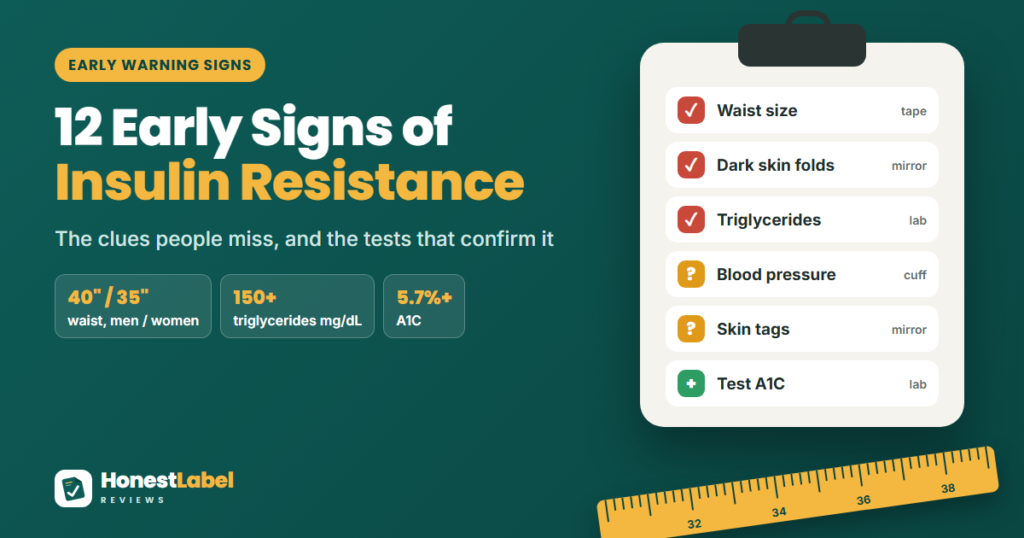
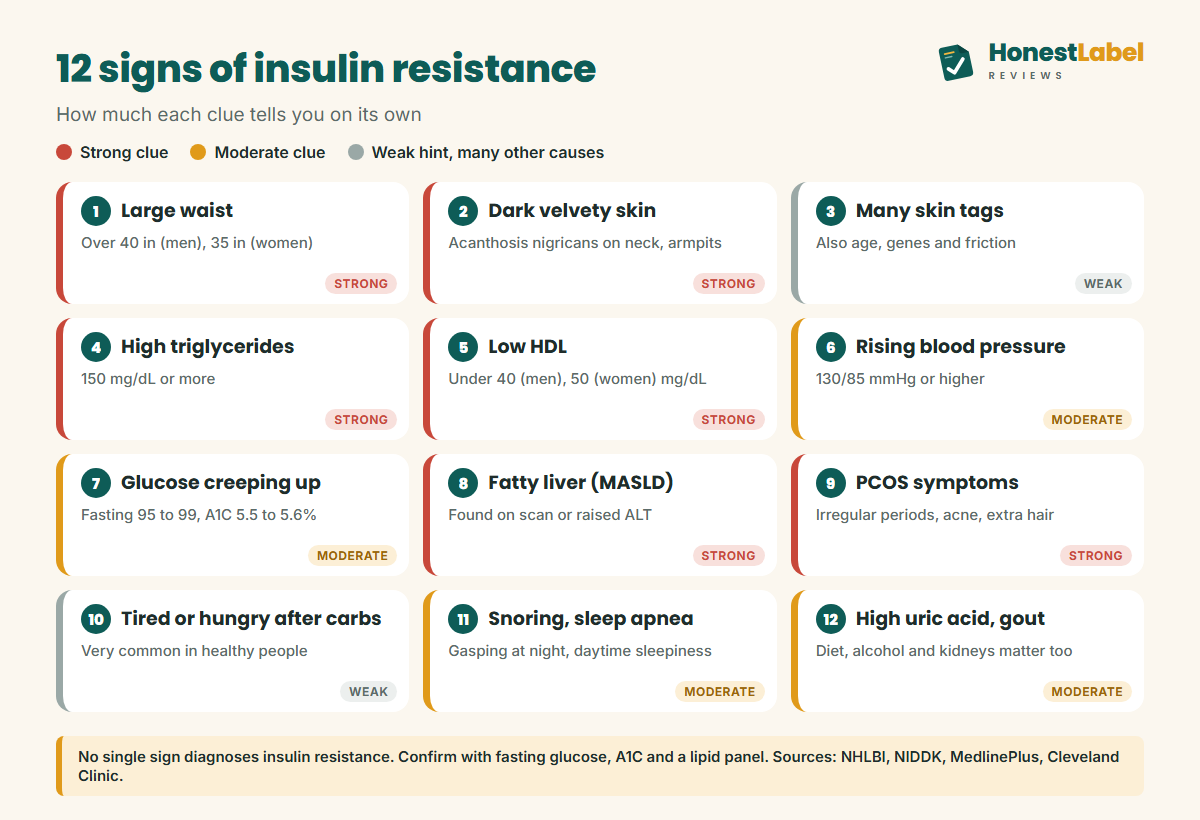
Early signs of insulin resistance include a waist over 40 inches (men) or 35 inches (women), dark velvety skin on the neck or armpits, skin tags, triglycerides over 150 mg/dL with low HDL, rising blood pressure and fatty liver. None proves it. A fasting glucose of 100 mg/dL or more or an A1C of 5.7% or more points to prediabetes.
Insulin resistance comes before prediabetes and type 2 diabetes, and it can run for years without symptoms. The extra insulin and the fat stored around your organs still leave small clues on your skin, your waistline and your routine blood work.
Below are 12 of those clues, with how strong each link is and what else could cause it. Our main guide has the full set of normal blood sugar ranges.
What insulin resistance is
Insulin moves glucose from your blood into muscle, liver and fat cells. With insulin resistance those cells respond weakly, so the pancreas releases more insulin to compensate. The NIH’s National Institute of Diabetes and Digestive and Kidney Diseases (NIDDK) names extra belly weight and physical inactivity as two of the main drivers, along with genetics, age, some medicines and hormone conditions. When the pancreas can no longer keep up, blood sugar starts to climb.
Most of the signs below come from the high insulin level or from the belly fat behind it. High blood sugar does not cause them, so they can show up years before a glucose test turns abnormal.
The 12 early signs of insulin resistance
1. A growing waistline
Fat stored deep in the belly, around the liver and intestines, is more closely tied to insulin resistance than fat on the hips or thighs. The NIH’s National Heart, Lung, and Blood Institute (NHLBI) uses a waist over 40 inches (102 cm) for men and over 35 inches (88 cm) for women as the cut-off for abdominal obesity, and notes that doctors may use different values depending on race and ethnicity. People of South Asian or East Asian background often develop insulin resistance at a smaller waist size.
Measure around your bare belly at the top of your hip bones, after breathing out normally. A waist that keeps growing while your weight barely changes is worth paying attention to.
2. Dark, velvety patches of skin (acanthosis nigricans)
This is the most specific sign you can see in a mirror. MedlinePlus describes acanthosis nigricans as dark, thick, velvety skin in body folds and creases, most often the back and sides of the neck, the armpits and the groin.
High insulin levels stimulate growth receptors in skin cells, which makes the skin thicken and darken. It does not wash off. In children and teens it is a strong reason to check blood sugar. Some medicines and, rarely, other conditions can cause it too, so a doctor should look at any new patch, especially one that appears suddenly.
3. Lots of skin tags
Skin tags are small, soft flaps of skin on the neck, armpits, eyelids or groin. One or two are common in almost everyone. A large number of them, especially together with darkened skin, has been linked to high insulin levels in small studies, and the Cleveland Clinic lists skin tags among the possible signs. Skin tags also run in families and become more common with age and friction, so on thier own they only hint at a problem.
4. High triglycerides
Triglycerides are the main type of fat in your blood. When insulin stops working well, the liver makes more of them. The NHLBI counts triglycerides consistently above 150 mg/dL as one of the five conditions of metabolic syndrome (NHLBI).
This is one of the most useful clues because most adults already have the number on a routine cholesterol test. Alot of people look only at LDL and miss it. Heavy drinking, an underactive thyroid and some medicines raise it too.
5. Low HDL cholesterol
HDL, the “good” cholesterol, tends to fall as triglycerides rise. The NHLBI threshold for metabolic syndrome is HDL under 40 mg/dL in men and under 50 mg/dL in women (NHLBI).
The two numbers together tell you more than either alone. In a study of 258 overweight adults, McLaughlin and colleagues (2003) found that a triglyceride to HDL ratio of about 3.0 or higher (both in mg/dL) picked out the insulin-resistant people reasonably well. Later research found the ratio works less well in some groups, including African American adults, who often have insulin resistance with normal triglycerides. Treat it as a screening hint that still needs a proper test.
6. Blood pressure that keeps creeping up
High insulin levels make the kidneys hold on to more salt and water, which pushes blood pressure up. The Cleveland Clinic lists 130/85 mmHg or higher as the blood pressure criterion for metabolic syndrome. Blood pressure has many other causes, so this sign matters most when it travels with a large waist and the lipid pattern above.
7. Fasting glucose or A1C at the top of “normal”
A fasting glucose of 95 to 99 mg/dL is still normal on paper, and so is an A1C of 5.5% or 5.6%. A number that edges up a little every year is the pattern to notice. Once fasting glucose reaches 100 to 125 mg/dL or A1C reaches 5.7% to 6.4%, the American Diabetes Association classes it as prediabetes.
Ask for copies of your old lab results and line them up. A trend over three or four years is often more noticable than any single value.
8. Fatty liver or a raised ALT
Fatty liver that is not caused by alcohol is now usually called metabolic dysfunction-associated steatotic liver disease (MASLD), formerly NAFLD. The NIDDK lists insulin resistance, type 2 diabetes, obesity and high blood fats among its main risk factors. Many people find out by accident, from an ultrasound done for something else or a slightly raised liver enzyme (ALT) on a routine blood test.
9. PCOS symptoms
Polycystic ovary syndrome, which is now also called polyendocrine metabolic ovarian syndrome (PMOS), is closely tied to insulin resistance. MedlinePlus explains that the name was changed because the condition affects many body systems. Signs include irregular or missed periods, acne, extra hair on the face or body, thinning scalp hair and trouble getting pregnant.
High insulin pushes the ovaries to make more androgens, which drives many of these symptoms, even in women at a normal weight.
10. Feeling tired, foggy or hungry soon after carb-heavy meals
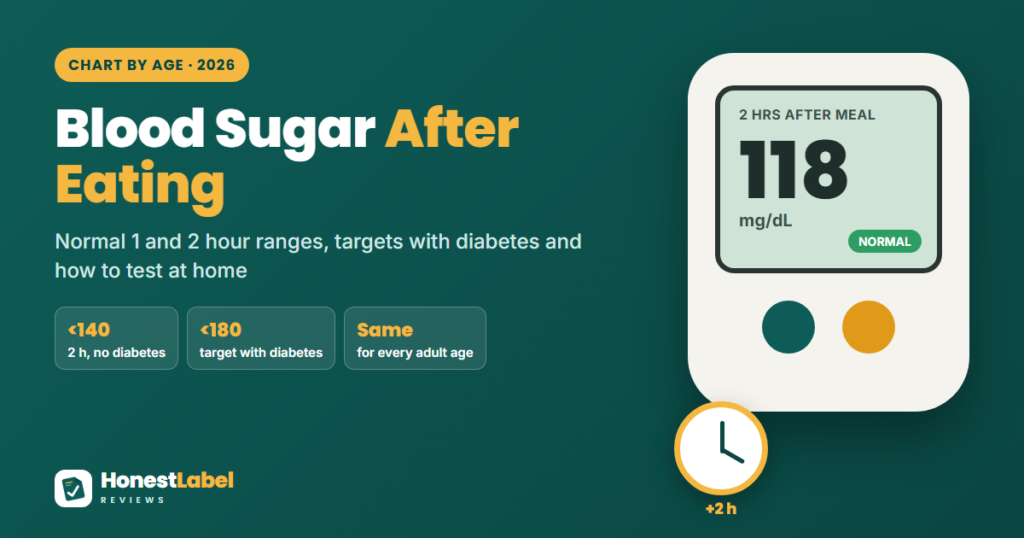
Many people with insulin resistance feel sleepy after a big pasta lunch or hungry again soon after a sweet breakfast. A large insulin release after a high-carb meal can bring blood sugar down quickly and trigger hunger. Our guide to blood sugar after eating explains what is normal at one and two hours.
This is the least specific sign on the list. Tiredness after meals is common in healthy people, and poor sleep, stress, anemia, thyroid problems and depression cause the same feelings. It is a reason to get tested and nothing more.
11. Loud snoring or sleep apnea
Obstructive sleep apnea and insulin resistance feed each other. Broken sleep raises stress hormones, and extra fat around the neck makes apnea more likely. MedlinePlus lists loud snoring, gasping during sleep and daytime sleepiness as common signs.
12. High uric acid or gout
Insulin makes the kidneys hold on to uric acid as well as salt, which is one reason gout is so often found alongside a large waist and high triglycerides. Gout causes sudden attacks of pain, swelling and redness, often in the big toe. Diet, alcohol, kidney function, genes and some diuretics also raise uric acid, so it only adds weight when other signs are present.
How many signs is “enough” to worry?
There is no official score. A useful rule of thumb comes from metabolic syndrome, the cluster that overlaps most with insulin resistance. The NHLBI diagnoses it when you have three or more of these five: a large waist, triglycerides of 150 mg/dL or more, low HDL, high blood pressure and a fasting glucose of 100 mg/dL or more (NHLBI). Three of those together make insulin resistance very likely, even if blood sugar is still normal.
The tests that actually confirm it
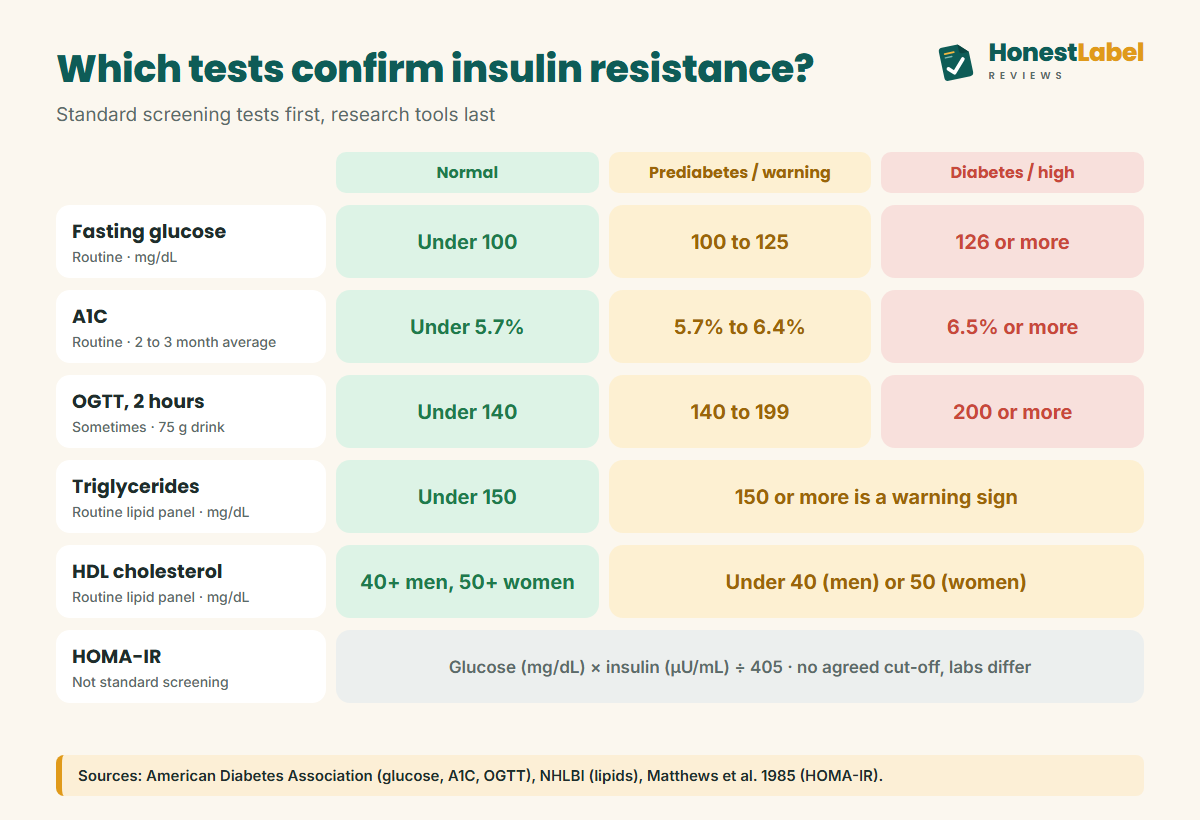
There is no single routine “insulin resistance test”. Doctors look at a few results together. The glucose and A1C cut-offs below come from the American Diabetes Association, and the lipid values from the NHLBI.
| Test | What it shows | Cut-offs | Used routinely? |
|---|---|---|---|
| Fasting plasma glucose | Blood sugar after 8+ hours without food | Under 100 normal; 100 to 125 prediabetes; 126 or more diabetes (mg/dL) | Yes |
| A1C | Average blood sugar over 2 to 3 months | Under 5.7% normal; 5.7% to 6.4% prediabetes; 6.5% or more diabetes | Yes |
| Oral glucose tolerance test (2 h) | How fast you clear a 75 g glucose drink | Under 140 normal; 140 to 199 prediabetes; 200 or more diabetes (mg/dL) | Sometimes |
| Lipid panel | Triglycerides and HDL | Triglycerides 150+ or HDL under 40 (men) / 50 (women) mg/dL are warning signs | Yes |
| Fasting insulin and HOMA-IR | How much insulin it takes to hold glucose steady | No agreed cut-off; labs and studies differ | No, not standard screening |
What about fasting insulin and HOMA-IR?
HOMA-IR combines fasting glucose and fasting insulin into one number. It was described by Matthews and colleagues in 1985. In US units it is fasting glucose (mg/dL) multiplied by fasting insulin (µU/mL), divided by 405. A higher number means more insulin resistance. Doctors rarely use it for routine screening, for three practical reasons:
- Insulin assays are not standardized, so the same sample can give different values at different labs.
- Studies in different countries and ethnic groups have used different thresholds, and none is agreed.
- A high result rarely changes the advice. The first-line treatment is the same lifestyle change either way.
It can still help in some cases, such as PCOS. If your doctor orders it, ask which reference range the lab uses.
What to do if the signs fit
Insulin resistance responds well to everyday changes. The strongest evidence comes from the Diabetes Prevention Program, a trial in more than 3,000 adults with prediabetes. Losing about 7% of body weight and doing around 150 minutes of brisk activity a week cut the risk of type 2 diabetes by 58% over about three years.
Practical steps to start with this week:
- Measure your waist and write it down, so you have a begining number to compare with in three months.
- Walk for 10 to 15 minutes after your largest meal.
- Add two short strength sessions a week. Muscle is the biggest place your body stores glucose.
- Cut sugary drinks first. Our list of foods that spike blood sugar covers the worst offenders and easy swaps.
- Protect your sleep, and ask about sleep apnea if you snore loudly.
Many people beleive they need a perfect diet to see results. The DPP changes were modest, and they truely held up over years. For more, see our guide on how to lower blood sugar naturally.
Who should be careful
Talk to your doctor before big changes to diet or exercise if any of these apply:
- You take insulin or a sulfonylurea (such as glipizide or glyburide). Fewer carbs or more exercise can push blood sugar below 70 mg/dL, so doses may need adjusting.
- You have kidney disease, which may limit protein or potassium.
- You have liver or heart disease and need to know what level of exercise is safe.
- You are pregnant. Targets and diet needs are different, and weight loss diets are not advised.
- You have a history of eating disorders, where strict food rules can do harm.
Some supplements can lower blood sugar on top of medication, so tell your doctor what you take.
When to see a doctor
The ADA recommends screening all adults from age 35, and earlier for adults who are overweight with other risk factors (ADA). Book an appointment sooner if you:
- Notice new dark, velvety patches of skin, especially if they appeared quickly
- Have three or more of the metabolic syndrome signs
- Have PCOS symptoms, a family history of type 2 diabetes or past gestational diabetes
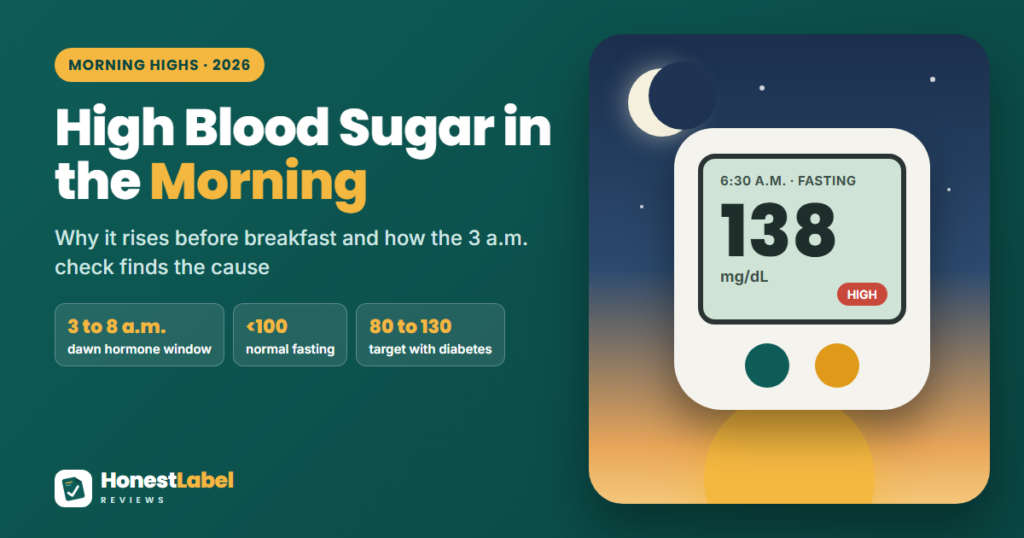
- Get a fasting home reading of 100 mg/dL or higher on more than one morning
- Have been told you have fatty liver or raised liver enzymes
See a doctor promptly for constant thirst, frequent urination, blurry vision or weight loss you cannot explain, which point to blood sugar that is already high. Get urgent care for vomiting, confusion or deep fast breathing together with high blood sugar.
Frequently asked questions
Can you have insulin resistance with normal blood sugar?
Yes, and it is common. Early on, the pancreas makes enough extra insulin to keep glucose and A1C normal for years. A large waist, high triglycerides, low HDL and acanthosis nigricans are often the only clues at that point.
Can thin people have insulin resistance?
Yes. Some people store fat in the belly and liver while looking slim, and it is common in lean women with PCOS. Only a blood test can tell.
Is insulin resistance reversible?
It often improves a lot with weight loss, regular activity, better sleep and fewer refined carbs. In the Diabetes Prevention Program, lifestyle change cut the risk of progressing to diabetes by 58% (DPP, 2002). How far it reverses depends on genetics, age and how long it has been present.
Do I need a fasting insulin test?
Most people do not. Fasting glucose, A1C and a lipid panel are enough for most adults, and the advice is usually the same either way.
The bottom line
A bigger waist, dark skin folds, high triglycerides with low HDL, rising blood pressure, fatty liver and PCOS symptoms can all appear before blood sugar rises. None of them is a diagnosis. A fasting glucose, A1C and lipid panel will tell you where you stand, and modest lifestyle changes have strong evidence behind them.
Sources
- American Diabetes Association. Diagnosis.
- National Institute of Diabetes and Digestive and Kidney Diseases (NIH). Insulin Resistance & Prediabetes; Nonalcoholic Fatty Liver Disease (MASLD).
- National Heart, Lung, and Blood Institute (NIH). Metabolic Syndrome: Diagnosis.
- MedlinePlus (US National Library of Medicine). Acanthosis nigricans; Polyendocrine metabolic ovarian syndrome; Sleep Apnea.
- Cleveland Clinic. Insulin Resistance; Metabolic Syndrome.
- Diabetes Prevention Program Research Group. Reduction in the incidence of type 2 diabetes with lifestyle intervention or metformin. New England Journal of Medicine, 2002.
- Matthews DR, et al. Homeostasis model assessment: insulin resistance and beta-cell function from fasting plasma glucose and insulin concentrations in man. Diabetologia, 1985. PubMed.
- McLaughlin T, et al. Use of metabolic markers to identify overweight individuals who are insulin resistant. Annals of Internal Medicine, 2003. PubMed.
Medical disclaimer: This article is for general information and is not medical advice. It does not replace a diagnosis or treatment from your doctor. If you have diabetes or take medication that affects blood sugar, talk to your healthcare provider before changing your diet, exercise or supplements.