Last reviewed: November 2026 · Sources: American Diabetes Association, Mayo Clinic, NIH (NIDDK, MedlinePlus), CDC and peer-reviewed studies (listed at the end)
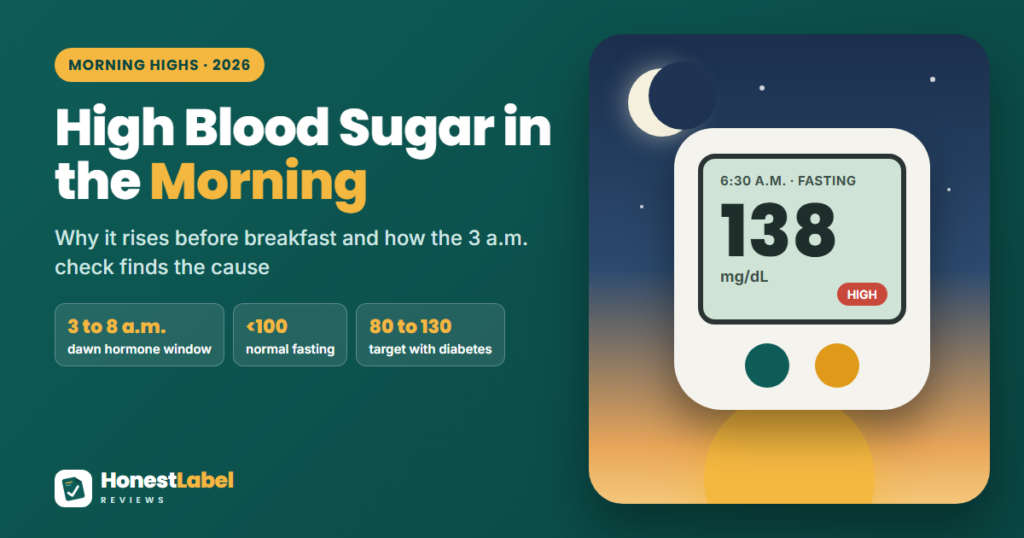
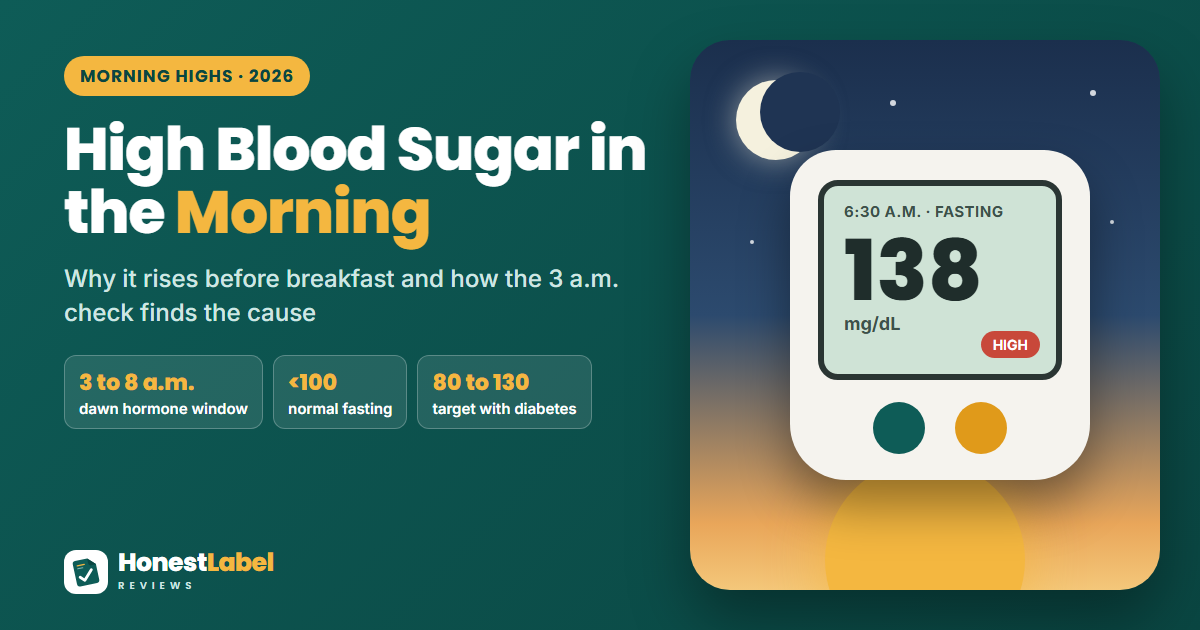
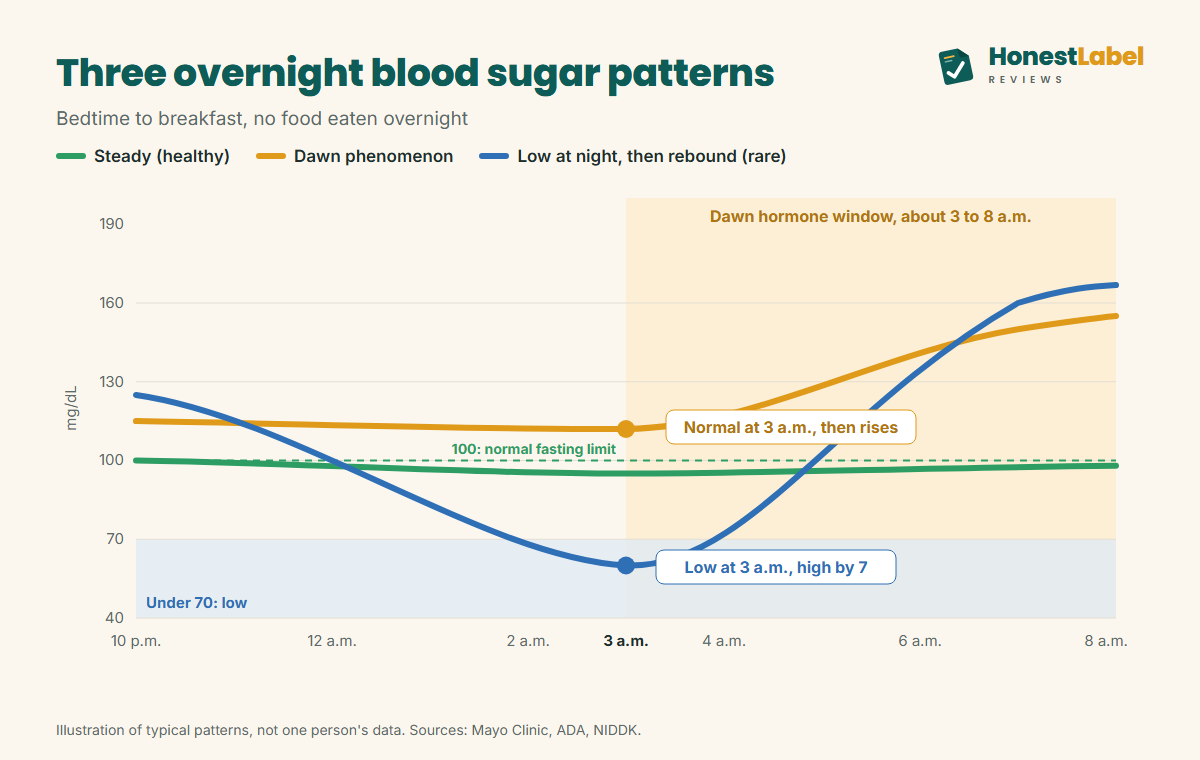
Blood sugar is often higher in the morning without eating because of the dawn phenomenon: between roughly 3 a.m. and 8 a.m. your body releases cortisol, growth hormone and other hormones that tell the liver to make glucose. Late or heavy dinners, medication that wears off overnight, poor sleep and stress can add to it.
It feels backwards: ten hours without food, yet the meter reads higher at 7 a.m. than at bedtime. Your liver keeps making glucose all night, and in the early morning it gets a push to make more.
If you need a refresher on normal blood sugar ranges, our main guide has the full chart. This page covers each cause of a morning high and the 3 a.m. check that tells them apart.
What counts as high blood sugar in the morning?
A morning reading before breakfast is your fasting blood sugar. The American Diabetes Association uses these cut-offs for a lab fasting test after at least 8 hours without food:
| Fasting reading | Without diabetes | With diabetes (most adults) |
|---|---|---|
| Under 100 mg/dL | Normal | In target if 80 or higher |
| 100 to 125 mg/dL | Prediabetes range | In target up to 130 |
| 126 mg/dL or higher | Diabetes range if confirmed on a second test | Above target from 131 |
For people who already have diabetes, the ADA’s usual target before meals is 80 to 130 mg/dL, though your doctor may set a different one. A single home reading is not a diagnosis. The CDC notes that diabetes is confirmed with lab tests, and home meters have a margin of error.
Why does blood sugar rise overnight without food?
Your brain needs glucose all night, so the liver releases a steady trickle of it while you sleep. Insulin keeps that trickle in balance. Toward morning, the body starts preparing you to wake up, and the balance shifts. Five things can push the morning number up, and some people have more than one.
1. The dawn phenomenon
This is the most common cause. The Mayo Clinic describes it as an early-morning rise in blood sugar driven by a natural release of hormones, including cortisol and growth hormone, that make the liver put out more glucose and make the body less responsive to insulin.
Everyone gets this hormone surge. In a healthy body the pancreas simply releases a bit more insulin and the fasting number stays under 100. With insulin resistance or diabetes, the extra insulin is not there or does not work as well, so the reading climbs.
In a French study of 248 people with type 2 diabetes who were not using insulin, about half had a clear dawn rise on continuous glucose monitoring, and in those people it added roughly 0.4 percentage points to their A1C (Monnier et al., 2013).
2. The Somogyi effect (rebound after a night-time low)
The Somogyi effect is the idea that blood sugar drops too low during the night, the body fires off stress hormones to fix it, and the rebound leaves you high by morning. It is named after the chemist Michael Somogyi, who described it in the mid-1900s.
The evidence for it is weak, and many specialists now think it is rare. Studies using continuous glucose monitors in people with type 1 diabetes have found that nights with a low were usually followed by lower fasting readings, not higher ones (Høi-Hansen et al., 2005). A rebound may still happen in some people, but it is truely uncommon, and it is mostly a concern for people who take insulin or a sulfonylurea.
The reason it still matters is safety. If your morning high comes after a night-time low, the answer is to prevent the low, which often means less evening medication. Taking more insulin to fix the morning number would make the low worse. That is why doctors want proof before they change anything, and why the 3 a.m. check below is so useful.
The NIDDK lists clues that you may be going low at night: nightmares or crying out in your sleep, sweating enough to dampen your pajamas or sheets, and waking up tired, irritable or confused. A morning headache is another common sign.
3. A late or heavy dinner
Your morning number partly reflects what happened the evening before. A big carb-heavy dinner at 9 p.m., or a bowl of cereal at 11 p.m., can keep blood sugar high for much of the night. Meals heavy in fat, such as pizza or a creamy pasta, digest slowly, so the glucose from them can keep arriving hours later.
Timing on its own seems to matter too. In a small crossover trial, 20 healthy adults ate the same dinner at 6 p.m. on one occasion and at 10 p.m. on another. The late dinner led to higher blood sugar after the meal (Gu et al., 2020). The study was short and in people without diabetes, so treat it as a hint.
If your bedtime reading is already high, the problem probably started at dinner, not at dawn. Our guide to normal blood sugar after eating shows what your evening readings should look like.
4. Medication timing
For people who take diabetes medication, the most common fixable cause is a dose that does not last the whole night. Some examples:
- An evening long-acting insulin that runs out before morning, or one taken late or skipped
- Intermediate-acting (NPH) insulin, which peaks and then fades during the night
- Evening tablets taken at a different time each day
- Insulin that has lost strength because it got too warm or is past its use-by date
Never change a dose or move it to a different time on your own. Bring your readings to your doctor or diabetes educator. They may move the dose, switch to a longer-acting insulin, or change pump settings to accomodate the early-morning rise.
Other medicines matter too. Steroids such as prednisone, especially when taken in the morning, can raise blood sugar later in the day and into the next morning.
5. Poor sleep, sleep apnea and stress
Short sleep shows up on the meter. In a small study of 9 healthy adults, a single night of about four hours’ sleep made them measurably more insulin resistant the following day (Donga et al., 2010). If you slept badly, a higher reading the next morning is no surprise.
Sleep apnea deserves its own mention. Each pause in breathing triggers a burst of stress hormones, and in moderate or severe apnea the pauses happen many times an hour. Loud snoring, gasping at night, morning headaches and daytime sleepiness are the usual signs. MedlinePlus explains how it is tested and treated.
Stress works the same way. A difficult week, worry about a deadline tommorow, pain or an infection all raise cortisol, and cortisol raises blood sugar. Illness is a big one: a cold or flu can push morning readings up for several days. A noisy or overheated bedroom enviroment that keeps waking you can add to it.
The 3 a.m. check: how to find your cause
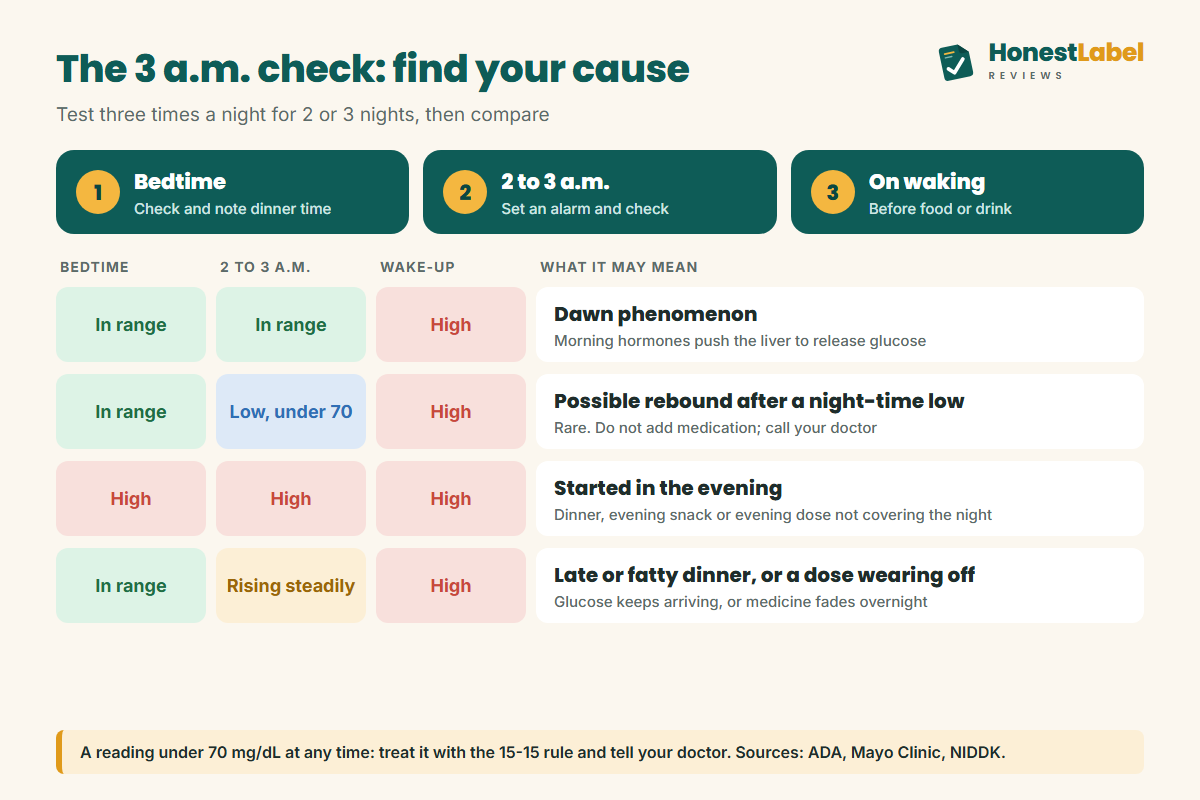
Because the dawn phenomenon and a night-time low can both end in a high morning reading, the only way to tell them apart is to look at what happens in the middle of the night.
- Check your blood sugar at bedtime and write it down.
- Set an alarm for between 2 a.m. and 3 a.m. and check again.
- Check as soon as you wake up, before eating or drinking anything but water.
- Note what you ate for dinner and when, any evening snack, your medication times and how you slept.
- Repeat for two or three nights, ideally on ordinary days.
A continuous glucose monitor makes this much easier, because it records the whole night without waking you. The ADA’s guide to checking your blood glucose covers both options.
How to read your results
| Bedtime | 2 to 3 a.m. | Wake-up | What it may mean |
|---|---|---|---|
| In range | In range | High | Dawn phenomenon |
| In range | Low (under 70) | High | Possible rebound after a night-time low |
| High | High | High | Dinner, evening snack or evening dose not covering the night |
| In range | Rising steadily | High | Late or fatty dinner, or a dose wearing off |
Treat this table as a starting point for a conversation with your doctor, not a diagnosis. It’s not wierd to see a different pattern on different nights. Any reading under 70 mg/dL at 3 a.m. should be treated straight away with the ADA’s 15-15 rule and reported to your doctor.
What can help lower morning blood sugar
What works depends on the cause, which is why the 3 a.m. check comes first. These changes are reasonable for most people and are worth testing one at a time, so you can see what each one does:
- Eat dinner earlier and lighter on carbs. Finishing a few hours before bed and building the plate around vegetables and protein gives your body time to clear the glucose before the dawn surge starts.
- Walk after dinner. Even a short, easy walk after the evening meal lowers the after-meal rise in studies. Our guide on how to lower blood sugar naturally covers the research.
- Rethink the late-night snack. If you need one, a small protein snack is a better bet than cereal, crackers or fruit juice. If you take insulin, ask your doctor first, since some people are told to have a bedtime snack to avoid lows.
- Protect your sleep. Keep a regular bedtime and get checked for sleep apnea if you snore loudly.
- Eat breakfast. Many people see their number settle after a balanced breakfast. If yours keeps climbing through the morning, note it in your log for your doctor.
If you have diabetes and your mornings stay high despite these steps, the fix is usually a medication change, and that is something to decide with your doctor. The evidence for most lifestyle steps against the dawn phenomenon specifically is limited. Most studies look at overall blood sugar, so expect a modest effect and track it.
Safety notes
- Insulin and sulfonylureas. These can cause lows at night. Do not take extra medication to fix a morning high until a 3 a.m. check rules out a night-time low.
- Diet changes on medication. Cutting evening carbs while keeping the same dose can push you too low. Check more often and tell your doctor.
- Alcohol at night. Alcohol can lower blood sugar for hours while the liver processes it, which raises the risk of a night-time low if you take insulin or sulfonylureas.
- Pregnancy. Fasting targets in pregnancy are tighter, so any morning high should go straight to your care team.
When to call a doctor
Call your doctor or book an appointment if:
- You do not have diabetes and your fasting readings are 100 mg/dL or higher on several mornings
- You get a fasting reading of 126 mg/dL or higher more than once
- You have diabetes and your morning readings are above your target on most days for a week or two
- Your 3 a.m. check shows a reading under 70 mg/dL
- You wake with headaches, damp sheets or nightmares and suspect night-time lows
- You snore loudly, stop breathing in your sleep or feel exhausted every day
Get urgent help if your blood sugar is very high and you have vomiting, stomach pain, confusion, fast deep breathing or a fruity smell on your breath. The ADA advises people with type 1 diabetes to check for ketones when blood sugar is above 240 mg/dL. It is neccessary to act fast on high ketones, because they can lead to diabetic ketoacidosis.
If your fasting numbers are creeping up and you are not sure why, the early signs are worth knowing. Our guide to the signs of insulin resistance covers the ones most people miss.
Frequently asked questions
Why is my blood sugar higher in the morning than at night?
Usually because of the dawn phenomenon. Hormones released in the early morning tell the liver to make more glucose and make your body less sensitive to insulin. If your insulin response is weak, the number rises before you have eaten anything.
Can you have the dawn phenomenon without diabetes?
Everyone has the early-morning hormone surge. In healthy people the pancreas releases extra insulin, so the fasting reading stays under 100 mg/dL. A fasting number that keeps sitting above 100 without diabetes is worth a lab test, because it can be an early sign of insulin resistance.
How do I know if it is the dawn phenomenon or the Somogyi effect?
Check your blood sugar at bedtime, at 2 to 3 a.m. and on waking for a few nights. A normal or rising reading at 3 a.m. points to the dawn phenomenon. A low reading at 3 a.m. followed by a high morning reading may point to a rebound, which is rare and needs your doctor’s input.
Does drinking water lower morning blood sugar?
Water does not lower blood sugar directly, but dehydration can make readings a little higher because the glucose is more concentrated. Drinking a glass of water in the morning is sensible. It will not fix a true dawn rise.
Is 130 fasting blood sugar in the morning bad?
Without diabetes, 130 mg/dL is above the 126 mg/dL diabetes cut-off and needs a repeat lab test. With diabetes, 130 is at the top of the ADA’s usual 80 to 130 target, so it is acceptable for many adults.
The bottom line
A high blood sugar in the morning without eating is usually the dawn phenomenon, the early-morning hormone surge that a healthy pancreas covers and an insulin-resistant body cannot. Late meals, medication that fades overnight, poor sleep and stress can push it higher. The Somogyi rebound is rare and debated, but it is the reason not to raise medication before checking. A few nights of bedtime, 3 a.m. and wake-up readings usually show which cause fits, and that log is the most useful thing you can take to your doctor.
Sources
- American Diabetes Association. Diagnosis; Checking Your Blood Glucose; Hypoglycemia (Low Blood Glucose); Hyperglycemia (High Blood Glucose).
- Mayo Clinic. Dawn phenomenon: What can you do?
- National Institute of Diabetes and Digestive and Kidney Diseases (NIH). Low Blood Glucose (Hypoglycemia).
- MedlinePlus (US National Library of Medicine). Sleep Apnea.
- Centers for Disease Control and Prevention. Diabetes Testing.
- Monnier L, et al. Magnitude of the dawn phenomenon and its impact on the overall glucose exposure in type 2 diabetes: is this of concern? Diabetes Care, 2013. PubMed.
- Høi-Hansen T, et al. Do nocturnal hypoglycaemic episodes cause morning hyperglycaemia? Diabetes Research and Clinical Practice, 2005. PubMed.
- Gu C, et al. Metabolic effects of late dinner in healthy volunteers: a randomized crossover clinical trial. Journal of Clinical Endocrinology & Metabolism, 2020. PubMed.
- Donga E, et al. A single night of partial sleep deprivation induces insulin resistance in multiple metabolic pathways in healthy subjects. Journal of Clinical Endocrinology & Metabolism, 2010. PubMed.
Medical disclaimer: This article is for general information and is not medical advice. It does not replace a diagnosis or treatment from your doctor. If you have diabetes or take medication that affects blood sugar, talk to your healthcare provider before changing your diet, exercise or supplements.