Last reviewed: November 2026 · Sources: American Diabetes Association, CDC, NIH (NIDDK, MedlinePlus) and peer-reviewed studies (listed at the end)
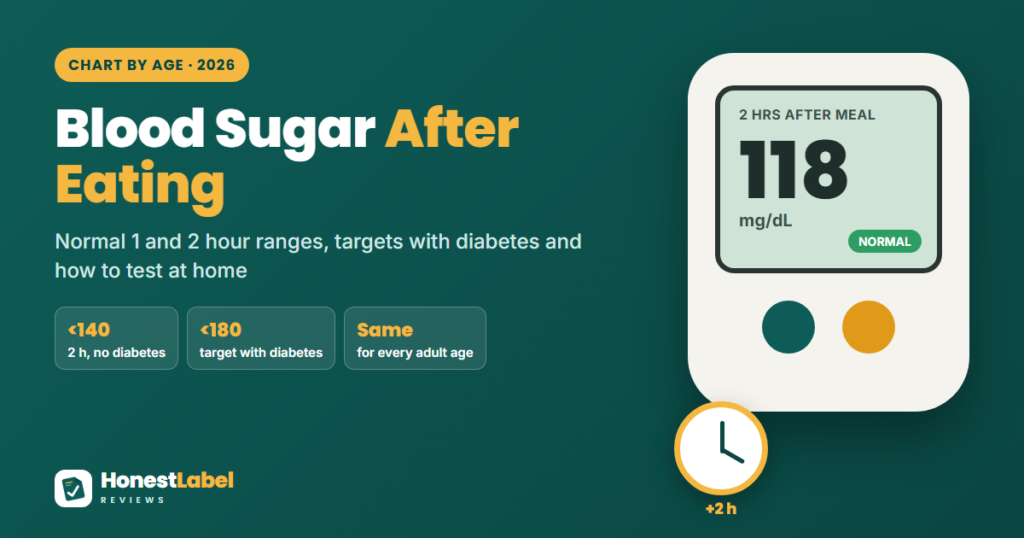
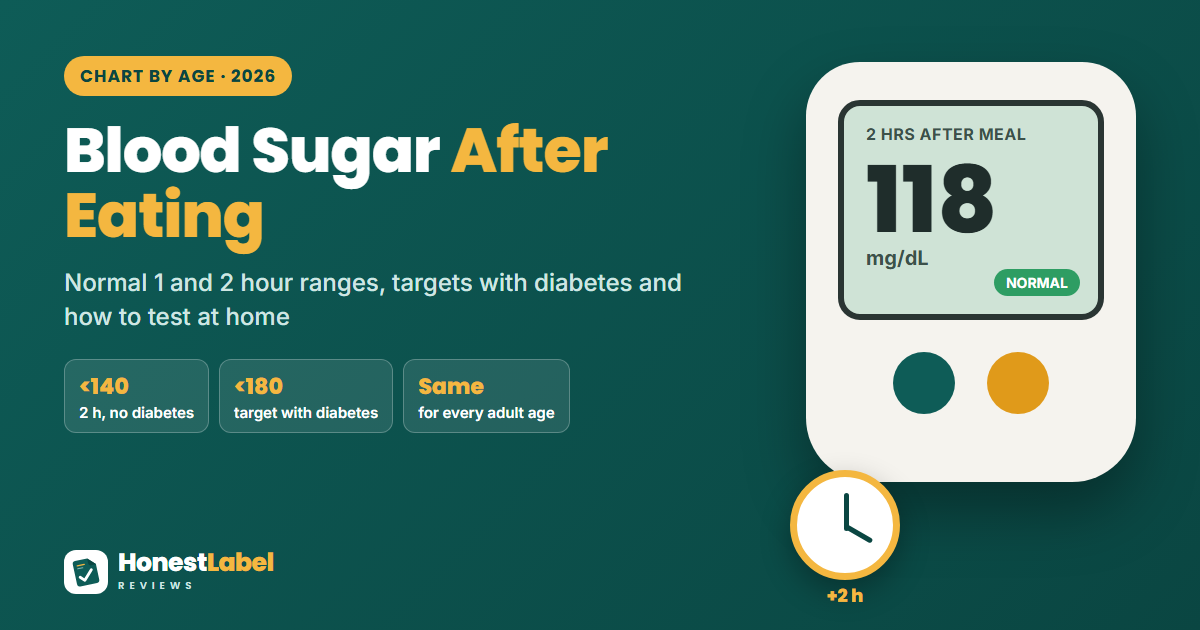
For adults without diabetes, a normal blood sugar level after eating is under 140 mg/dL two hours after the meal starts. It usually peaks within the first hour, then falls. If you have diabetes, the ADA target for most adults is under 180 mg/dL one to two hours after eating. The limits are the same at any adult age.
Doctors call this reading postprandial glucose. Many people with early insulin resistance have a normal fasting number but a slow, high curve after meals. Our main guide lists all the normal blood sugar ranges for fasting, A1C and lows. This page covers the after-meal numbers in more depth.
Normal blood sugar after eating: the quick chart
The cut-offs below come from the American Diabetes Association diagnosis criteria and the ADA’s targets for people who check their blood sugar. Numbers are in mg/dL. To get mmol/L, divide by 18.
| Who | 1 hour after eating | 2 hours after eating |
|---|---|---|
| Adult without diabetes | No official cut-off | Under 140 (7.8 mmol/L) |
| Prediabetes range (2 h glucose test) | 155 or higher is linked to higher risk (IDF proposal) | 140 to 199 |
| Diabetes range (2 h glucose test) | IDF proposes 209 or higher | 200 or higher (11.1 mmol/L) |
| Target for most adults with diabetes | Under 180 | Under 180 |
| Target in pregnancy with diabetes | Under 140 | Under 120 |
The diagnostic numbers come from the oral glucose tolerance test (OGTT), where you drink 75 grams of glucose. Ordinary meals vary too much to diagnose anything, so treat home readings after food as a guide and expect your doctor to want a lab test.
What happens to blood sugar in the two hours after a meal
Once food reaches your small intestine, glucose moves into the blood and the number starts to climb. A healthy pancreas answers with a quick burst of insulin and then a steadier stream. Muscle and liver take up the glucose, the level peaks, and then it drifts back toward where it started.
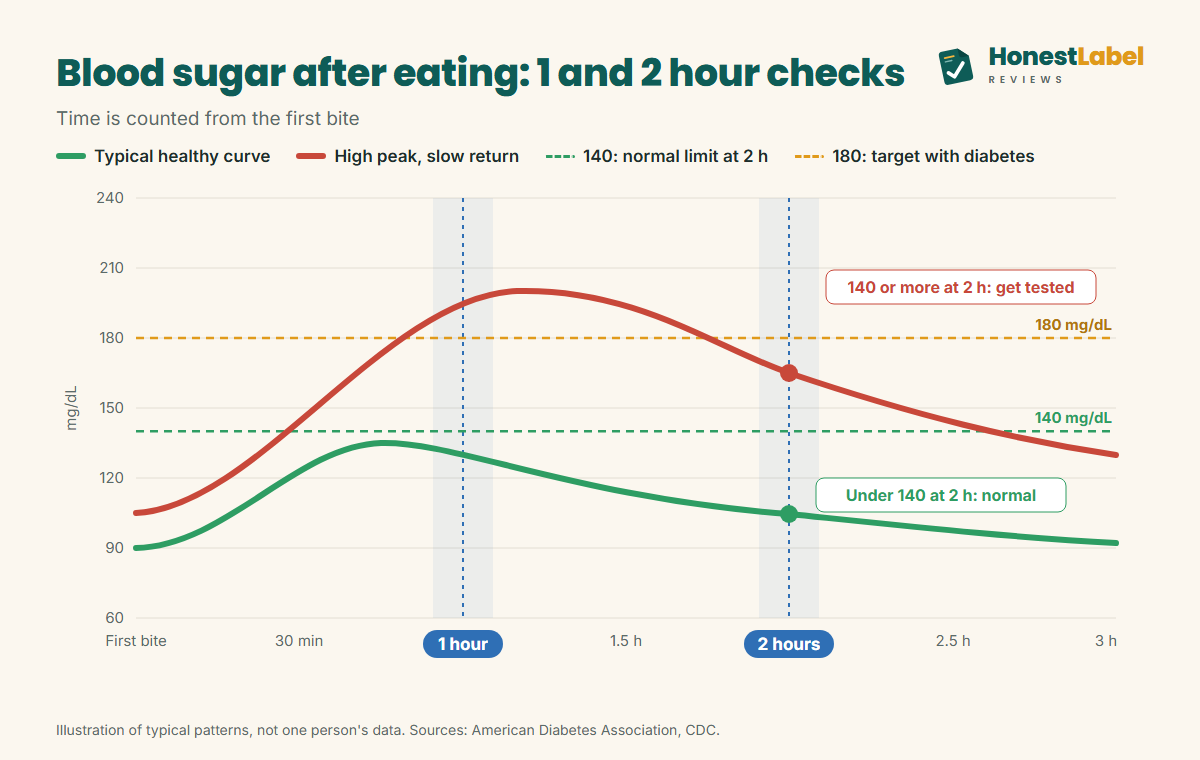
Continuous glucose monitors (CGMs) show how tightly a healthy body holds this range. In a study of 153 healthy volunteers without diabetes who wore a CGM for up to 10 days, average glucose was about 99 mg/dL and readings stayed between 70 and 140 mg/dL for roughly 96 percent of the day (Shah et al., 2019). Short trips above 140 do happen after big carb-heavy meals.
Blood sugar 1 hour after eating
There is no official “normal” number at one hour, wich surprises alot of people. The ADA uses the 2-hour value for diagnosis, and the 1-hour peak varies a lot with the meal. A large bowl of white rice or a soda pushes it higher than eggs and vegetables.
The 1-hour number is getting more attention, though. Several research groups have found that a value of 155 mg/dL or higher one hour into an OGTT predicts later type 2 diabetes, even when the 2-hour number is normal. In 2024 the International Diabetes Federation proposed using 155 mg/dL as a sign of intermediate hyperglycemia and 209 mg/dL as a sign of type 2 diabetes (Bergman et al., 2024). The ADA has not adopted them, and they apply to a lab glucose drink, not a meal.
Blood sugar 2 hours after eating
This is the number most doctors ask about. Under 140 mg/dL two hours after you start eating is normal. Home readings of 140 to 199 at two hours, seen more than once, are worth mentioning to your doctor. A reading of 200 mg/dL or higher at any time, especially with thirst or frequent urination, needs a proper test soon. Start the clock at the first bite. If you start it when you finish a long dinner, you test late and may see a falsely reassuring number.
Does normal blood sugar after eating change with age?
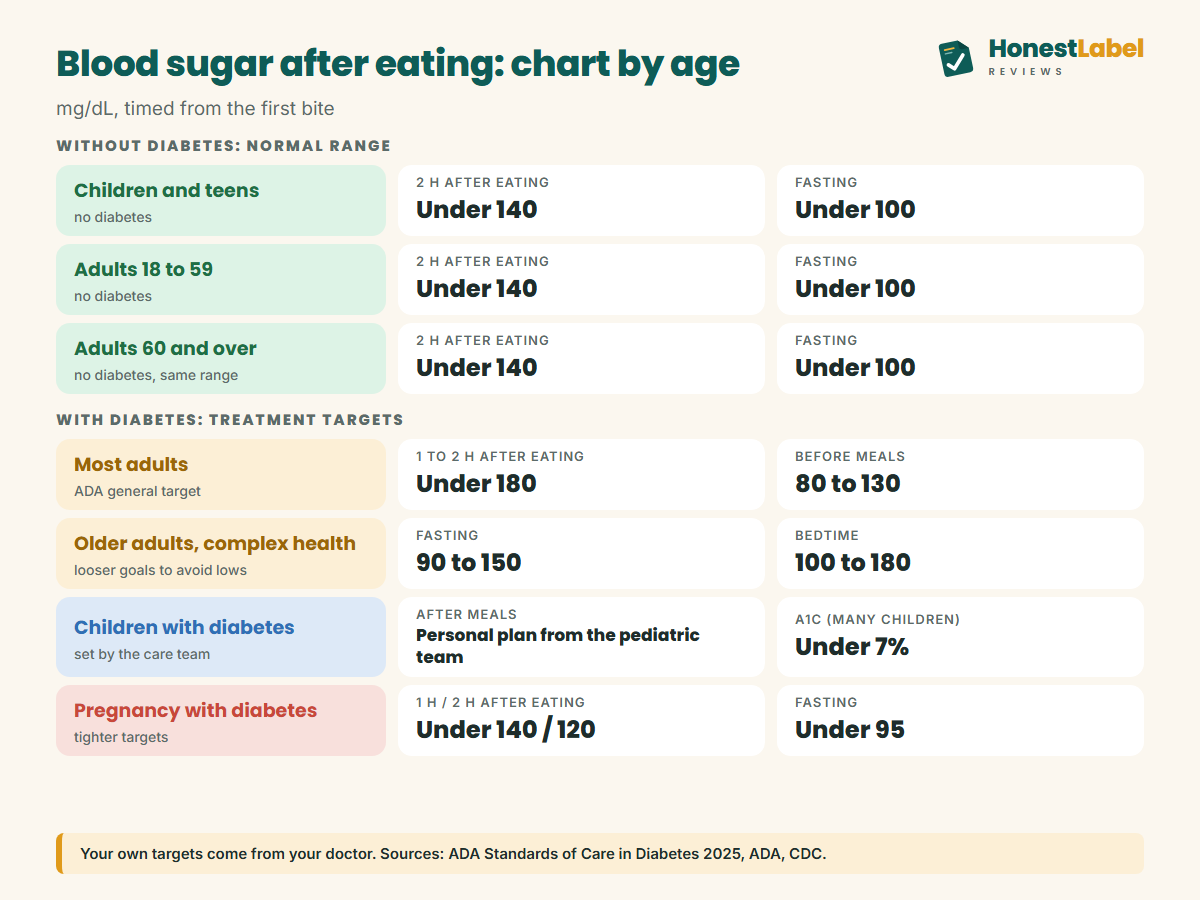
For people without diabetes, no. The CDC and the ADA use the same cut-offs for every adult: under 140 mg/dL two hours after eating and under 100 mg/dL fasting. There is no separate “normal” chart for 40-year-olds and 70-year-olds.
Age still shows up in real readings. Insulin sensitivity tends to fall with age, partly from muscle loss and less activity, and in the CGM study above average readings ran slightly higher in older participants. So a 70-year-old may see a slower curve than a 25-year-old after the same meal. That is common, but a 2-hour reading of 170 is still above normal at any age and is a reason to get tested. Age changes the numbers only once someone has diabetes.
Older adults with diabetes
The ADA Standards of Care recommend looser goals for many older adults, because a low can cause a fall, confusion or a heart rhythm problem. The guidance groups people by overall health rather than by birthday:
- Healthy older adults with few other conditions usually keep standard goals, such as an A1C under 7.0 to 7.5% and a fasting range of 80 to 130 mg/dL.
- Those with several chronic conditions or mild memory problems are often given an A1C goal under 8.0%, a fasting goal of 90 to 150 mg/dL and a bedtime goal of 100 to 180 mg/dL.
- People in very poor health may get even looser goals, where avoiding lows and high-sugar symptoms is the main aim.
The standards do not give older adults a separate after-meal number, so the general under 180 mg/dL target is usually the starting point, adjusted by the doctor.
Children and teens
A healthy child’s blood sugar after eating follows the same pattern as an adult’s and normally stays under 140 mg/dL at two hours. Children with diabetes are different. Thier targets are set by the pediatric diabetes team and depend on age, type of diabetes, how often they have lows and whether they use a CGM or pump. The ADA Standards of Care suggest an A1C under 7% for many children with type 1 diabetes, but day-to-day after-meal goals should come from the child’s own care plan, never from a chart online.
Blood sugar after eating in pregnancy
Hormones from the placenta make a pregnant woman more insulin resistant as the weeks go on, which is why gestational diabetes usually appears in the second half. Most women are screened between 24 and 28 weeks, according to the NIDDK.
For women who have gestational diabetes or diabetes from before pregnancy, the targets in the ADA Standards of Care are tighter than usual:
- Fasting: under 95 mg/dL
- 1 hour after a meal: under 140 mg/dL
- 2 hours after a meal: under 120 mg/dL
Your care team will say which after-meal check to use. These targets apply only after a diagnosis; otherwise follow your prenatal screening schedule. MedlinePlus explains the screening tests.
What makes a blood sugar reading high after eating?
Before worrying about one high number, check the usual suspects. Some come from the meal and some from your body that day.
- Fast carbs with nothing to slow them. White bread, white rice, potatoes, sweets and juice turn into glucose quickly. Our guide to foods that spike blood sugar lists the worst offenders and easy swaps.
- Portion size. Two cups of pasta raise blood sugar much more than one.
- Very fatty meals. Fat slows the stomach. Pizza can give a lower 1-hour reading but a higher reading at 2 or 3 hours, because the sugar arrives late.
- Stress and illness. Cortisol and adrenaline make the liver release extra glucose, so the same meal reads higher when you have a cold.
- Poor sleep. Even one short night can leave the body less sensitive to insulin the next day.
- Medications. Steroids such as prednisone are the best-known cause. Some diuretics and antipsychotics can raise readings too.
The test itself can also mislead you. Sugar left on your fingers from the meal can push a finger-prick reading up sharply, so wash your hands first. Meters also have an allowed error. Under the ISO 15197:2013 standard most meters are tested against, 95 percent of readings must fall within 15 mg/dL of the lab value below 100 mg/dL, or within 15 percent above that (Freckmann et al.). A reading of 150 could really be anywhere from about 128 to 172.
If a high reading occured right after a big holiday meal, it is nothing to lose sleep over. If most of your 2-hour readings sit above 140 on ordinary meals, it is time for a proper test.
How to test your blood sugar after eating at home
A basic finger-prick meter from a pharmacy is enough, and the Mayo Clinic’s testing guide covers the device basics. This is the routine we suggest:
- Wash and dry your hands with soap and warm water.
- Test before you eat so you have a starting number.
- Note the time of your first bite and set a phone timer for 1 hour, 2 hours or both.
- Prick the side of your fingertip, which hurts less than the pad.
- Write down the reading and what you ate, including drinks and roughly how much.
- Repeat with different meals over a week or two, because one test of one meal tells you very little.
With a CGM, look at the shape of the curve. A peak that is back near baseline within two to three hours is the healthy pattern. A peak that stays up for three hours or more, meal after meal, is worth showing your doctor. The CDC is clear that a diagnosis needs a lab test such as fasting glucose, A1C or an OGTT.
How to bring after-meal readings down
Small changes to how you eat can make a noticable difference, often within days. Our guide on how to lower blood sugar naturally covers the research in depth. These act most directly on the spike:
- Walk for 10 to 15 minutes soon after eating. A review of seven small studies found that even 2 to 5 minutes of light walking after a meal lowered the glucose rise compared with sitting (Buffey et al., 2022).
- Eat vegetables and protein first and the starchy food last.
- Swap juice and soda for water or unsweetened drinks.
- Pick whole grains, beans and lentils over white bread and white rice, and keep starches to about a quarter of the plate.
The walking evidence comes from short lab trials, so the size of the effect at home will vary. Test before and after a change to see what it does for you.
Safety: who should be careful
- People on insulin or sulfonylureas (such as glipizide or glyburide). Cutting carbs or adding walks lowers blood sugar and can tip you into a low, sometimes a few hours after a meal. Treat a reading under 70 mg/dL with the ADA’s 15-15 rule: 15 grams of fast sugar, then check again after 15 minutes. Ask your doctor before changing any dose.
- Pregnant women. Do not cut carbs hard on your own. Your care team or dietitian should set the plan.
- People with kidney disease. High-protein swaps do not suit everyone with reduced kidney function, so check protein amounts with your doctor.
- People with heart disease, foot ulcers or nerve damage. Walking is usually fine, but ask what activity level suits you and check your feet daily.
When to see a doctor
Make an appointment if:
- Your readings two hours after ordinary meals are regularly 140 mg/dL or higher
- You get any reading of 200 mg/dL or higher
- You have constant thirst, frequent urination, blurry vision or unexplained weight loss
- You have diabetes and most of your after-meal readings are above 180 mg/dL
- You get shaky, sweaty or confused two to four hours after meals, which can be a low
- You are pregnant and your readings are above the targets your team gave you
Get urgent care for very high readings with vomiting, confusion or fast deep breathing. At a routine visit, ask for a fasting glucose, A1C or glucose tolerance test, since these give a far clearer picture than home readings. If your numbers are also high first thing in the morning, our guide on why blood sugar is high in the morning explains the usual causes.
Frequently asked questions
Is 160 blood sugar after eating normal?
At one hour, 160 mg/dL can happen in healthy people after a large carb-heavy meal. At two hours it is above the normal cut-off of 140. If you see it more than once, ask your doctor for a proper test.
What should blood sugar be 2 hours after eating for a non-diabetic?
Under 140 mg/dL, according to the ADA. In healthy people it is often back close to the pre-meal level by then.
What is a normal blood sugar after eating for a 60-year-old?
The same as for any adult without diabetes: under 140 mg/dL two hours after eating. Readings may run a little higher with age, but the normal range does not change. Older adults with diabetes may be given looser targets by their doctor.
Is it better to check blood sugar 1 hour or 2 hours after eating?
The 2-hour reading is the standard one and matches the diagnostic cut-offs. The 1-hour reading catches the peak, so it shows which foods give you the biggest spikes. In pregnancy, your care team will tell you which to use.
The bottom line
A normal blood sugar level after eating is under 140 mg/dL two hours after the first bite, at 30 or at 70. Most adults with diabetes aim for under 180 mg/dL. Older adults, children and pregnant women with diabetes have their own targets. Test with clean hands, start the clock at the first bite, and judge the pattern over a couple of weeks. We beleive that tells you far more than any single reading.
Sources
- American Diabetes Association. Diagnosis; Checking Your Blood Glucose; Hypoglycemia (Low Blood Glucose).
- American Diabetes Association Professional Practice Committee. Standards of Care in Diabetes 2025 (sections on older adults, children and adolescents, and pregnancy). Diabetes Care, 2025. PubMed.
- Centers for Disease Control and Prevention. Diabetes Testing.
- National Institute of Diabetes and Digestive and Kidney Diseases (NIH). Gestational Diabetes.
- MedlinePlus (US National Library of Medicine). Gestational Diabetes.
- Mayo Clinic. Blood sugar testing: Why, when and how.
- Shah VN, et al. Continuous glucose monitoring profiles in healthy nondiabetic participants: a multicenter prospective study. Journal of Clinical Endocrinology & Metabolism, 2019. PubMed.
- Bergman M, et al. International Diabetes Federation position statement on the 1-hour post-load plasma glucose for the diagnosis of intermediate hyperglycaemia and type 2 diabetes. Diabetes Research and Clinical Practice, 2024. PubMed.
- Buffey AJ, et al. The acute effects of interrupting prolonged sitting time in adults with standing and light-intensity walking on biomarkers of cardiometabolic health. Sports Medicine, 2022. PubMed.
- Freckmann G, et al. System accuracy evaluations of blood glucose meters against ISO 15197:2013. PubMed search.
Medical disclaimer: This article is for general information and is not medical advice. It does not replace a diagnosis or treatment from your doctor. If you have diabetes or take medication that affects blood sugar, talk to your healthcare provider before changing your diet, exercise or supplements.