Last reviewed: November 2026 · Sources: American Diabetes Association, CDC, NIH (NIDDK), MedlinePlus, the international GI tables and peer-reviewed studies (listed at the end)
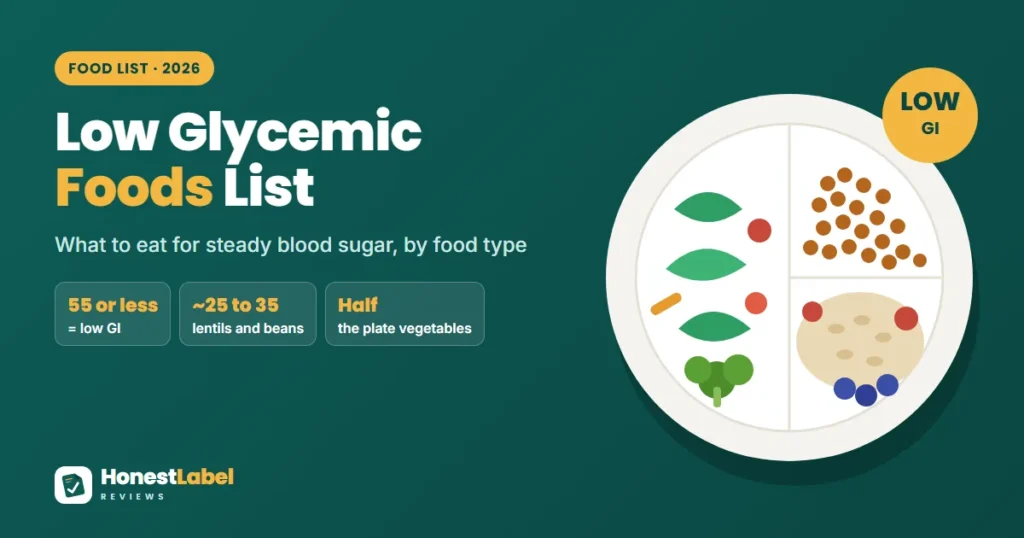
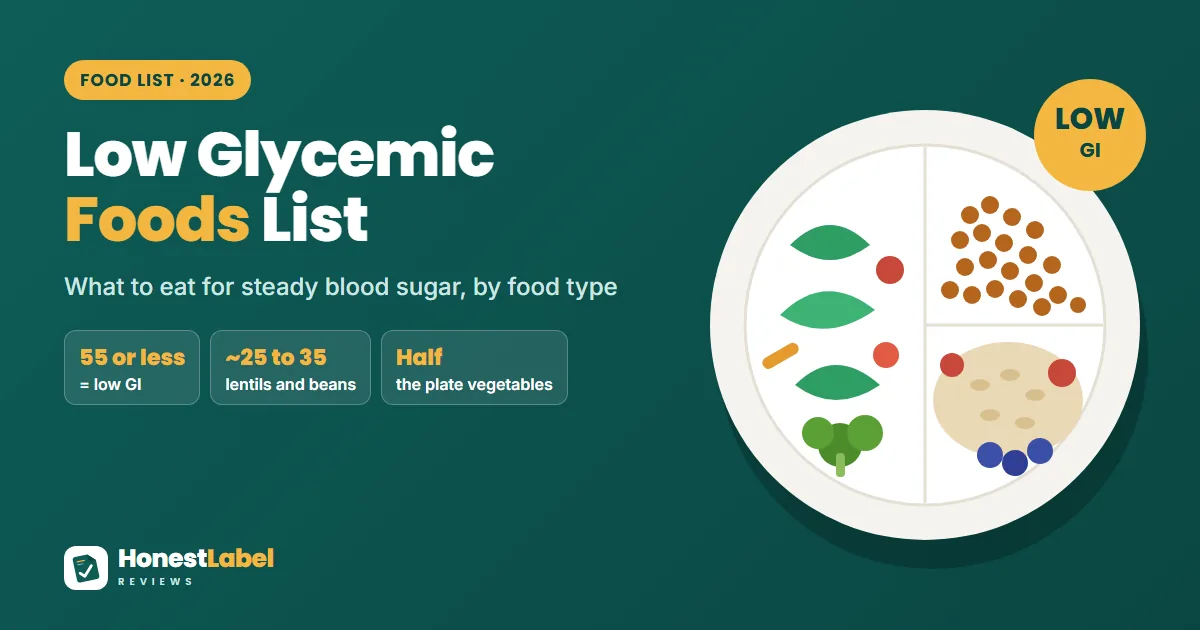
Low glycemic foods have a glycemic index of 55 or less, so they raise blood sugar slowly. The best everyday choices are non-starchy vegetables, beans and lentils (GI about 25 to 35), barley, rolled or steel-cut oats, most whole fruits such as apples, pears and berries, plain milk and yogurt, and protein foods, nuts and healthy fats.
This page is the positive side of the story. Instead of a list of foods to cut, it is a shopping list of foods that help keep your numbers inside the normal blood sugar ranges, grouped by food type so you can build meals from it. We give approximate GI values only where the published tables are consistent, and we say so when a food varies too much to pin down.
GI and glycemic load in one minute
The glycemic index (GI) compares how fast a carbohydrate food raises blood sugar against pure glucose, which scores 100. MedlinePlus uses three bands: low is 55 or less, medium is 56 to 69, and high is 70 or more.
Glycemic load (GL) adds the portion size. It multiplies the GI by the grams of carbohydrate you actually eat and divides by 100. A GL of 10 or less is low and 20 or more is high. GL is usualy the more useful number at the table, because a low-GI food eaten in a huge portion can still raise blood sugar a lot. Our guide to foods that spike blood sugar explains both measures with worked examples, along with the foods to limit and swaps for them.
Two quick points before the list:
- GI values come from lab tests in small groups of volunteers, usually around 10 people per food. The numbers below are rounded ranges from the international tables by Atkinson, Foster-Powell and Brand-Miller (2008) and the 2021 update.
- Foods with very little carbohydrate, such as meat, eggs, oils and most leafy vegetables, cannot be tested for GI at all. They are effectively “no GI” foods and barely move blood sugar on their own.
Does eating low glycemic foods actually help?
For people with diabetes, the evidence is moderate and the effect is real but modest. A 2021 meta-analysis in the BMJ pooled 29 controlled trials with about 1,600 people with diabetes and found that low-GI or low-GL diets lowered A1C by roughly 0.3 percentage points compared with higher-GI diets, along with small improvements in fasting glucose, LDL cholesterol and body weight (Chiavaroli et al., 2021).
One well-known trial tested a single change. In a 3-month study of 121 adults with type 2 diabetes, eating at least 1 cup of beans, chickpeas or lentils a day lowered A1C by about 0.5 percentage points, compared with about 0.3 for a high wheat-fiber diet (Jenkins et al., 2012).
For people without diabetes, the evidence is thinner. Low-GI eating overlaps heavily with the high-fiber diet the NIDDK already recommends, but trials in healthy people show smaller, less consistent effects. Still, the CDC estimates that 115.2 million US adults have prediabetes and 8 in 10 of them dont know it. For that group, a diet built from this list is a reasonable place to start, together with the habits in our guide on how to lower blood sugar naturally.
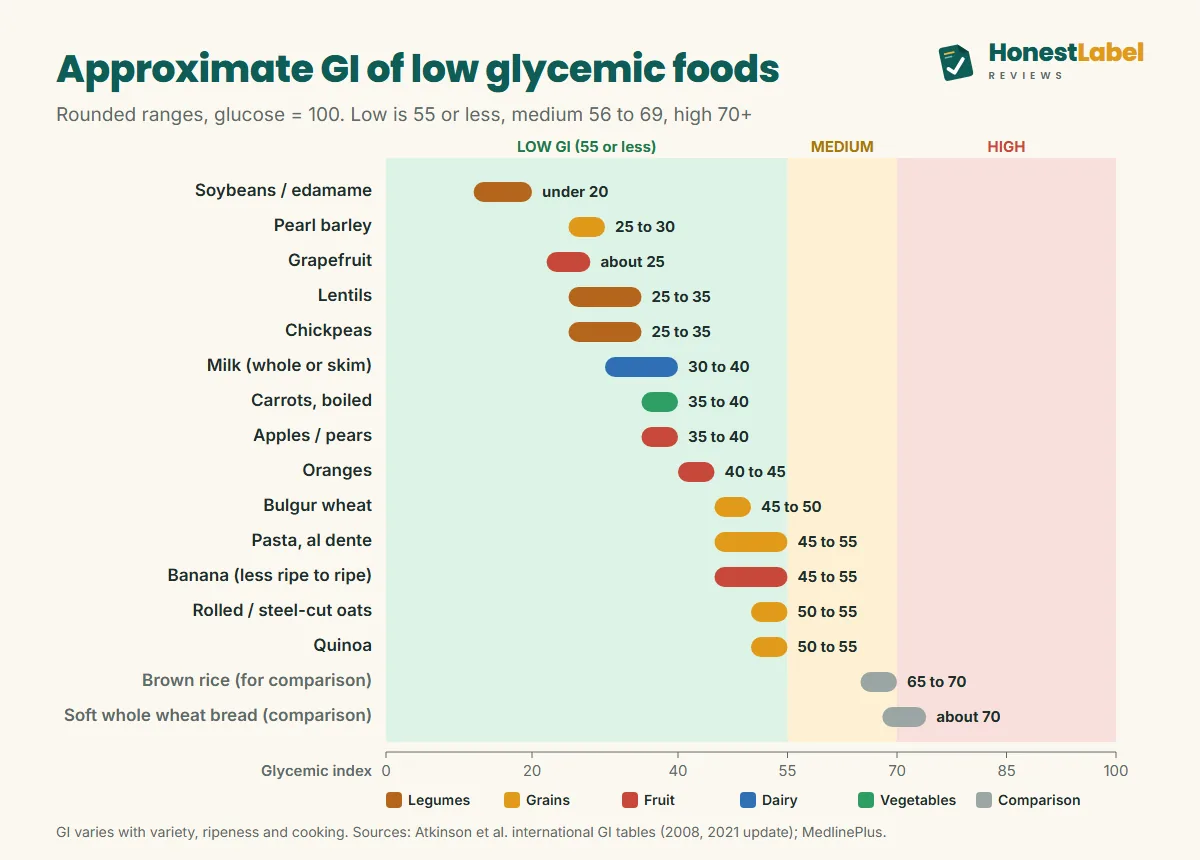
The low glycemic foods list, by food type
1. Non-starchy vegetables (eat freely)
These are the base of the plate. Most contain so little carbohydrate that a normal portion has almost no effect on blood sugar, and they add fiber, water and volume. The American Diabetes Association suggests filling half your plate with them.
- Leafy greens: spinach, lettuce, kale, chard, arugula, cabbage
- Broccoli, cauliflower, Brussels sprouts
- Zucchini, eggplant, cucumber, celery
- Bell peppers, tomatoes, onions, mushrooms
- Green beans, asparagus, okra
- Carrots, which test at about 35 to 40 when boiled and have very little carbohydrate per serving
Starchy vegetables are a separate group. Corn and peas sit in the low to medium range. Sweet potato varies widely with variety and cooking, from medium to high, and white potato is usually high. Treat those as your carb portion, not as the “vegetable half” of the plate.
2. Beans, lentils and other legumes (the strongest group)
If you only add one thing from this page, make it legumes. They combine slow-digesting starch, a lot of fiber and plenty of protein, and they have some of the lowest GI values of any carbohydrate food.
- Lentils (red, green, brown): GI about 25 to 35
- Chickpeas: about 25 to 35
- Kidney beans, black beans, navy beans: mostly 25 to 40
- Soybeans and edamame: very low, often under 20
- Split peas and hummus: low
Canned beans test a little higher than beans cooked from dry, but they are still low and far more convenient. Rinse them to cut the sodium. If beans give you gas, start with a few spoonfuls a day and build up slowly.
3. Whole grains and better starches (watch the portion)
Grains are where GI varies most, because milling, flaking and cooking change how fast the starch is digested. The rule of thumb: the more intact the grain, the lower the GI.
- Pearl barley: one of the lowest grains, about 25 to 30
- Rolled oats and steel-cut oats: about 50 to 55 (instant oats are much higher)
- Bulgur wheat: about 45 to 50
- Quinoa: about 50 to 55, borderline low
- Pasta cooked al dente, white or whole wheat: roughly 45 to 55
- Corn tortillas: about 45 to 50
- Dense whole-grain or rye breads with visible grains: often in the 50s
Some foods people expect to be low are not. Brown rice usually tests in the medium range, around 65 to 70, and most soft “whole wheat” sandwich bread is close to white bread, around 70. Both still carry more fiber than refined versions. Parboiled rice tends to score lower than regular white rice.
Portion is what decides the glycemic load here. A cup of cooked pasta and three cups of pasta are very different meals, even at the same GI. A fist-sized portion, or about a quarter of the plate, is a good starting point.
4. Fruits (whole, not juiced)
Most whole fruit is low GI, helped by its fiber, water and the fact that much of its sugar is fructose, which raises blood glucose slowly. These are reliably low in the tables:
- Apples: about 35 to 40
- Pears: about 35 to 40
- Oranges: about 40 to 45
- Grapefruit: about 25
- Peaches and plums: about 40
- Strawberries: about 40; other berries are low in carbohydrate per cup
- Bananas: about 45 to 55, lower when slightly green and higher when very ripe
Grapes, mango and pineapple sit higher, mostly in the medium range, and watermelon is high GI but very low GL because a slice has so little carbohydrate. Dried fruit and fruit juice raise blood sugar much faster than the whole fruit, so keep those portions small.
5. Dairy and dairy alternatives
Plain dairy is low GI because lactose is a slow sugar and milk protein slows things further.
- Milk, whole or skim: about 30 to 40
- Plain yogurt and plain Greek yogurt: low, and Greek yogurt has extra protein
- Cheese and cottage cheese: almost no carbohydrate
- Unsweetened soy milk: low
Flavored yogurts and sweetened plant milks can carry several teaspoons of added sugar, so check the “added sugars” line on the label and pick plain where you can.
6. Protein foods (no GI)
These contain litle or no carbohydrate, so they do not raise blood sugar much by themselves. Eating them with carbs also slows digestion and blunts the rise.
- Eggs
- Fish and seafood, especially oily fish such as salmon, sardines and mackerel
- Chicken and turkey
- Tofu, tempeh and edamame
- Lean red meat in moderate amounts
Processed meats such as bacon, ham and sausages are low GI too, but they are linked with higher diabetes and heart risk in large studies, so the low number is not a green light. The Mayo Clinic’s diabetes diet guide recommends fish, beans and poultry ahead of processed red meat.
7. Nuts, seeds and healthy fats
Nuts and seeds are low in carbohydrate and high in fiber and unsaturated fat. Peanuts and most tree nuts have very low GI values.
- Almonds, walnuts, pistachios, pecans, peanuts
- Chia seeds, flaxseed, pumpkin seeds, sunflower seeds
- Natural nut butters with no added sugar
- Olive oil, avocado and olives
Fats are calorie dense, so keep portions modest: a small handful of nuts (about 1 ounce) or a quarter to a half of an avocado is a typical serving.
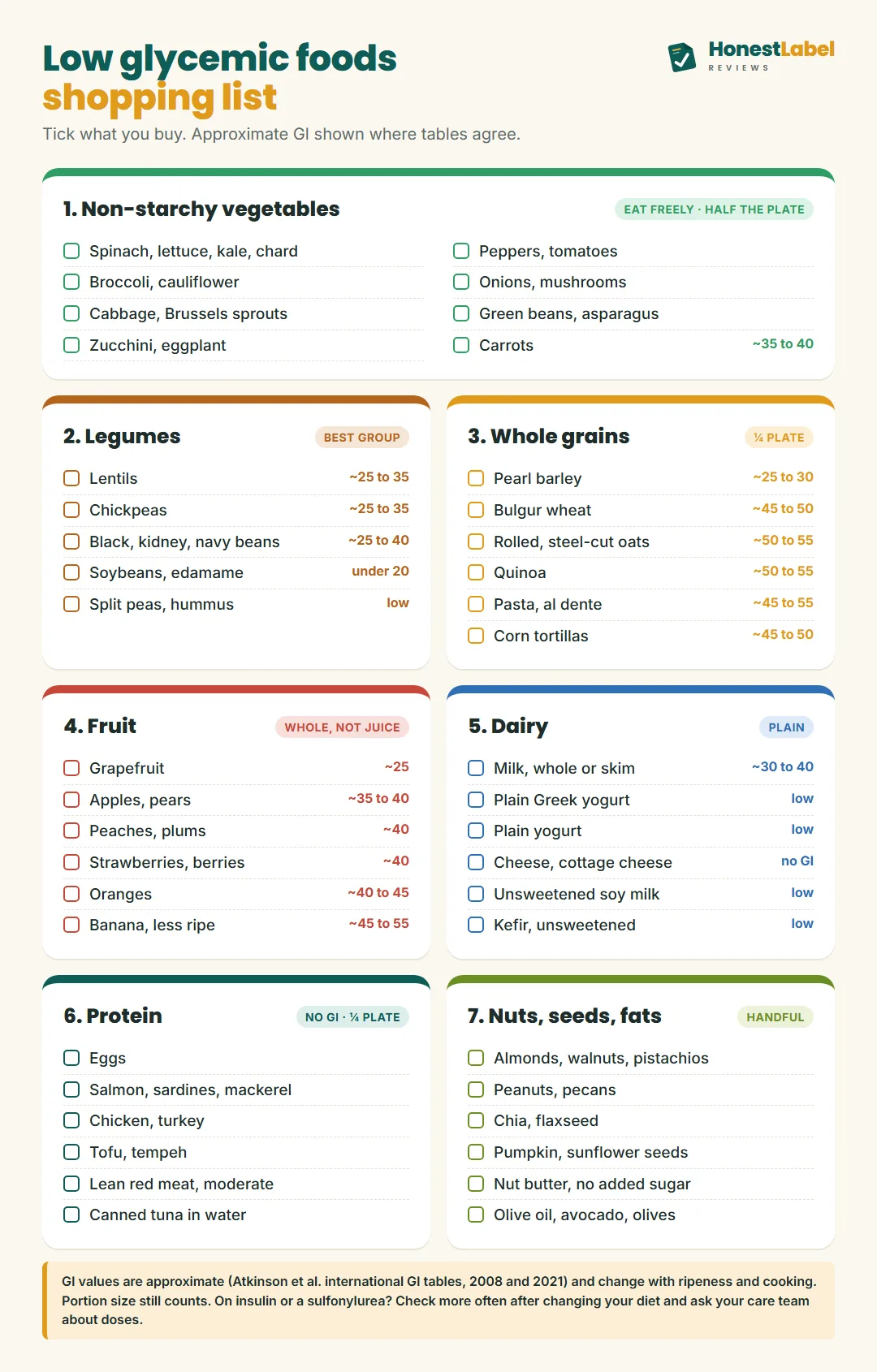
Turning the list into meals
The simplest system is the plate method that the CDC and the ADA both teach: half the plate non-starchy vegetables, a quarter protein, and a quarter carbohydrate foods, ideally from groups 2 to 4 above.
Some easy combinations:
| Meal | Low glycemic build | Why it works |
|---|---|---|
| Breakfast | Rolled oats cooked in milk, topped with berries and walnuts | Intact oats, dairy protein and nut fat slow the rise |
| Lunch | Lentil and vegetable soup with a slice of dense rye bread | Legumes do most of the carb work at a GI around 30 |
| Dinner | Salmon, roasted broccoli and a small portion of pearl barley or al dente pasta | Half the plate is vegetables and the starch portion is modest |
| Snack | An apple with a tablespoon of peanut butter | Whole fruit plus fat and protein |
| Snack | Plain Greek yogurt with chia seeds | High protein, almost no added sugar |
Limits of the glycemic index
GI has blind spots worth knowing before you follow the numbers too far.
- It says nothing about overall health. Ice cream and some chocolate bars test low because of their fat, and potato chips can test lower than a boiled potato. Low GI does not make a food healthy.
- Your response is personal. Studies with glucose monitors show that two people can react quite differently to the same food. Your own meter readings beat any table.
- Mixed meals change the result. Protein, fat and fiber eaten alongside a carb food lower its effect.
We belive the most practical approach is to use the list for the bulk of your food and not to worry about single GI points. The difference between a GI of 50 and 55 will not be noticeable on a meter. The difference between a plate of beans and vegetables and a plate of white rice and juice will be.
Who should be careful when changing their diet
- People on insulin or sulfonylureas (such as glipizide or glyburide). Swapping high-GI foods for low-GI ones, or eating fewer carbs overall, can lower your blood sugar more than your current dose expects. Check more often for the first couple of weeks and talk to your care team about adjusting doses. Lows are anything under 70 mg/dL.
- People with kidney disease. Beans, lentils, nuts and dairy are high in potassium and phosphorus, which may need limits in later stages of kidney disease. A renal dietitian can tell you what is right for you.
- Pregnancy. Low-GI eating fits well with gestational diabetes diets, but carbohydrate needs rise in pregnancy, so follow the plan from your obstetric team.
- Digestive conditions. People with irritable bowel syndrome may not tolerate large amounts of beans, onions or some fruits. Increase fiber slowly and drink enough water.
- People taking warfarin should keep their intake of leafy greens fairly steady from week to week, because vitamin K affects how the drug works.
When to see a doctor
Diet changes are helpful, but they are not a replacement for testing or treatment. See a doctor if you:
- Have a fasting reading of 100 to 125 mg/dL (prediabetes range) or 126 mg/dL or higher (diabetes range), or an A1C of 5.7% or higher
- Get readings over 180 mg/dL one to two hours after meals on a regular basis if you have diabetes
- Have constant thirst, frequent urination, blurry vision or weight loss you can’t explain
- Have readings under 70 mg/dL, especially more than once a week
- Plan a big change in diet while on glucose-lowering medication
Get urgent care for a reading under 54 mg/dL that does not come up with treatment, confusion or fainting, or very high readings with vomiting or fast, deep breathing.
Frequently asked questions
What foods have a glycemic index of zero?
Foods with almost no carbohydrate, such as meat, fish, eggs, oils, butter and most cheese, are often listed as zero or “no GI” becuase they can’t be tested. They have very little direct effect on blood sugar.
Are low glycemic foods good for weight loss?
They can help a little, because many are high in fiber and protein and keep you full. Trials show small extra weight loss at best.
Is oatmeal low glycemic?
Rolled and steel-cut oats are borderline low, at about 50 to 55. Instant oats are processed further and usually test much higher, often above 70. Adding milk, nuts or seeds lowers the effect of the bowl as a whole.
Which fruits have the lowest glycemic index?
Grapefruit, cherries, apples, pears, oranges, peaches, plums and strawberries are among the lowest, mostly between about 25 and 45. Whole fruit is always a better choice than juice or dried fruit.
The bottom line
A low glycemic diet is mostly a list of ordinary foods: vegetables, beans and lentils, intact grains like barley and oats, whole fruit, plain dairy, and protein foods, nuts and healthy fats. Use the GI numbers as a rough guide and the portion as the real control. For people with diabetes, trials show a modest drop in A1C from eating this way, and it is necessary to adjust medication with your care team if your readings start falling. For everyone else, it is a simple, low-risk way to keep blood sugar steadier from the beginning of the day to the end.
Sources
- American Diabetes Association. Understanding Carbs.
- Centers for Disease Control and Prevention. Diabetes Meal Planning; National Diabetes Statistics Report.
- National Institute of Diabetes and Digestive and Kidney Diseases (NIH). Diabetes Diet, Eating, & Physical Activity.
- MedlinePlus (US National Library of Medicine). Glycemic index and diabetes.
- Mayo Clinic. Diabetes diet: Create your healthy-eating plan.
- Atkinson FS, Foster-Powell K, Brand-Miller JC. International tables of glycemic index and glycemic load values: 2008. Diabetes Care, 2008. PubMed.
- Atkinson FS, et al. International tables of glycemic index and glycemic load values 2021: a systematic review. American Journal of Clinical Nutrition, 2021. PubMed.
- Chiavaroli L, et al. Effect of low glycaemic index or load dietary patterns on glycaemic control and cardiometabolic risk factors in diabetes: systematic review and meta-analysis of randomised controlled trials. BMJ, 2021. PubMed.
- Jenkins DJ, et al. Effect of legumes as part of a low glycemic index diet on glycemic control and cardiovascular risk factors in type 2 diabetes mellitus: a randomized controlled trial. Archives of Internal Medicine, 2012. PubMed.
Medical disclaimer: This article is for general information and is not medical advice. It does not replace a diagnosis or treatment from your doctor. If you have diabetes or take medication that affects blood sugar, talk to your healthcare provider before changing your diet, exercise or supplements.