Last reviewed: November 2026 · Sources: American Diabetes Association, NIH (PubMed) and peer-reviewed studies (listed at the end)
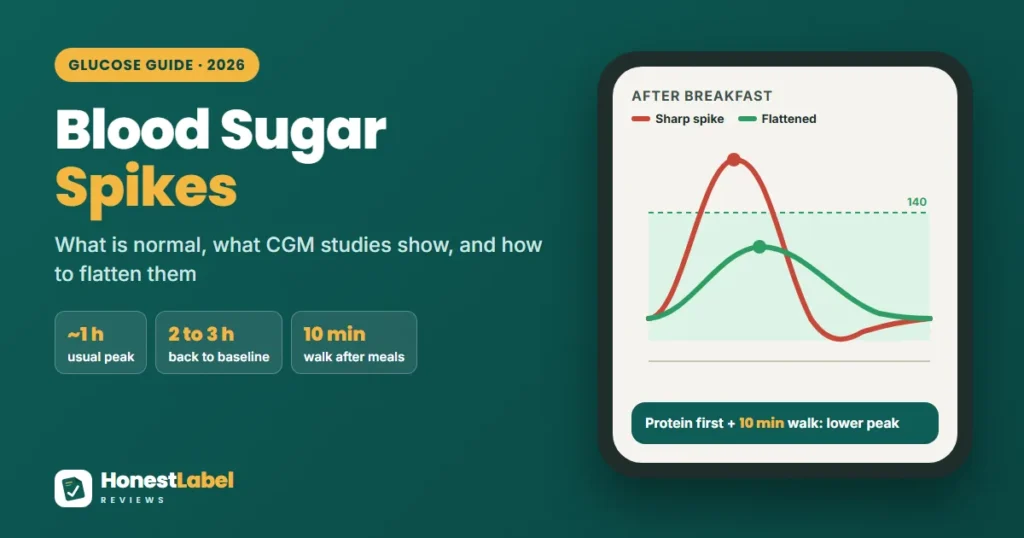
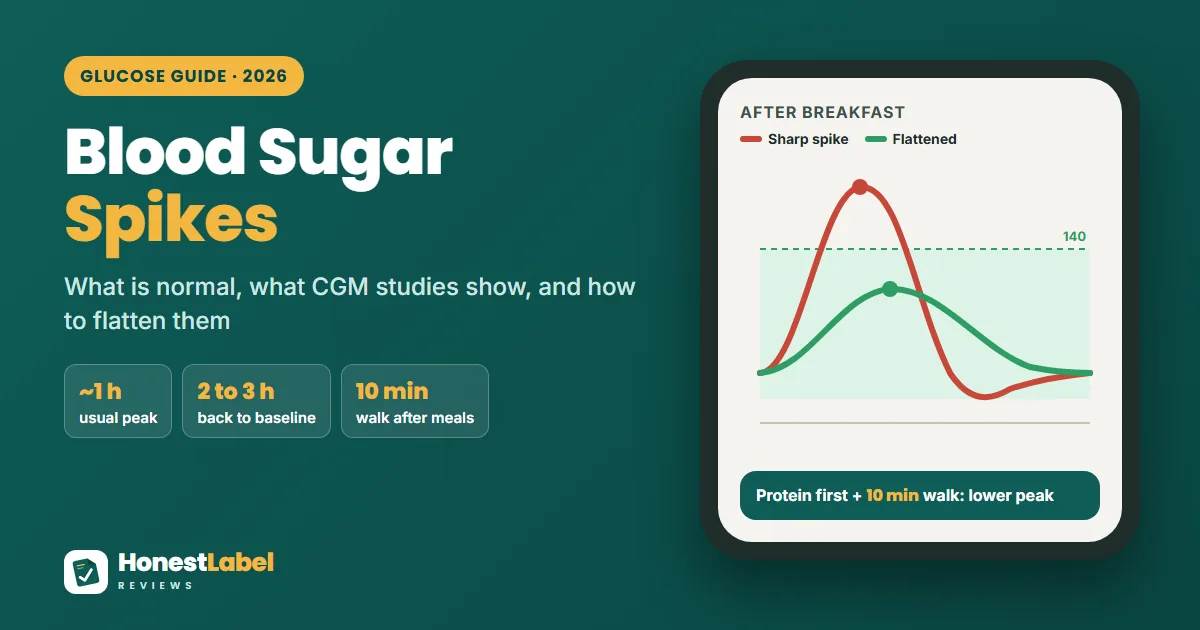
A blood sugar spike is the rise in glucose after you eat. In healthy people it usually peaks within about an hour, rarely goes much above 140 mg/dL and is back near baseline within 2 to 3 hours. To flatten spikes, eat protein and vegetables before starch, walk 10 minutes after meals, split big carb portions, and consider vinegar.
Spikes have become a popular topic since glucose sensors went on sale to anyone. People now see there own curve after a bagel and wonder if it is a problem. Some of the worry is fair and some is overblown, so this guide sticks to what the research shows.
We will not repeat the number ranges here. For the official cut-offs, see our guides to normal blood sugar ranges and blood sugar after eating. For a list of the worst offenders, see foods that spike blood sugar.
What a blood sugar spike actually is
There is no official medical definition of a spike. Doctors talk about “postprandial glucose”, meaning glucose after a meal, and diagnose problems with lab tests. The word comes mostly from people wearing continuous glucose monitors (CGMs).
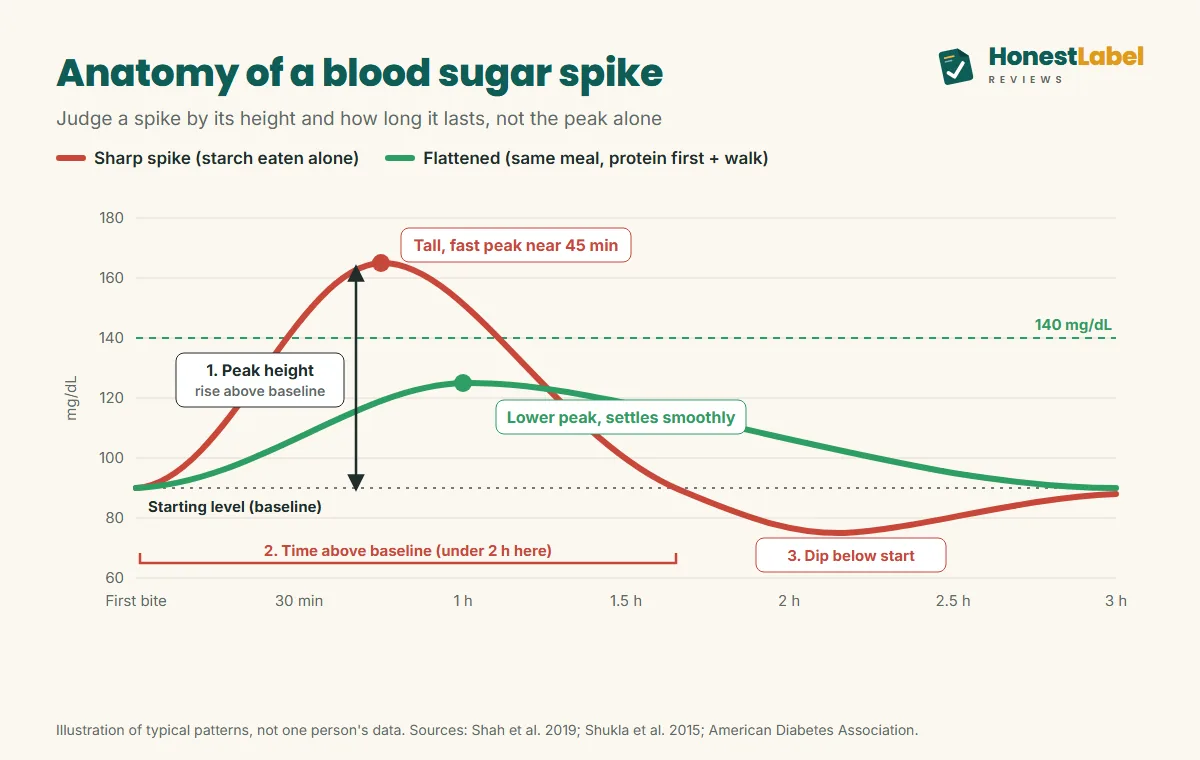
Two meals can reach the same peak and still be very diffrent. A useful way to judge a spike is to look at four parts of the curve:
- Starting point. Your level before eating. A rise of 40 points from 85 is different from a rise of 40 from 120.
- Peak height. The highest reading, usually 30 to 60 minutes after the first bite.
- Duration. How long glucose stays clearly above where it started. A peak that is gone in 45 minutes puts less glucose exposure on the body than one that sits up for three hours.
- The landing. Some people drop below their starting level a couple of hours later and feel shaky or hungry. That dip is part of the same pattern.
Researchers often combine height and duration into one number, the area under the curve. A tall, narrow peak and a lower, wide hump can add up to a simliar amount of extra glucose.
What CGM studies show in people without diabetes
CGM research is still young, so it helps to know what each study can and cannot tell us.
Healthy glucose stays in a narrow band most of the day
The best reference so far comes from Shah et al. (2019), who put blinded CGMs on 153 healthy children and adults without diabetes for up to 10 days. Average glucose was about 99 mg/dL, and readings stayed between 70 and 140 mg/dL for about 96 percent of the day. Short trips above 140 did happen, but they took up a small share of the time. Readings ran a little higher in older participants. A normal body does spike, then, but it keeps the spikes short.
The “glucotypes” study
A Stanford team led by Hall et al. (2018) gave CGMs to 57 adults, most of whom did not have diabetes on standard tests. They sorted people into three “glucotypes” by how much their glucose swung: low, moderate and severe variability. Some people whose lab tests looked normal had swings that reached the prediabetes or diabetes range at times.
They also served standard breakfasts. A bowl of cornflakes with milk pushed glucose above 140 mg/dL in about 80 percent of participants.
The study got a lot of attention, and it is often overstated. Keep these limits in mind:
- It was small, at 57 people, and short.
- Glucotypes are a research label. They are not a diagnosis, and no guideline uses them.
- It did not show that people with “severe” glucotypes go on to get sick more often. That would need years of follow-up.
- CGMs read fluid under the skin, which lags behind blood and can be off by a fair margin, especially at the extremes.
The same food spikes people differently
An Israeli study of 800 adults found that people’s glucose responses to identical meals varied widely, so one person’s “safe” bread could spike another person far more (Zeevi et al., Cell 2015). Sleep, activity and even gut bacteria seemed to play a part, which is why testing your own response can be useful.
Why repeated large spikes may matter
Claims about spikes online often go further than the research, so we have split this into what is known and what is still open.
What we know
- High after-meal glucose predicts risk. In a large European dataset, the 2-hour reading on a glucose tolerance test predicted death from all causes better than fasting glucose did (DECODE Study Group, Lancet 1999). That is an observational finding, so it shows a link and not proof of cause.
- Big spikes can be an early warning. After-meal glucose often rises before fasting glucose does. Spikes that are large and slow to come down on ordinary meals can be a sign of insulin resistance and are worth a proper test.
- Swings affect cells in the lab. In a small study of people with type 2 diabetes, larger glucose swings tracked with a marker of oxidative stress more closely than average glucose did (Monnier et al., JAMA 2006).
What we don’t know
- Whether flattening normal spikes prevents disease in healthy people. No trial has tested this. Healthy people whose curves already return to baseline quickly may gain little from chasing a flat line.
- Whether targeting spikes beats targeting overall glucose. In the HEART2D trial, 1,115 people with type 2 diabetes who had had a heart attack were treated with insulin aimed either at after-meal or at fasting glucose. Heart events did not differ between the groups (Raz et al., Diabetes Care 2009).
Our reading: frequent big spikes that stay up for hours are worth fixing and worth telling a doctor about. A quick rise to the 130s after a meal that settles within two hours is normal, and you do not need to fear it. We truly belive the habits below are worth doing anyway, since they help with weight and A1C too.
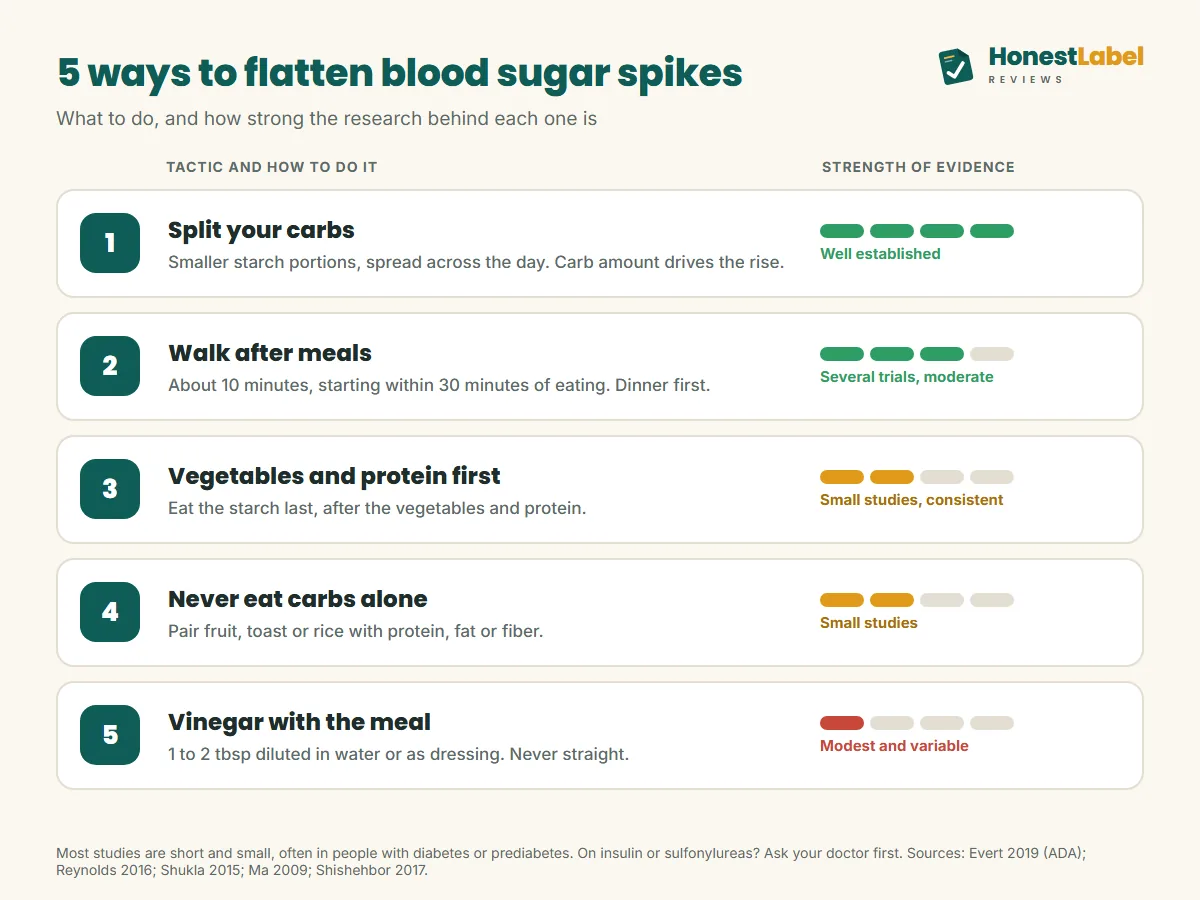
How to flatten blood sugar spikes: 5 tactics
These tactics change the shape of the curve after a meal. Most of the research is in short lab studies, often in people with diabetes or prediabetes, so expect smaller effects if your glucose is already normal.
1. Eat vegetables and protein first, starch last
Order matters because protein, fat and fiber slow down how fast the stomach empties. If they arrive first, the starch that follows reaches the gut more slowly. In a small study of 11 adults with type 2 diabetes, eating vegetables and protein 15 minutes before the bread and juice led to much lower glucose at 30, 60 and 120 minutes than the reverse order (Shukla et al., Diabetes Care 2015).
In practice: start dinner with the salad or cooked vegetables, eat the chicken or fish, and finish with the rice. It feels weird at first, but it is the same meal.
2. Never eat carbs “naked”
A related trick is a protein or fiber “preload”. In a small study of adults with type 2 diabetes, a whey protein drink taken 30 minutes before a mashed potato meal slowed stomach emptying and lowered the after-meal glucose rise (Ma et al., Diabetes Care 2009). You do not need a shake. Pairing foods works too:
- Apple with a handful of nuts or a slice of cheese
- Toast with eggs or peanut butter, instead of jam alone
- Rice with beans, lentils or tofu and a side of greens
3. Walk for 10 minutes after eating
Muscles that are working pull glucose out of the blood, partly without needing extra insulin. Timing seems to matter. In a trial of 41 adults with type 2 diabetes, a 10-minute walk after each meal lowered after-meal glucose by about 12 percent compared with one 30-minute walk at another time of day, with the biggest effect after the evening meal (Reynolds et al., Diabetologia 2016).
Start within about 30 minutes of finishing the meal, when glucose is still climbing. Even a few minutes helps, and dinner is the best meal to target becuase most people sit for the rest of the evening.
4. Try vinegar before or with a carb-heavy meal (modest evidence)
Vinegar seems to slow stomach emptying and may help muscles take up glucose. A 2017 meta-analysis of small clinical trials found that vinegar with a meal lowered the after-meal glucose and insulin response (Shishehbor et al., 2017). The effects were modest and varied a lot from study to study, and most trials looked at a single meal.
If you want to try it, use 1 to 2 tablespoons diluted in a large glass of water, or as a vinaigrette on a starter salad. Never drink it straight, because it can burn the throat and wear down tooth enamel. It is an add-on and will not undo a large sugary meal.
5. Split your carbs
The total amount of carbohydrate in a meal is the biggest driver of the rise, which is why the ADA’s nutrition consensus report puts so much weight on carbohydrate amount and quality. Halving a big portion and moving the other half to later gives your body two smaller loads to clear instead of one large one.
- Have half the pasta at dinner and the rest as part of lunch tomorrow.
- Choose between the bread basket and the dessert, rather than both.
| Tactic | How to do it | Strength of evidence |
|---|---|---|
| Food order | Vegetables and protein first, starch last | Small short studies, consistent results |
| Protein or fiber first | Pair every carb with protein, fat or fiber | Small studies |
| Walk after meals | 10 minutes within 30 minutes of eating | Several trials and a review, moderate |
| Vinegar | 1 to 2 tbsp diluted, with the meal | Small studies, modest and variable |
| Split carbs | Smaller portions, spread across the day | Well established that carb amount drives the rise |
How to check if it is working
If you own a meter or a CGM, test one change at a time.
- Pick a meal you eat often, such as your usual breakfast.
- Check before eating, then at 1 hour and 2 hours after the first bite.
- Repeat it on another day with one change, for example the eggs first, or a walk afterwards.
- Compare the peak and how fast you came back down.
Do not chase a perfectly flat line. A rise after a meal is how a healthy body works. Some people find that watching every curve makes them anxious about food, and if that has occurred to you, it is fine to put the sensor away.
Safety: who should be careful
- People on insulin or sulfonylureas (such as glipizide or glyburide). Walking after meals, eating less starch or adding vinegar can push glucose too low. Treat a low under 70 mg/dL with the ADA’s 15-15 rule and ask your doctor before changing a dose.
- People with gastroparesis, reflux or ulcers. Skip vinegar, and go easy on high-fat preloads that slow the stomach further.
- Pregnant women. Follow the plan from your care team. Cutting carbs hard is not advised in pregnancy.
- People with kidney disease. Extra protein is not right for everyone with reduced kidney function.
When to see a doctor
Book an appointment if:
- Your readings 2 hours after ordinary meals are often 140 mg/dL or higher
- You get any reading of 200 mg/dL or higher, especially with thirst or frequent urination
- You often feel shaky, sweaty or hungry 2 to 4 hours after eating, which may be reactive hypoglycemia
- You have risk factors such as a family history, a large waist or past gestational diabetes and have never been tested
Get urgent care for confusion, fainting, or very high readings with vomiting or fast, deep breathing.
Frequently asked questions
Is it normal for blood sugar to spike after eating?
Yes. Everyone’s glucose rises after a meal with carbohydrate. In healthy people the rise is short and usually stays under about 140 mg/dL. A spike becomes a concern when it is very high or stays up for hours on ordinary meals.
How long should a blood sugar spike last?
In people without diabetes, glucose usualy peaks within about an hour and is back near the starting level within 2 to 3 hours. A curve that stays well above baseline for longer, meal after meal, is worth discussing with a doctor.
Can you have blood sugar spikes without diabetes?
Yes. CGM studies show that people without diabetes do go above 140 mg/dL at times, especially after sugary cereal or a large starchy meal. Frequent or long high periods may be an early sign of insulin resistance.
Do blood sugar spikes cause weight gain?
That has not been proven. Total calories, food quality and activity matter far more.
The bottom line
A spike is judged by how high it goes and how long it lasts. Healthy bodies spike briefly and come back down within 2 to 3 hours. Large spikes that linger on ordinary meals deserve a proper test, while the claim that every small spike harms healthy people goes beyond the evidence. To flatten your curve, eat vegetables and protein first, pair your carbs, walk after meals, split big portions and, if you like it, add a litle diluted vinegar.
Sources
- American Diabetes Association. Hypoglycemia (Low Blood Glucose).
- Evert AB, et al. Nutrition therapy for adults with diabetes or prediabetes: a consensus report. Diabetes Care, 2019. PubMed.
- Shah VN, et al. Continuous glucose monitoring profiles in healthy nondiabetic participants: a multicenter prospective study. Journal of Clinical Endocrinology & Metabolism, 2019. PubMed.
- Hall H, et al. Glucotypes reveal new patterns of glucose dysregulation. PLoS Biology, 2018. PubMed.
- Zeevi D, et al. Personalized nutrition by prediction of glycemic responses. Cell, 2015. PubMed.
- DECODE Study Group. Glucose tolerance and mortality: comparison of WHO and American Diabetes Association diagnostic criteria. Lancet, 1999. PubMed.
- Monnier L, et al. Activation of oxidative stress by acute glucose fluctuations compared with sustained chronic hyperglycemia in patients with type 2 diabetes. JAMA, 2006. PubMed.
- Raz I, et al. Effects of prandial versus fasting glycemia on cardiovascular outcomes in type 2 diabetes: the HEART2D trial. Diabetes Care, 2009. PubMed.
- Shukla AP, et al. Food order has a significant impact on postprandial glucose and insulin levels. Diabetes Care, 2015. PubMed.
- Ma J, et al. Effects of a protein preload on gastric emptying, glycemia, and gut hormones after a carbohydrate meal in diet-controlled type 2 diabetes. Diabetes Care, 2009. PubMed.
- Reynolds AN, et al. Advice to walk after meals is more effective for lowering postprandial glycaemia in type 2 diabetes mellitus than advice that does not specify timing. Diabetologia, 2016. PubMed.
- Shishehbor F, et al. Vinegar consumption can attenuate postprandial glucose and insulin responses: a systematic review and meta-analysis of clinical trials. Diabetes Research and Clinical Practice, 2017. PubMed.
Medical disclaimer: This article is for general information and is not medical advice. It does not replace a diagnosis or treatment from your doctor. If you have diabetes or take medication that affects blood sugar, talk to your healthcare provider before changing your diet, exercise or supplements.