Last reviewed: November 2026 · Sources: CDC, NIH (NIDDK, MedlinePlus), American Diabetes Association, American College of Obstetricians and Gynecologists and peer-reviewed studies (listed at the end)
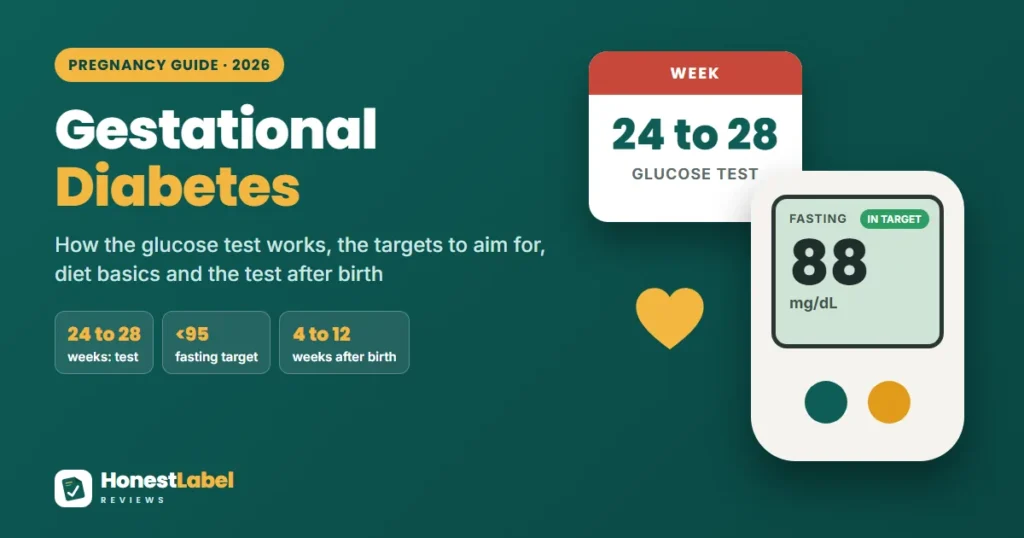
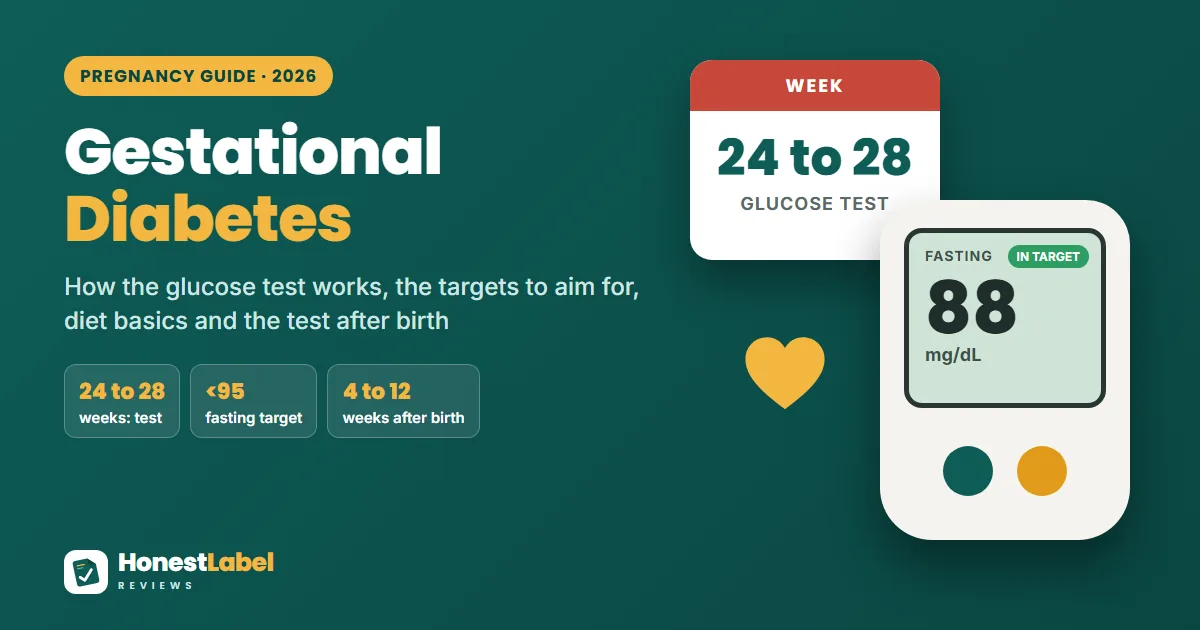
Gestational diabetes is high blood sugar that first shows up in pregnancy. Most women are tested at 24 to 28 weeks. ADA targets are under 95 mg/dL fasting, and under 140 one hour or under 120 two hours after meals. Diet and activity come first, then insulin if needed, and a test follows 4 to 12 weeks after birth.
When you receive a diagnosis of gestational diabetes, it can feel like a shock, especially when you feel completely fine. It is common and treatable, and most women who get it go on to have healthy babies. For the general background on how glucose works, see our guide to normal blood sugar ranges.
Everything here is general information. Your obstetric team, diabetes educator and dietitian set your targets, your meal plan and any medicine, and their advice comes before anything you read online.
What gestational diabetes is
As pregnancy goes on, the placenta makes hormones that make your body more resistant to insulin. This keeps a steady supply of glucose going to the baby, and most mothers simply make more insulin to match. When yours cannot keep up, blood sugar rises, and that is gestational diabetes.
It usually appears in the second half of pregnancy, which is why the test is timed for 24 to 28 weeks. The CDC estimates that it affects 2% to 10% of pregnancies in the US each year. Most women have no symptoms at all, so testing is the only way to find it.
Who is more likely to get it
Anyone can develop gestational diabetes, including women with no risk factors. The NIDDK and the CDC list these as raising the odds:
- Overweight or obesity before pregnancy
- Gestational diabetes in an earlier pregnancy
- A previous baby who weighed more than 9 pounds
- Prediabetes, or a parent or sibling with type 2 diabetes
- Polycystic ovary syndrome (PCOS)
- Being older than 25
- Being African American, Hispanic/Latino, American Indian, Alaska Native, Asian American or Pacific Islander
If you have several of these, your provider may test you early in pregnancy as well. An early test mainly looks for type 2 diabetes or prediabetes that was already there before you got pregnant and was never picked up.
How the gestational diabetes test works
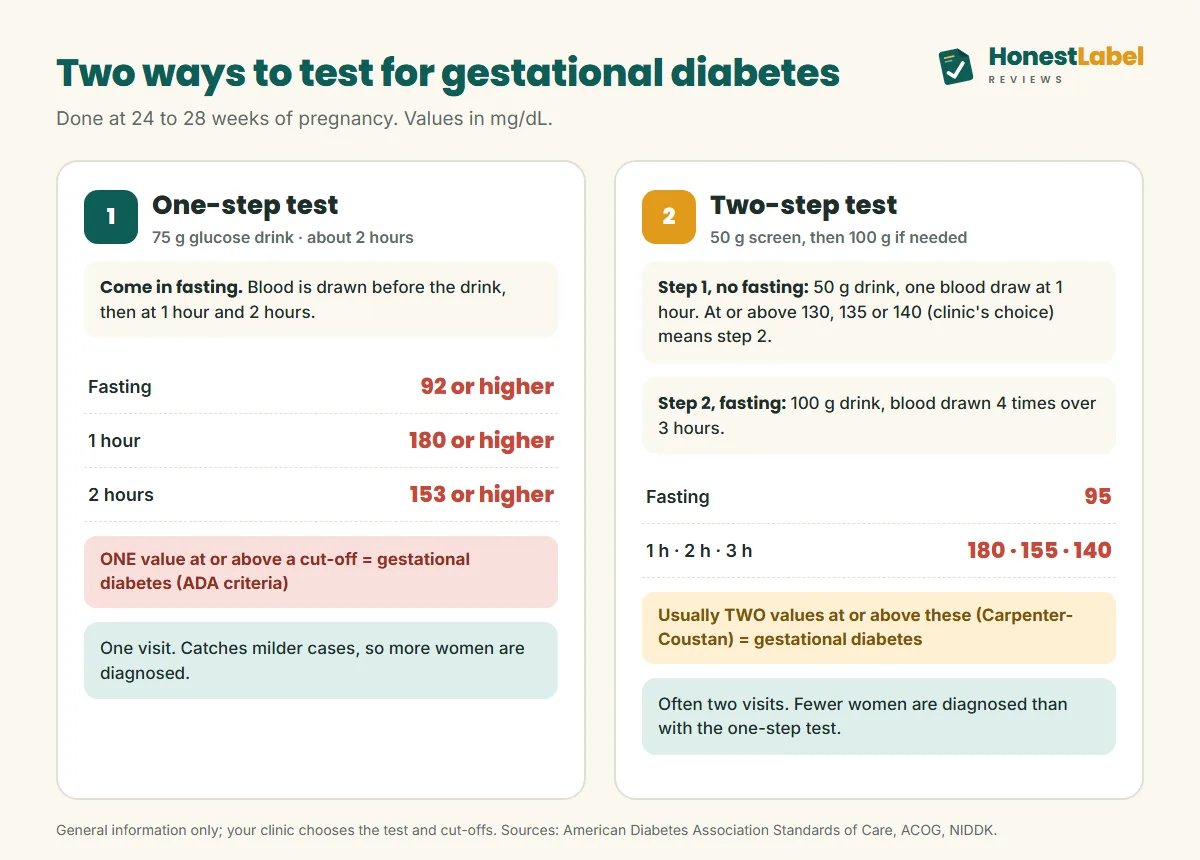
There are two accepted ways to test at 24 to 28 weeks. Both use a sweet glucose drink and timed blood draws. Which one you get depends on your clinic. The American Diabetes Association accepts both, and the American College of Obstetricians and Gynecologists (ACOG) has long favored the two-step approach in the US.
The one-step test (75 grams, 2 hours)
You come in fasting, drink 75 grams of glucose, and have blood drawn fasting, at 1 hour and at 2 hours. Under the ADA’s criteria, one value at or above 92 mg/dL fasting, 180 at 1 hour or 153 at 2 hours makes the diagnosis.
The two-step test (50 grams, then 100 grams)
Step one is a 50-gram drink with no fasting and one blood draw 1 hour later. If that result is at or above your clinic’s cut-off (130, 135 or 140 mg/dL), you come back on a separate day for a 3-hour test: you fast, drink 100 grams of glucose and have blood taken four times. The most widely used cut-offs (Carpenter-Coustan) are 95 fasting, 180 at 1 hour, 155 at 2 hours and 140 at 3 hours. Usually two or more high values are needed for a diagnosis, although some clinicians treat a single high value too.
| One-step test | Two-step test | |
|---|---|---|
| Glucose drink | 75 g | 50 g screen, then 100 g if needed |
| Fasting needed? | Yes | No for step 1, yes for step 2 |
| Time in the lab | About 2 hours | 1 hour, then about 3 hours |
| Diagnosis | One value at or above 92 / 180 / 153 | Usually two values at or above 95 / 180 / 155 / 140 |
| Trade-off | Diagnoses more women, one visit | Fewer diagnoses, often two visits |
The one-step cut-offs came out of the HAPO study, which followed more than 23,000 pregnant women and found that the risk of problems such as a large baby rose steadily with the mother’s glucose, with no clean threshold (HAPO Study Group, NEJM 2008). The one-step test catches milder cases, and experts still disagree on which approach gives mothers and babies the best results.
Blood sugar targets with gestational diabetes
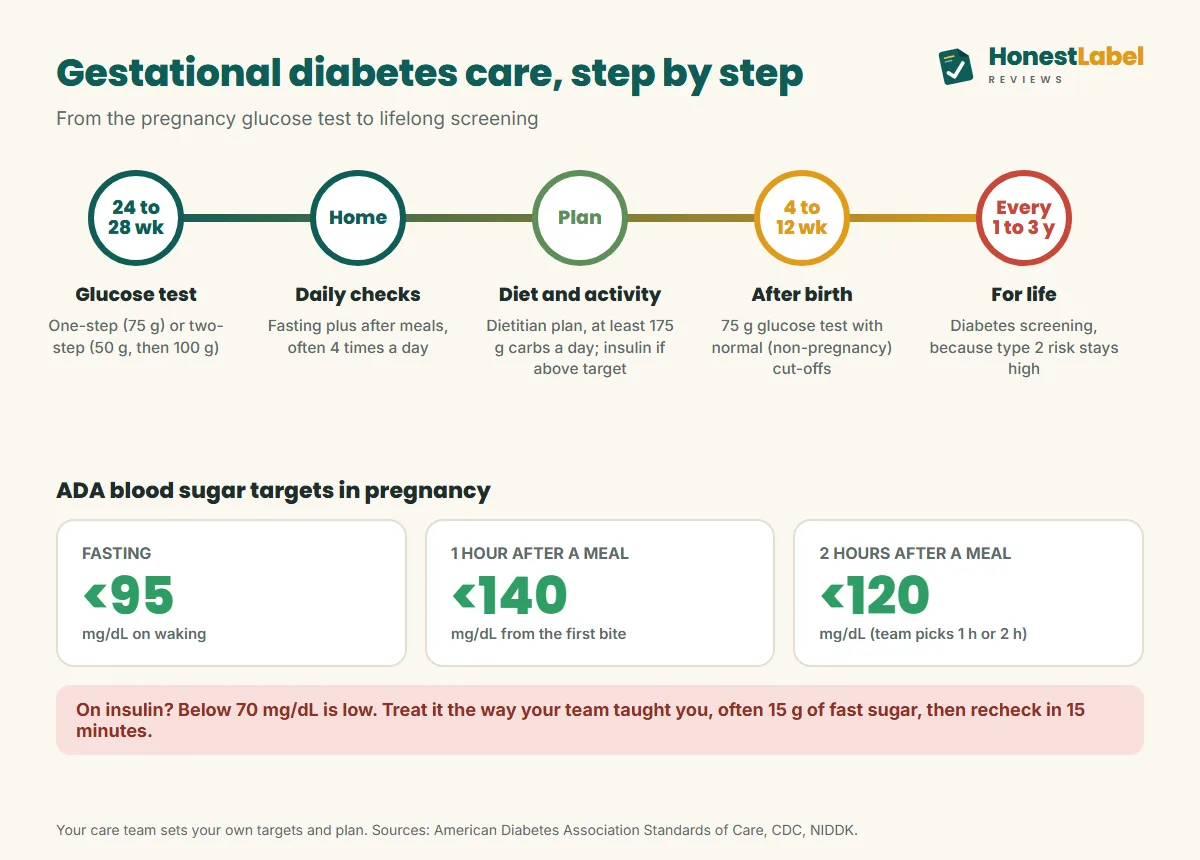
After a diagnosis, you will most likley check your blood sugar at home with a finger-prick meter, often four times a day: on waking, and after each main meal. The targets in the ADA Standards of Care chapter on pregnancy are:
| Check | ADA target in pregnancy | Compare: outside pregnancy |
|---|---|---|
| Fasting (on waking) | Under 95 mg/dL | Normal is under 100 |
| 1 hour after starting a meal | Under 140 mg/dL | No official 1 hour target |
| 2 hours after starting a meal | Under 120 mg/dL | Normal is under 140 |
Your team will tell you whether to test at 1 hour or 2 hours after meals. You do not need both. Our page on blood sugar after eating explains how to time an after-meal check so the clock starts at the first bite.
Log every reading with what you ate. Your team looks at patterns over a week or two, so one odd number after a birthday dinner is no cause for panic.
The gestational diabetes diet: the basics
Food is the first treatment, and the ADA notes that lifestyle changes alone are enough for most women with gestational diabetes. A registered dietitian should build the actual plan, since needs change with your weight, activity and stage of pregnancy. A good plan can accommodate the foods you allready like and your culture’s dishes.
Carbohydrates are still needed
Cutting carbs to near zero is the wrong move in pregnancy. The ADA Standards point to the Dietary Reference Intakes, which call for at least 175 grams of carbohydrate, 71 grams of protein and 28 grams of fiber a day during pregnancy. The goal is to spread those carbs out and pick slower ones.
What a typical plan looks like
- Three smaller meals and two to three snacks. Many plans include a bedtime snack to help the fasting number.
- A lighter-carb breakfast. Insulin resistance tends to be highest in the morning. Eggs with one slice of whole-grain toast often works better than cereal and juice.
- Protein at every meal and snack. Eggs, Greek yogurt, cheese, fish low in mercury, chicken, tofu, beans and nuts.
- Slower carbs. Beans, lentils, whole grains, oats, vegetables and whole fruit instead of white bread, sweet cereals and juice. Our list of foods that spike blood sugar shows which ones to keep small.
- No sugary drinks. Juice, soda and sweet coffee drinks raise glucose fastest.
Movement after meals
For most women with an uncomplicated pregnancy, ACOG recommends about 150 minutes of moderate activity a week. A 10 to 15 minute walk after meals is a gentle way to bring the after-meal number down. Ask first if you have bleeding, placenta previa or any limit on exercise.
What about supplements?
Blood sugar supplements have not been tested for safety in pregnancy, so they have no place here unless your care team suggests one. Berberine in particular is considered unsafe in pregnancy, because it may cause or worsen jaundice in newborns, according to the NIH’s National Center for Complementary and Integrative Health.
When insulin or other medicine is used
If your numbers stay above target despite diet and activity, usually over a week or two, your team will add medicine. Needing it does not mean you failed. Placental hormones keep rising through the third trimester.
Insulin is the preferred medicine for gestational diabetes in the ADA’s guidance, because it does not cross the placenta in meaningful amounts. It may be a night dose for high fasting numbers, a dose before meals, or both. Doses are usually small at the beginning and go up over the weeks.
Metformin and glyburide are pills some doctors use, but both cross the placenta, and the ADA does not recomend them as first-line treatment.
Low blood sugar on insulin
Insulin can cause lows, especially if a meal is late or smaller than usual. Below 70 mg/dL is low. Your team will teach you how to treat one, usually with 15 grams of fast sugar such as half a cup of juice or glucose tablets, then a recheck after 15 minutes. Keep glucose tablets in your bag.
Why it matters: risks for baby and mother
Extra glucose in your blood crosses the placenta. The baby’s pancreas answers with extra insulin, and that extra insulin acts as a growth signal. The CDC and NIDDK list these.
For the baby
- A large baby (macrosomia), which raises the chance of a hard delivery and shoulder injury
- Low blood sugar right after birth, because the baby’s own insulin is still running high.
- Jaundice and breathing problems, and a higher chance of being born early
- A higher chance of obesity and type 2 diabetes later in childhood or adult life
- Stillbirth, which is rare but more likely when blood sugar is not controlled
For the mother
- High blood pressure and preeclampsia
- A higher chance of a cesarean birth
- Gestational diabetes again in a future pregnancy
- Type 2 diabetes later in life, which we cover below
The good news is that treatment works. In the ACHOIS trial of 1,000 women, treating gestational diabetes cut serious problems for babies from 4% to 1% (Crowther et al., NEJM 2005). A later US trial in women with mild gestational diabetes found fewer large babies, fewer shoulder injuries at birth and less preeclampsia with treatment (Landon et al., NEJM 2009).
After the birth: the postpartum test and lifelong screening
For most women, blood sugar goes back to normal soon after delivery, once the placenta is gone, and insulin is usually stopped. That is why follow-up is so often missed.
The ADA recommends a 75-gram glucose tolerance test at 4 to 12 weeks after delivery, read with the normal non-pregnancy cut-offs. An A1C test is not used at this point, because pregnancy and blood loss at delivery can throw it off.
After that, the advice is lifelong screening at least every 1 to 3 years, even when the postpartum test is normal. According to the CDC, about 50% of women with gestational diabetes go on to develop type 2 diabetes. A large review found the risk was about seven times higher than in women whose pregnancies had normal glucose (Bellamy et al., Lancet 2009).
Lowering your later risk
In the Diabetes Prevention Program, women with past gestational diabetes and current prediabetes lowered their risk of type 2 diabetes with both lifestyle change and metformin (Ratner et al., 2008).
- Book the 4 to 12 week test before you leave the hospital, if you can.
- Breastfeed if it works for you. Observational studies link longer breastfeeding with lower later risk, though they cannot prove cause and effect.
- Get tested before trying for another baby, and tell every new provider about your history.
Safety: who should be careful
- Anyone on insulin. Skipping a meal, delaying a snack or exercising longer than usual can cause a low. Never change a dose on your own.
- Women who cut carbs hard. Very low-carb eating can lead to ketones. Follow the 175-gram minimum unless your team says otherwise.
- Women with kidney disease, high blood pressure or other conditions. The diet and exercise plan needs to be personal.
When to see a doctor
Call your care team the same day if:
- Your readings are above target for several days in a row
- You have a reading under 70 mg/dL that keeps coming back, or a low that needed help from someone else
- You are vomiting and cannot keep food or fluids down
- You notice the baby moving less than usual
Get urgent care for a severe headache that will not go away, changes in your vision, sudden swelling of the face or hands, pain under the ribs on the right side, or shortness of breath. These can be signs of preeclampsia, which is more common with gestational diabetes.
Frequently asked questions
Can I fail the glucose test and not have gestational diabetes?
Yes. A high result on the 1-hour, 50-gram screen is not a diagnosis. Many women who screen high pass the 3-hour test that follows.
What is a normal fasting blood sugar in pregnancy?
For women with gestational diabetes, the ADA target is under 95 mg/dL. Fasting glucose runs a little lower in pregnancy, so the one-step test counts 92 mg/dL or higher as a positive result.
Does gestational diabetes go away after birth?
Usualy, yes, within days. The higher risk of type 2 diabetes stays, so a test at 4 to 12 weeks after delivery and screening every 1 to 3 years after that are recommended.
Will I need insulin?
Many women manage with diet and activity alone. If your numbers stay above target, insulin is the usual next step, and it is safe for the baby when used as prescribed.
The bottom line
Gestational diabetes is found with a glucose test at 24 to 28 weeks. Once diagnosed, aim for the targets your team sets, usually under 95 mg/dL fasting and under 140 at one hour or 120 at two hours after meals. A dietitian-led plan plus walking comes first, and insulin is added when needed. After the birth, keep the 4 to 12 week test and screen every 1 to 3 years, because early action on the later type 2 risk makes a noticeable difference.
Sources
- Centers for Disease Control and Prevention. Gestational Diabetes.
- National Institute of Diabetes and Digestive and Kidney Diseases (NIH). Gestational Diabetes.
- MedlinePlus (US National Library of Medicine). Diabetes and Pregnancy.
- American Diabetes Association. Gestational Diabetes; Standards of Care in Diabetes, Management of Diabetes in Pregnancy. PubMed.
- American College of Obstetricians and Gynecologists. Practice Bulletin No. 190: Gestational Diabetes Mellitus. PubMed.
- National Center for Complementary and Integrative Health (NIH). Goldenseal.
- HAPO Study Cooperative Research Group. Hyperglycemia and adverse pregnancy outcomes. New England Journal of Medicine, 2008. PubMed.
- Crowther CA, et al. Effect of treatment of gestational diabetes mellitus on pregnancy outcomes. New England Journal of Medicine, 2005. PubMed.
- Landon MB, et al. A multicenter, randomized trial of treatment for mild gestational diabetes. New England Journal of Medicine, 2009. PubMed.
- Bellamy L, et al. Type 2 diabetes mellitus after gestational diabetes: a systematic review and meta-analysis. Lancet, 2009. PubMed.
- Ratner RE, et al. Prevention of diabetes in women with a history of gestational diabetes: effects of metformin and lifestyle interventions. Journal of Clinical Endocrinology & Metabolism, 2008. PubMed.
Medical disclaimer: This article is for general information and is not medical advice. It does not replace a diagnosis or treatment from your doctor. If you have diabetes or take medication that affects blood sugar, talk to your healthcare provider before changing your diet, exercise or supplements.