Last reviewed: November 2026 · Sources: CDC, NIH (NIDDK), American Diabetes Association, NEJM and peer-reviewed studies (listed at the end)
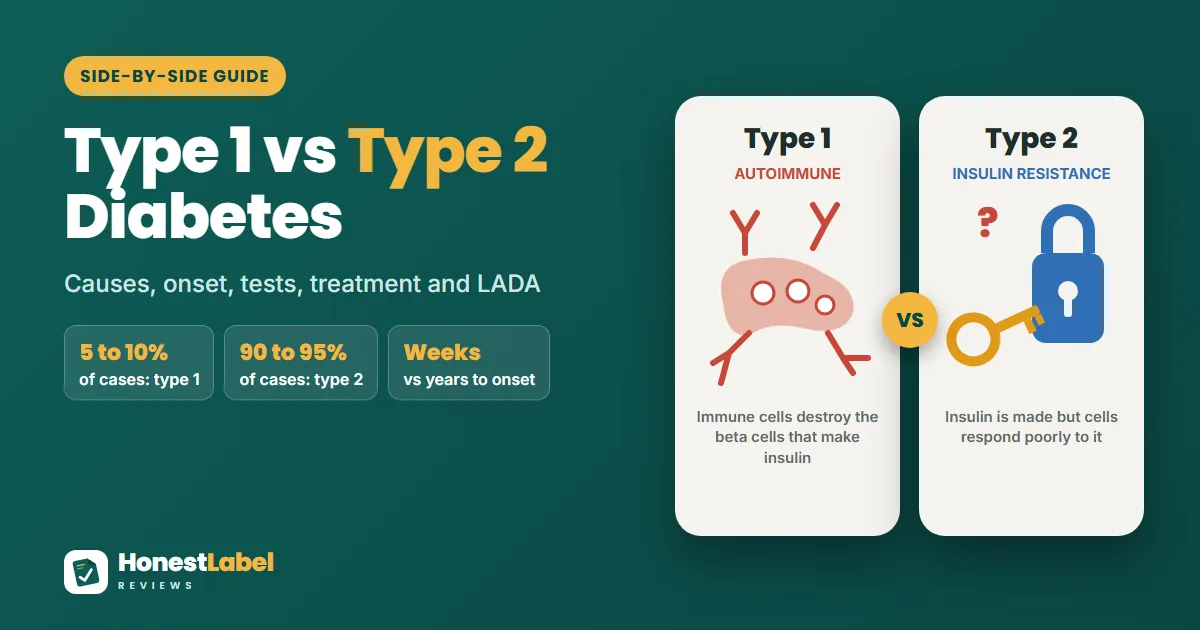
Type 1 diabetes is an autoimmune disease: the immune system destroys the cells that make insulin, so insulin is needed from diagnosis. Type 2, which makes up about 90 to 95 percent of cases, starts with insulin resistance and a slow decline in insulin output. Type 1 often appears over weeks. Type 2 usually builds over years.
Both types end in the same place, blood sugar that is too high, and both are diagnosed with the same tests and the same cut-offs. Our guide to normal blood sugar ranges lists those numbers. What differs is why the sugar rises, how fast it happens, who it happens to and what treatment works.
Mixing them up has real consequences. An adult with slow-onset type 1 can spend years on the wrong pills, and a person with type 2 can be told, wrongly, that they will need insulin forever. Below we compare the two point by point, explain the in-between form called LADA, and cover the two blood tests doctors use to tell them apart.
Type 1 vs type 2 diabetes at a glance
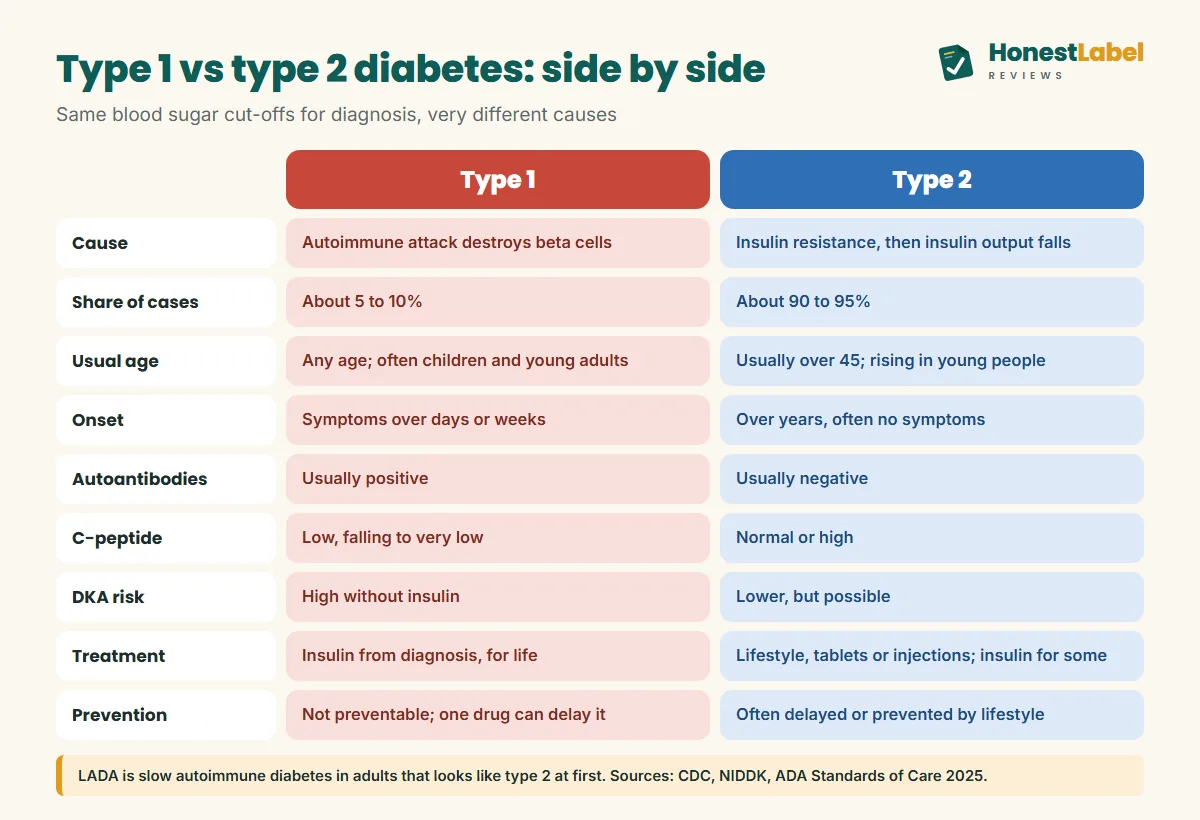
| Feature | Type 1 diabetes | Type 2 diabetes |
|---|---|---|
| Main cause | Immune system destroys insulin-making beta cells | Insulin resistance plus a slow fall in insulin output |
| Share of all diabetes | About 5 to 10 percent | About 90 to 95 percent |
| Typical age at diagnosis | Any age; often children, teens and young adults | Usually over 45, but more young people now |
| Speed of onset | Symptoms over days or weeks | Develops over years, often with no symptoms |
| Insulin production | Very low or none over time | Normal or high at first, falls later |
| Autoantibodies | Usually present | Usually absent |
| C-peptide | Low or undetectable after the first few years | Normal or high |
| Ketoacidosis risk | High without insulin | Lower, but possible |
| Treatment | Insulin from diagnosis, for life | Lifestyle, then tablets or injections; insulin for some |
| Can it be prevented? | No; one drug can delay it in high-risk people | Often delayed or prevented with lifestyle change |
The share of cases comes from the CDC’s National Diabetes Statistics Report, which counts about 40 million Americans with diabetes. The rest of the table is explained section by section below.
The causes: an immune attack compared with insulin resistance
Type 1: the immune system destroys beta cells
In type 1 diabetes, immune cells attack the beta cells in the pancreas, the only cells in the body that make insulin. According to the NIDDK, the attack is driven by a mix of genes and something in the environment that sets it off. Viruses have been studied as triggers for decades, but nobody has pinned down a single cause.
Type 1 is not caused by eating sugar, by weight or by lifestyle. People with type 1 often hear that it was something they did, and that is simply wrong.
Type 2: insulin stops working well, and supply falls behind
In type 2 diabetes, the pancreas still makes insulin, often a lot of it at first. The problem is that muscle, liver and fat cells respond poorly to it. The pancreas compensates for years by making more. Eventually the beta cells cant keep up and blood sugar rises. Our post on the signs of insulin resistance covers that early stage.
The risk factors listed by the CDC include extra weight, especially around the belly, being 45 or older, a parent or sibling with type 2, being active fewer than three times a week, and past gestational diabetes. Genes matter a lot in type 2, often more then in type 1, which is why it runs so strongly in families. Weight is a big factor but not the whole story, and people at a normal weight can develop it.
Age of onset
Type 1 used to be called “juvenile diabetes”, and the name stuck long after doctors dropped it. Type 1 can start at any age. It is the most common type in children, but the American Diabetes Association notes that it is also diagnosed in adults, and adult cases are easy to mislabel as type 2.
Type 2 is the opposite story. It was once called “adult-onset diabetes”, and the CDC says it still most often develops in people over 45. More and more children, teens and young adults are now being diagnosed with it, though, mostly alongside obesity. Age alone can no longer tell the two apart.
Speed of onset
This is often the clearest difference in day to day life.
Type 1 usually feels sudden. Once most beta cells are gone, blood sugar can climb within days or weeks. People become very thirsty, pee constantly, lose weight quickly and feel exhausted. Some are first diagnosed in the emergency room with diabetic ketoacidosis (DKA), a dangerous build-up of acids called ketones. Mayo Clinic lists vomiting, stomach pain, fruity-smelling breath, deep breathing and confusion as warning signs.
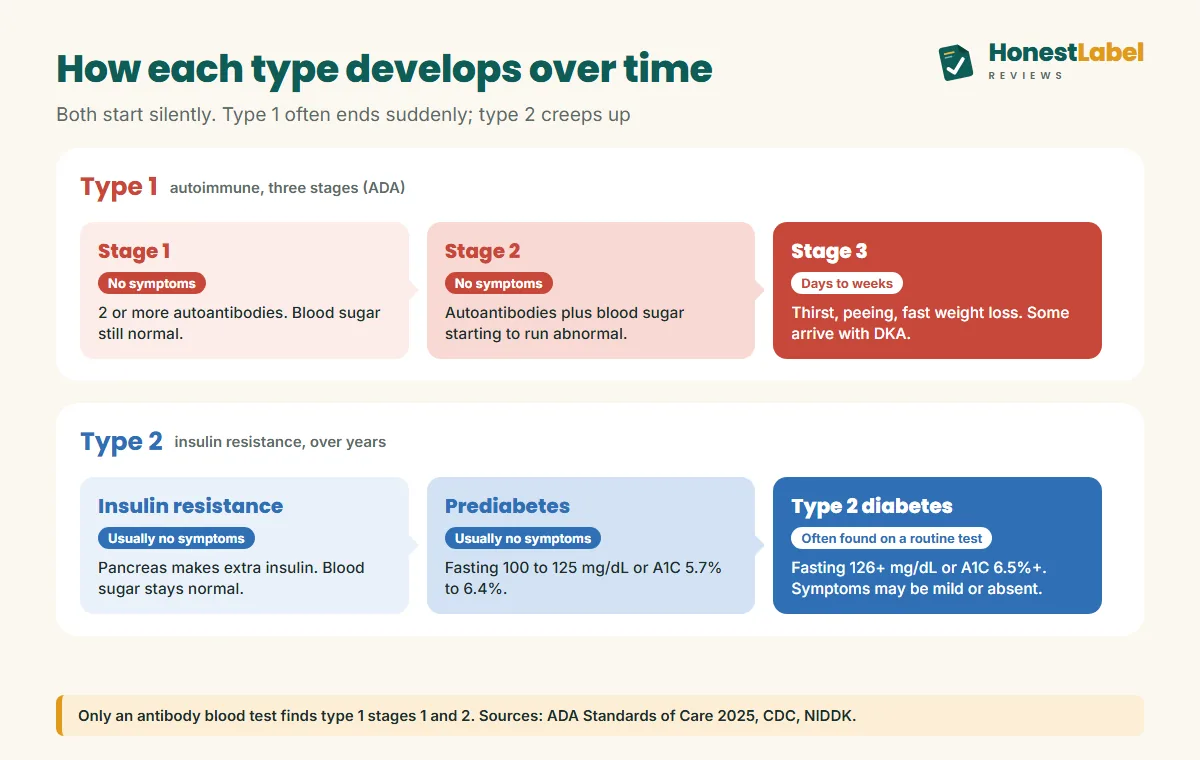
The immune attack itself starts much earlier. The ADA’s Standards of Care describe type 1 in three stages:
- Stage 1: two or more diabetes autoantibodies in the blood, normal blood sugar, no symptoms.
- Stage 2: autoantibodies plus blood sugar that is starting to run abnormal, still without symptoms.
- Stage 3: high blood sugar with symptoms, the point most people are diagnosed.
Stages 1 and 2 can last months or years, and can only be found with an antibody blood test.
Type 2 develops slowly, and most people feel nothing for a long time. Many are diagnosed from a routine blood test. Insulin resistance and prediabetes can run for years until blood sugar crosses the diabetes line.
Treatment
Type 1: insulin is required
Because the body makes little or no insulin, people with type 1 need insulin every day for life, either as several injections a day or through an insulin pump. Most now use a continuous glucose monitor, and many use an automated insulin delivery system, where the pump adjusts insulin based on sensor readings. Counting carbohydrates helps match each insulin dose to the meal.
One newer option targets the immune attack itself. In a trial of 76 relatives of people with type 1 who were at stage 2, a single 14-day course of the antibody drug teplizumab delayed the start of stage 3 diabetes by about two years on average compared with placebo (Herold et al., 2019). The US FDA approved it in 2022 for people aged 8 and older with stage 2 type 1. It delays the disease and does not cure it.
Type 2: lifestyle first, then medication as needed
Type 2 treatment usually starts with food, activity and weight changes. The strongest evidence that these work comes from the Diabetes Prevention Program, where people with prediabetes who lost about 7 percent of their weight and walked around 150 minutes a week cut their risk of type 2 by 58 percent over about three years. Our guide on how to lower blood sugar naturally covers the habits in detail.
Most people with type 2 also take medication. Metformin is often the first. Doctors may add GLP-1 receptor agonists, SGLT2 inhibitors or other drug classes, chosen partly on heart and kidney health. Some people with type 2 eventually need insulin, because beta-cell output keeps falling over the years. Needing insulin does not turn type 2 into type 1.
Safety notes for both types
- People with type 1 should never stop or skip basal insulin, even when they are ill and not eating. Without it, ketoacidosis can develop within hours.
- Insulin and sulfonylureas such as glipizide can cause low blood sugar, below 70 mg/dL. Big changes in food, exercise or alcohol need a plan with your care team.
- No supplement can replace insulin. Supplements sold for blood sugar may also add to the effect of diabetes drugs and push levels too low.
- Pregnancy, kidney disease and liver disease all change which drugs and doses are safe, so treatment is set individually.
LADA: the type that sits in between
Latent autoimmune diabetes in adults, or LADA, is a slow form of autoimmune diabetes. It has the antibodies of type 1 but starts in adulthood and progresses slowly, so at first it looks like type 2. Some experts call it type 1.5, and the ADA groups it under type 1.
Doctors usually think of LADA when an adult over 30 has diabetes autoantibodies and does not need insulin for atleast the first six months after diagnosis. In the UK Prospective Diabetes Study, about 1 in 10 adults newly diagnosed with type 2 had antibodies to GAD, the most common marker of autoimmune diabetes (Turner et al., 1997). Many of those people needed insulin within a few years. Rates vary between countries and studies, so treat that figure as a rough guide.
Clues that “type 2” might really be LADA:
- A normal or low body weight, with no signs of insulin resistance
- Blood sugar that keeps rising within a few years despite tablets and a good diet
- Unplanned weight loss after diagnosis
- A personal or family history of other autoimmune conditions, such as thyroid disease or celiac disease
If this sounds familiar, ask your doctor about an antibody test. LADA usually needs insulin sooner than type 2 does, and finding it early helps avoid months of high blood sugar.
Other types worth knowing about
A small share of diabetes comes from a single gene change. The NIDDK describes MODY, a monogenic form that often appears in teens or young adults and runs through several generations of one family. It is often mistaken for type 1 or type 2, and some forms are treated with tablets alone. Gestational diabetes in pregnancy and diabetes caused by pancreas damage or steroid drugs are separate categories again.
The tests that tell type 1 and type 2 apart
The usual glucose and A1C tests confirm diabetes but cannot tell you which type it is. Two other blood tests can help.
Diabetes autoantibody tests
These look for antibodies against parts of the beta cell. The main ones are:
- GAD65 antibodies (GADA), the most common, and the main test for LADA
- IA-2 antibodies
- Insulin autoantibodies (IAA), useful only before insulin treatment starts
- Zinc transporter 8 antibodies (ZnT8A)
The ADA’s Standards of Care state that one or more of these are present in about 85 to 90 percent of people with type 1 when high blood sugar is first found. A positive result points strongly to autoimmune diabetes. A negative result makes type 1 less likely without ruling it out, because antibody levels can fade over the years.
C-peptide test
When the pancreas makes insulin, it releases a matching amount of a small protein called C-peptide. Measuring it shows how much insulin your own body is still making, even if you inject insulin. In a widely cited review, Jones and Hattersley suggest that a C-peptide level below about 200 pmol/L points to severe insulin deficiency, typical of type 1, while a level above about 600 pmol/L makes type 1 unlikely (Jones and Hattersley, 2013).
Timing matters. Soon after a type 1 diagnosis many people still have some working beta cells, often called the honeymoon phase, so C-peptide can look normal. The test is most useful three or more years after diagnosis, when the two types have usually drifted apart. Results also depend on the lab and on whether you were fasting, so your doctor will read them with your history.
| Test | What it shows | Typical in type 1 | Typical in type 2 |
|---|---|---|---|
| Autoantibodies (GAD, IA-2, ZnT8, IAA) | An immune attack on beta cells | One or more positive | Negative |
| C-peptide | How much insulin your body still makes | Low, falling to very low | Normal or high |
| Ketones (blood or urine) | Fat breakdown from lack of insulin | Often raised at diagnosis | Usually normal |
When to see a doctor
Get emergency care for any of these, whatever type of diabetes you have or suspect:
- Vomiting or stomach pain together with high blood sugar
- Fruity-smelling breath, or deep fast breathing
- Confusion, extreme drowsiness or fainting
- Moderate or high ketones on a home test
Book an appointment soon if you have strong thirst, frequent urination and weight loss over a few weeks, especially in a child or young adult. Ask about antibody or C-peptide testing if you were told you have type 2 but you are lean, your blood sugar is rising quickly despite treatment, or you have other autoimmune conditions. Relatives of people with type 1 can ask about antibody screening, which a research network funded by the US government offers free of charge.
Frequently asked questions
Which is worse, type 1 or type 2 diabetes?
Neither is “mild”. Both can cause heart, kidney, eye and nerve damage if blood sugar stays high. Type 1 carries a higher short-term risk of ketoacidosis and needs insulin every day. Type 2 is often found later, after damage has started. Good control lowers the risk of complications in both.
Can type 2 diabetes turn into type 1?
No. They have diffrent causes. A person with type 2 may need insulin later, and some adults first labelled type 2 turn out to have LADA, which is autoimmune. In that case the original diagnosis gets corrected.
Can you get type 1 diabetes as an adult?
Yes. Type 1 can start at any age, and many people are diagnosed as adults. Adult-onset type 1 and LADA are often mistaken for type 2 at first, which is why antibody tests matter.
Is type 1 diabetes genetic?
Genes raise the risk, but most people with type 1 have no close relative with it. Something in the environment seems to be needed to set off the immune attack. Type 2 actually runs more strongly in families.
Can type 1 or type 2 diabetes be reversed?
Type 1 cannot be reversed with diet or lifestyle; insulin is always needed. Some people with type 2 reach remission, meaning normal blood sugar without medication, usually after significant weight loss. It needs regular monitoring because blood sugar can rise again.
The bottom line
Type 1 diabetes is an autoimmune disease that destroys insulin production, often appears over weeks and allways needs insulin. Type 2 makes up about 90 to 95 percent of cases, grows out of insulin resistance over years and is treated first with lifestyle change and tablets. Age and weight are only rough clues. If your diagnosis does not fit the usual pattern, antibody and C-peptide tests can definitely help settle the question, and you should receive a clear answer about your type before treatment is set for the long term.
Sources
- Centers for Disease Control and Prevention. National Diabetes Statistics Report; Type 2 Diabetes.
- National Institute of Diabetes and Digestive and Kidney Diseases (NIH). Type 1 Diabetes; Monogenic Diabetes (Neonatal Diabetes Mellitus & MODY).
- American Diabetes Association. Type 1 Diabetes.
- American Diabetes Association Professional Practice Committee. Diagnosis and Classification of Diabetes: Standards of Care in Diabetes 2025. Diabetes Care, 2025. PubMed.
- Mayo Clinic. Diabetic ketoacidosis.
- Diabetes Prevention Program Research Group. Reduction in the incidence of type 2 diabetes with lifestyle intervention or metformin. New England Journal of Medicine, 2002.
- Herold KC, et al. An anti-CD3 antibody, teplizumab, in relatives at risk for type 1 diabetes. New England Journal of Medicine, 2019. PubMed.
- Turner R, et al. UKPDS 25: autoantibodies to islet-cell cytoplasm and glutamic acid decarboxylase for prediction of insulin requirement in type 2 diabetes. The Lancet, 1997. PubMed.
- Jones AG, Hattersley AT. The clinical utility of C-peptide measurement in the care of patients with diabetes. Diabetic Medicine, 2013. PubMed.
Medical disclaimer: This article is for general information and is not medical advice. It does not replace a diagnosis or treatment from your doctor. If you have diabetes or take medication that affects blood sugar, talk to your healthcare provider before changing your diet, exercise or supplements.