Last reviewed: November 2026 · Sources: CDC, NIH (NIDDK), American Diabetes Association, Mayo Clinic and peer-reviewed studies (listed at the end)
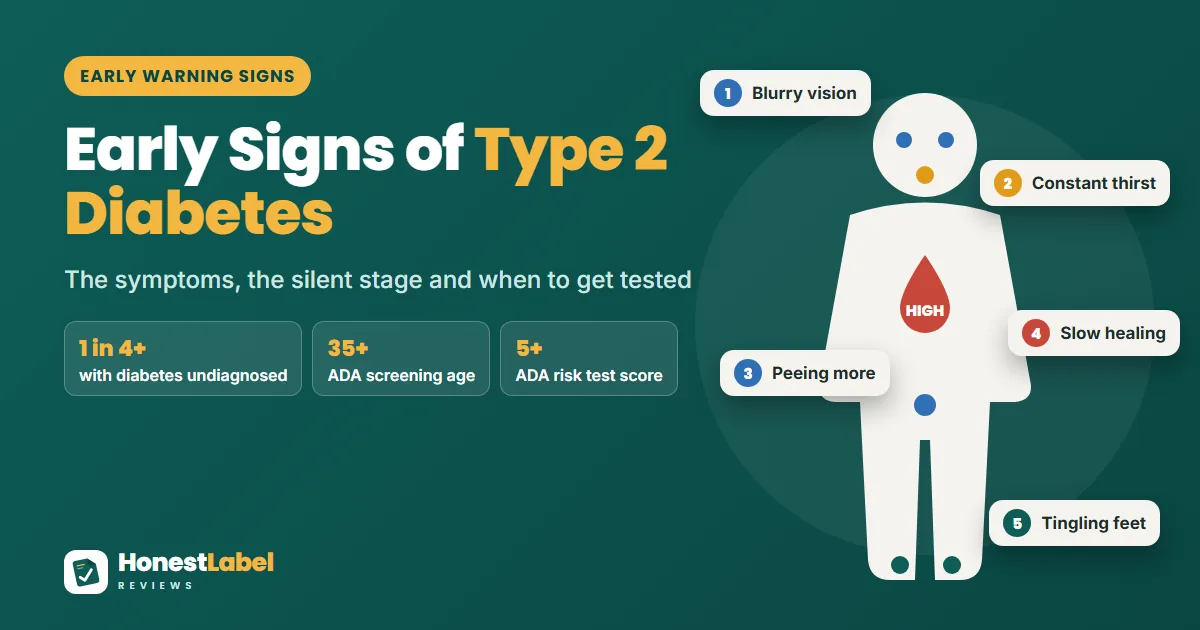
The early signs of type 2 diabetes are the signs of blood sugar that has been high for a while: constant thirst, peeing more, tiredness, blurry vision, slow-healing cuts and repeated infections. Many people feel none of them. The CDC estimates that more than 1 in 4 adults with diabetes are undiagnosed, which is why the ADA advises testing from age 35.
Type 2 diabetes creeps up over years, and people put the changes down to stress, age or a busy week. If you want the numbers that separate normal from high, our guide to normal blood sugar ranges has the full chart.
This article covers the early signs of diabetes that appear after that line is crossed. Our post on the early signs of insulin resistance covers the stage before, when blood sugar is still normal and the clues show up on your waistline, skin and cholesterol test. Here we cover the symptoms of glucose that is allready running high, why many people have none, and how to find out where you stand.
Why type 2 diabetes is so easy to miss
The scale of missed diagnoses is large. According to the CDC’s National Diabetes Statistics Report, about 40 million Americans have diabetes, and more than 1 in 4 of them do not know it. Type 2 makes up about 90 to 95 percent of all cases.
It hides well becuase blood sugar rises slowly, so there is never a clear “before” and “after” day, and the symptoms that do show up, such as tiredness or getting up at night to pee, have plenty of ordinary explanations.
Researchers have tried to estimate how long the silent stage lasts. Harris and colleagues looked at how common early eye damage already was when people were first diagnosed, and worked back from there. There estimate was that type 2 diabetes begins at least 4 to 7 years before the diagnosis is made (Harris et al., 1992). That is a modelled estimate from the early 1990s and screening has improved since, so treat the exact years loosely.
The early signs of type 2 diabetes
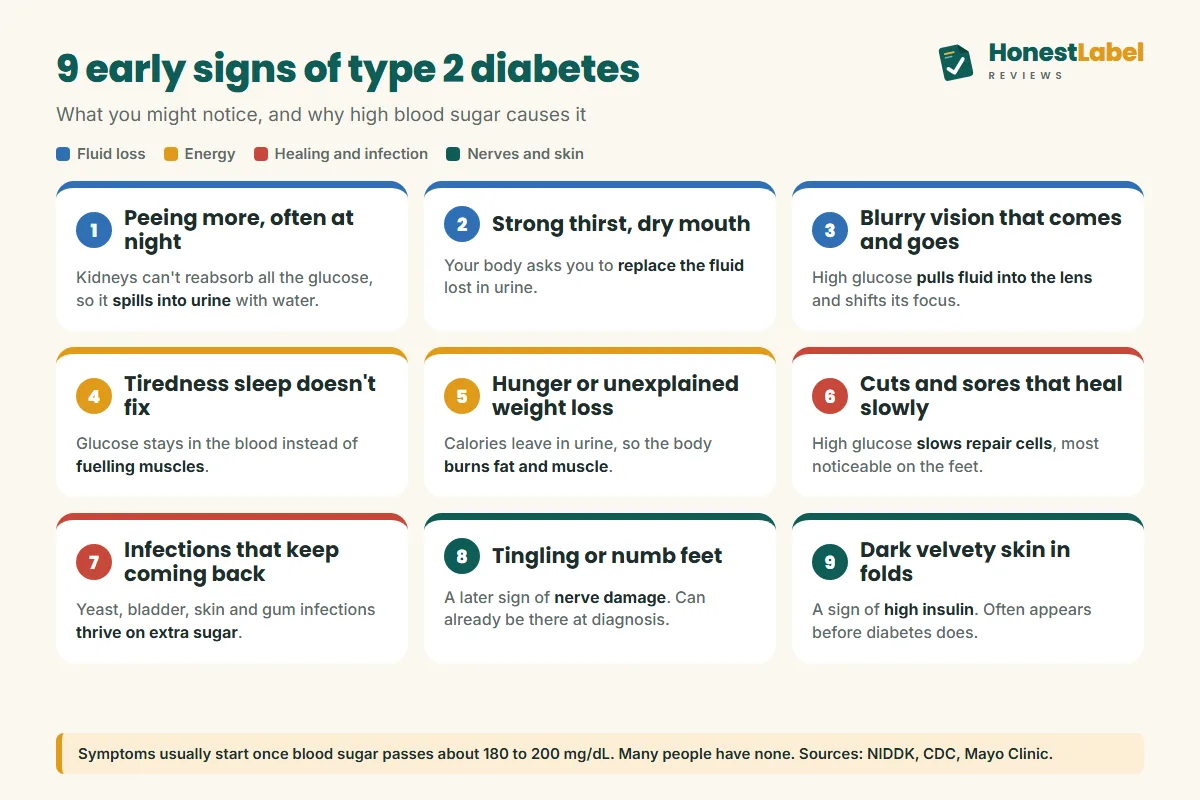
The NIDDK and the CDC list largely the same symptoms. Here is each one and the reason it happens.
1. Peeing more often, especially at night
Your kidneys filter glucose out of the blood and then pull it back in. They can only reabsorb so much. Once blood sugar climbs past that limit, the extra glucose spills into the urine and drags water with it. The result is more trips to the bathroom and more of them at night. Getting up two or three times a night when you used to sleep through is worth noting down.
2. Thirst that water does not seem to fix
This follows directly from the first sign. You lose more fluid, so your brain asks for more. People often describe a dry, sticky mouth. If you reach for juice or soda to quench it, the extra sugar keeps the cycle going.
3. Tiredness that sleep does not explain
When insulin is not working well, glucose stays in the blood instead of reaching your muscles. Add broken sleep and mild dehydration, and many people feel drained. This is the least specific sign on the list. Anemia, thyroid problems, depression and sleep apnea cause the same feeling, so on its own it tells you very litle.
4. Blurry vision that comes and goes
High glucose pulls fluid into the lens of the eye and changes its focus, so vision can blur for a few days and then sharpen again. One practical point: if your eyesight has changed recently, it is worth getting your blood sugar checked before you pay for new glasses, because the prescription can move again once glucose comes down.
5. Hunger, and sometimes weight loss you cannot explain
When cells cannot use glucose well, the body can feel underfed even after a meal. Some people eat more and still lose weight, because calories are leaving in the urine and the body starts burning fat and muscle. It is more typical of type 1 diabetes but happens in type 2 too, and losing weight without trying is allways worth a doctor’s visit.
6. Cuts and sores that heal slowly
High blood sugar slows the cells that repair tissue and fight bacteria. A blister from new shoes or a small scrape on the shin that is still raw after two or three weeks is a clue, especially on the feet.
7. Infections that keep coming back
Germs grow well in a sugar-rich environment, and the immune system works less well when blood sugar is high. Mayo Clinic lists frequent infections among the main symptoms. The common ones are:
- Vaginal yeast infections, or thrush, and in men, a red sore foreskin (balanitis)
- Bladder and urinary tract infections
- Skin infections, boils and fungal rashes in skin folds
- Gum infections, bleeding gums and gum disease
Some people find out from their dentist or from a third yeast infection in a year. It can feel embarassing to bring up, but repeated infections are a good reason to ask for a blood sugar test.
8. Tingling, burning or numbness in the feet or hands
This is a sign of nerve damage, which builds up when blood sugar has been high for some time. It usually starts in the toes and feet, on both sides, and can feel like pins and needles, burning or a sock that is not there. It is a later sign, and it can already be present at diagnosis.
9. Dark, velvety skin in body folds
Darkened skin on the back of the neck or in the armpits (acanthosis nigricans) is a sign of high insulin levels rather than high glucose, so it often shows up before diabetes does. If you see it together with any of the signs above, get tested.
What else could cause these symptoms?
None of these signs proves diabetes, and several are very common. Only a test settles it.
| Sign | How high blood sugar causes it | Other common causes |
|---|---|---|
| Peeing more, waking at night | Glucose spills into urine and pulls water with it | Drinking late, caffeine, enlarged prostate, bladder infection, diuretic pills |
| Strong thirst | Fluid lost through urine | Hot weather, exercise, salty food, some medicines |
| Tiredness | Cells short of fuel, broken sleep | Poor sleep, anemia, thyroid problems, depression |
| Blurry vision | Fluid shifts in the lens | Needing glasses, dry eyes, screen strain |
| Weight loss | Calories lost in urine, fat and muscle burned | Overactive thyroid, stress, other illness |
| Repeated infections | Germs feed on glucose, weaker immune response | Antibiotics, hormone changes, poor oral hygiene |
| Tingling feet | Nerve damage from long-term high glucose | Low vitamin B12, heavy drinking, back problems |
Many people have no symptoms at all
Mayo Clinic notes that high blood sugar usually causes no symptoms until it passes about 180 to 200 mg/dL. Someone with a fasting reading of 135 mg/dL and an A1C of 6.8% has diabetes by the official definition, yet can feel completely normal.
That is why so many diagnoses happen by accident. Common ways people find out:
- A routine blood test at a yearly check-up
- An eye exam that shows early changes in the retina
- Blood work before surgery or during a hospital stay for something else
- A dentist pointing out gum disease that keeps getting worse
Waiting for symptoms means waiting for higher blood sugar. Your risk factors are a better guide.
Who should get tested, even without symptoms
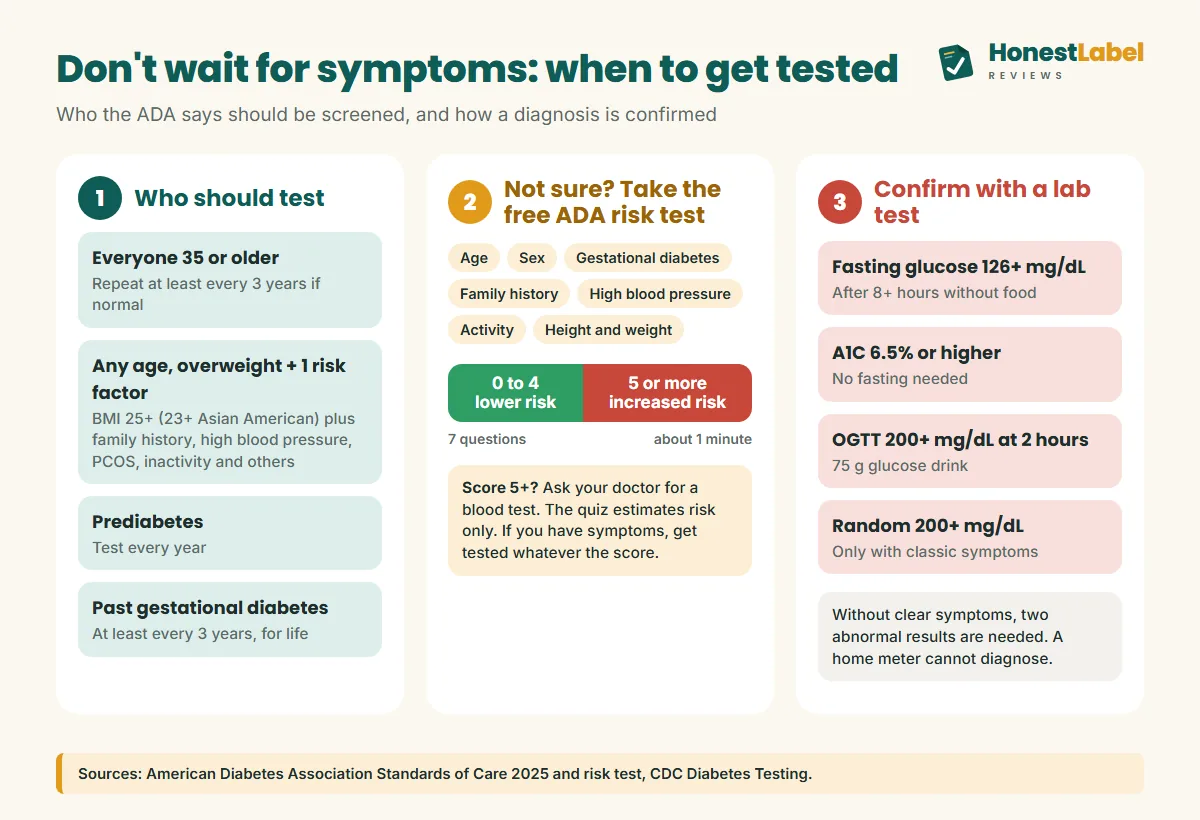
The American Diabetes Association’s Standards of Care set out who should be screened. The main groups are:
- Everyone aged 35 or older. If results are normal, repeat at least every 3 years.
- Adults of any age who are overweight (a BMI of 25 or more, or 23 or more for Asian Americans) and have at least one other risk factor. Those include a parent or sibling with diabetes, high blood pressure, low HDL or high triglycerides, heart disease, PCOS, physical inactivity, and being African American, Latino, Native American, Asian American or Pacific Islander.
- Anyone with prediabetes, every year.
- Women who had gestational diabetes, at least every 3 years for life.
The CDC’s testing page gives the same core advice. If you fit a group and have not been tested in three years, book a test, symptoms or not.
The free ADA risk test
If you are unsure where you fall, the ADA has a free type 2 diabetes risk test online. It takes about a minute and asks seven short questions:
- Your age
- Your sex
- For women, whether you have had gestational diabetes
- Whether a parent or sibling has diabetes
- Whether you have high blood pressure
- Whether you are physically active
- Your height and weight
Each answer adds points. A score of 5 or higher means you are at increased risk for type 2 diabetes, and the ADA advises talking to your doctor about a blood test. The quiz estimates risk and cannot diagnose anything, so if you have several of the signs above, get tested whatever your score.
The tests that confirm it
A diagnosis needs a lab test. The ADA’s diagnostic cut-offs for diabetes are:
- Fasting plasma glucose of 126 mg/dL or higher
- A1C of 6.5% or higher
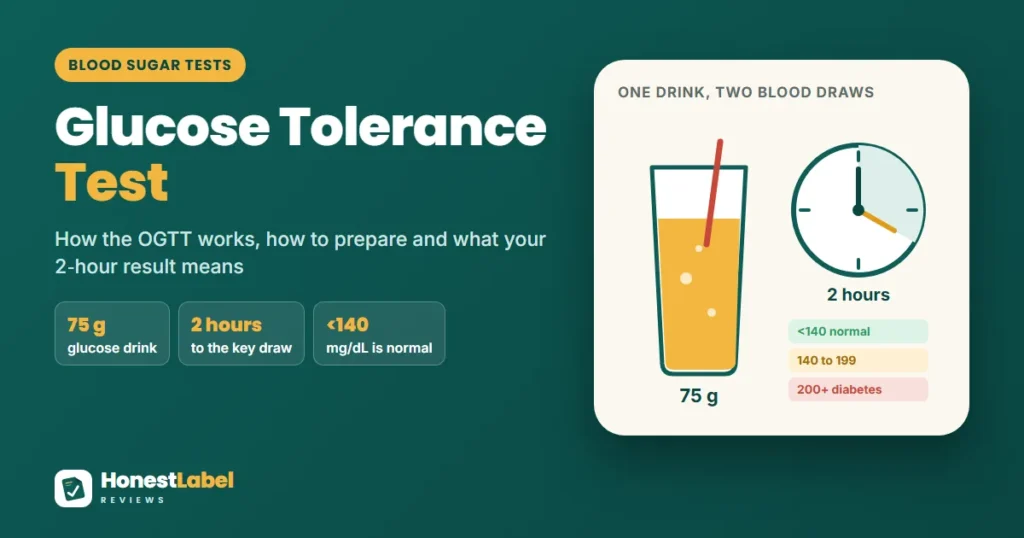
- 2-hour oral glucose tolerance test result of 200 mg/dL or higher
- A random glucose of 200 mg/dL or higher together with classic symptoms
Without clear symptoms, two abnormal results are necessary, either two different tests from the same blood sample or the same test repeated on another day. A fasting result of 100 to 125 mg/dL or an A1C of 5.7% to 6.4% means prediabetes. If you have recently checked your sugar after a meal at home, our guide to blood sugar after eating explains what one and two hour readings mean.
A home meter or a borrowed one from a relative can give a hint, but it cannot diagnose diabetes. Under the international ISO 15197 standard, home meters may read up to about 15 percent above or below the true value (Freckmann et al.), and a single reading after a big lunch says little about your baseline.
What to do before your appointment
If the signs fit, here are practical steps for the next few days:
- Book a test with your doctor or a clinic. Ask for a fasting glucose and an A1C.
- Write down your symptoms and when each one started.
- List your family history: parents, brothers and sisters with diabetes, and at what age.
- Bring a list of every medicine and supplement you take, since steroids and some other drugs raise blood sugar.
- Swap sugary drinks for water now. Thirst plus soda is one of the fastest ways to push blood sugar higher.
- Take a 10 to 15 minute walk after your biggest meal. It lowers the after-meal rise and is safe for most people.
If tests confirm high blood sugar, the research on lifestyle change is encouraging. Our guide on how to lower blood sugar naturally covers the habits with the best evidence. Small steady changes are easier to keep than trying to change everything at once tomorrow.
Who should be careful with changes
Most people can safely cut sugary drinks and walk more. Talk to your doctor first if any of these apply:
- You already take insulin or a sulfonylurea such as glipizide. Eating fewer carbs or exercising more can push you below 70 mg/dL.
- You are pregnant. Testing and targets are different, and weight loss diets are not advised.
- You have kidney, liver or heart disease.
- You are thinking of taking supplements sold for blood sugar. Some can lower glucose on top of medication or interact with other drugs.
Never stop a prescribed medicine on your own because a home reading looked good.
When to see a doctor
Book an appointment within the next week or two if you have:
- Two or more of the signs above, lasting more than a couple of weeks
- Unexplained weight loss
- Repeated yeast, urinary or skin infections
- A fasting home reading of 126 mg/dL or more on two mornings, or any reading of 200 mg/dL or more
Get urgent care the same day, or call emergency services, for any of these red flags:
- Vomiting or stomach pain together with high blood sugar or strong thirst
- Deep, fast breathing or a fruity smell on the breath
- Confusion, extreme drowsiness or fainting
- Signs of severe dehydration, such as very dark urine, dizziness when standing and a dry mouth that will not go away
- Home readings that stay very high and will not come down
These can point to diabetic ketoacidosis or hyperosmolar hyperglycemic state, two emergencies that need hospital treatment. Mayo Clinic notes that ketoacidosis is sometimes the first sign of diabetes. It is far more common in type 1, but it has occurred in people with type 2 as well. Treating it as a weird stomach bug and waiting at home is the risk to avoid.
Frequently asked questions
Can you have type 2 diabetes and feel completely fine?
Yes. Many people with an A1C in the 6.5% to 7% range feel normal. Symptoms usually appear once blood sugar stays above about 180 to 200 mg/dL. That is why the ADA recommends testing everyone from age 35 and earlier for people with risk factors.
How long can you have diabetes without knowing?
Often for years. One well-known estimate, based on eye changes found at diagnosis, put the hidden stage at 4 to 7 years or more.
At what blood sugar level do symptoms start?
It varies. Mayo Clinic puts the usual point at about 180 to 200 mg/dL, which is roughly where the kidneys start leaking sugar into the urine and thirst and frequent urination begin. Some people feel fine at higher levels, especialy when the rise has been slow.
Can a home glucose meter tell me if I have diabetes?
No. A home reading can be a useful nudge, but a diagnosis needs lab tests such as fasting plasma glucose, A1C or an oral glucose tolerance test, usually confirmed twice.
The bottom line
The early signs of type 2 diabetes are thirst, frequent urination, tiredness, blurry vision, slow-healing cuts, repeated infections and, later, tingling feet. Many people never notice them, so if you are 35 or older, or younger with extra weight and one other risk factor, a fasting glucose or A1C test will tell you more than any list of signs. The free ADA risk test takes a minute and is a good place to start.
Sources
- Centers for Disease Control and Prevention. National Diabetes Statistics Report; Diabetes Symptoms; Diabetes Testing.
- National Institute of Diabetes and Digestive and Kidney Diseases (NIH). Symptoms & Causes of Diabetes.
- American Diabetes Association. Type 2 Diabetes Risk Test; Diagnosis.
- American Diabetes Association Professional Practice Committee. Diagnosis and Classification of Diabetes: Standards of Care in Diabetes 2025. Diabetes Care, 2025. PubMed.
- Mayo Clinic. Type 2 diabetes: Symptoms and causes; Hyperglycemia in diabetes; Diabetic ketoacidosis.
- Harris MI, Klein R, Welborn TA, Knuiman MW. Onset of NIDDM occurs at least 4 to 7 yr before clinical diagnosis. Diabetes Care, 1992. PubMed.
- Freckmann G, et al. System accuracy evaluation of blood glucose monitoring systems following ISO 15197:2013. PubMed.
Medical disclaimer: This article is for general information and is not medical advice. It does not replace a diagnosis or treatment from your doctor. If you have diabetes or take medication that affects blood sugar, talk to your healthcare provider before changing your diet, exercise or supplements.