Last reviewed: November 2026 · Sources: American Diabetes Association, CDC, NIH (NIDDK), MedlinePlus and peer-reviewed studies (listed at the end)
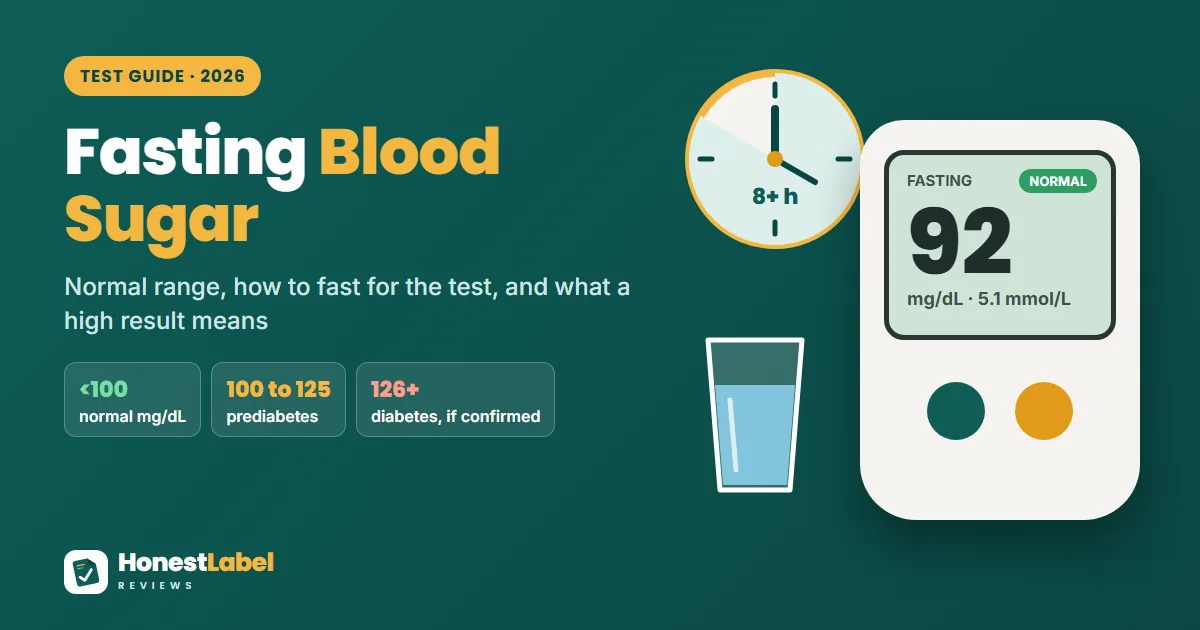
A normal fasting blood sugar is under 100 mg/dL (5.6 mmol/L) after at least 8 hours without food. A result of 100 to 125 mg/dL points to prediabetes, and 126 mg/dL or higher on two separate tests points to diabetes. Drink only water before the test, and repeat any high result before drawing conclusions.
Fasting blood sugar is the most common blood sugar test there is. It is cheap, it is part of many routine check-ups, and it gives a clean baseline because no recent meal is muddying the result. It is also easy to get wrong. A splash of milk in your coffee, a late snack or a rough night can all nudge the number, and a single reading on a home meter is not the same thing as a lab result.
This guide covers the fasting ranges, how to prepare so the result is accurate, how lab tests differ from home meters, and what to do next if your number comes back high. For every other test and its cut-offs, see our overview of normal blood sugar ranges.
Fasting blood sugar ranges
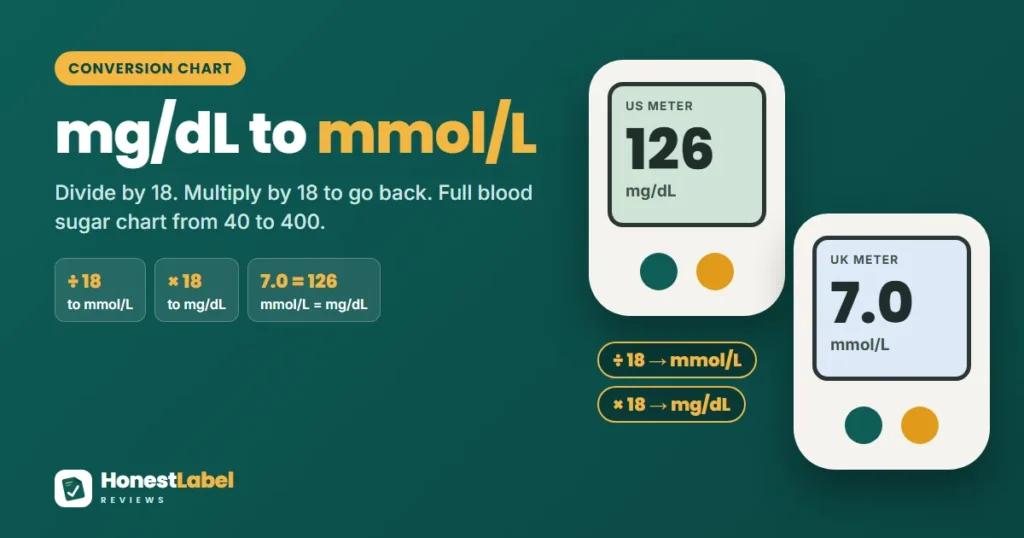
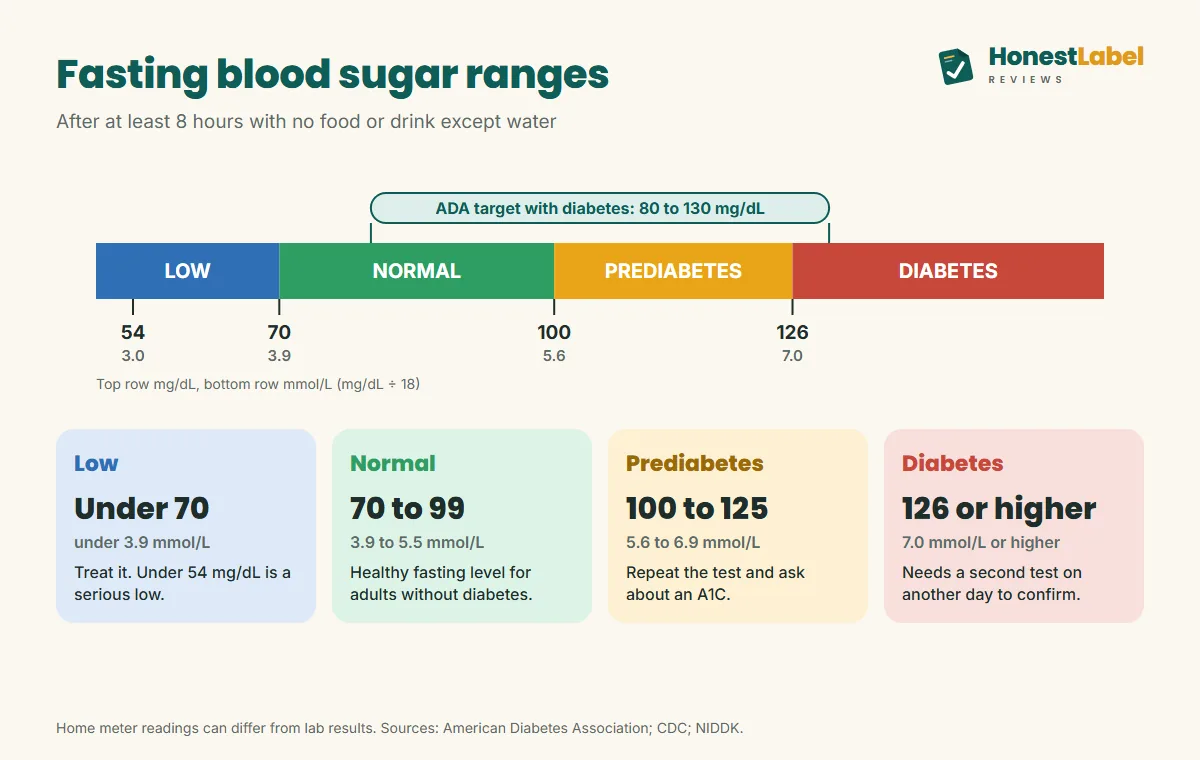
The American Diabetes Association and the CDC use the same cut-offs for a fasting plasma glucose test. To convert mg/dL to mmol/L, divide by 18.
| Fasting result | mg/dL | mmol/L | What it means |
|---|---|---|---|
| Low | Under 70 | Under 3.9 | Hypoglycemia; under 54 is a serious low |
| Normal | 70 to 99 | 3.9 to 5.5 | Healthy fasting level |
| Prediabetes | 100 to 125 | 5.6 to 6.9 | Impaired fasting glucose |
| Diabetes | 126 or higher | 7.0 or higher | Needs a second confirming test |
| Target with diabetes (most adults) | 80 to 130 | 4.4 to 7.2 | ADA general goal before meals |
The diabetes target is a treatment goal. It is set looser than the normal range becuase pushing fasting levels too low raises the risk of hypoglycemia in people on medication. The ADA lists 80 to 130 mg/dL before meals as a general goal for many non-pregnant adults with diabetes (American Diabetes Association). Pregnancy has its own, tighter targets that a care team sets.
What counts as “fasting”?
For the test, fasting means no calories for at least 8 hours (ADA). Most people do this by skipping food after dinner and having blood drawn first thing in the morning. Going much longer does not make the test more accurate, and a very long fast can make you lightheaded.
How to fast correctly for a blood sugar test
Preparation matters more than people expect. These steps follow the general advice from MedlinePlus and the testing guidance from the NIDDK. Always follow your own lab’s instructions if they differ.
The evening before
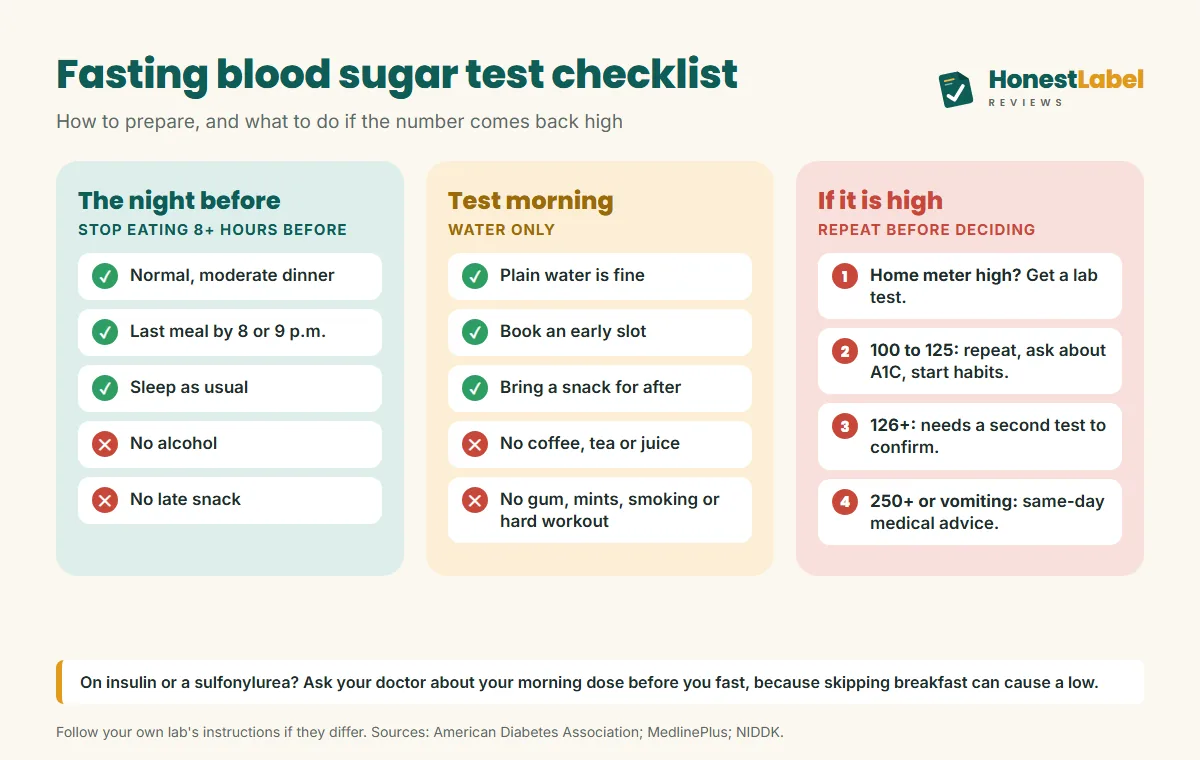
- Eat a normal dinner. A huge, late, carb-heavy meal can still affect the next morning, so keep it moderate.
- Skip alcohol. It can lower or raise blood sugar the next day depending on how much you drink and what you ate.
- Set the cut-off time. If your draw is at 8 a.m., finish eating by midnight at the latest. Finishing around 8 to 9 p.m. gives you a comfortable margin.
- Try to sleep normally. A short night can make your body more insulin resistant the next morning (Donga et al., 2010).
The morning of the test
- Drink plain water. It does not affect the result and makes the blood draw easier.
- Skip coffee and tea, even black. Most labs ask for water only, and caffeine raises blood sugar slightly in some people.
- No gum, mints, cough drops or juice. Even “sugar-free” gum can contain sugar alcohols or small amounts of carbohydrate.
- Do not smoke or vape, and skip a hard workout. Both can shift the number.
- Book an early slot. The later in the morning, the longer you go without food, and the harder it is for people on medication.
Medication
Most medicines can be taken as usual with water, but ask your doctor ahead of time. This is necessary if you take insulin or a sulfonylurea such as glipizide or glyburide, because taking your normal dose without breakfast can push you into a low. Your doctor may tell you to delay or reduce the morning dose until after the test. Bring a snack to eat straight after the draw.
Lab test vs home meter
A fasting plasma glucose test at a lab and a finger-prick check at home both report a fasting number, but they are not interchangeable.
| Lab fasting plasma glucose | Home meter | |
|---|---|---|
| Sample | Vein, plasma measured in a lab analyser | Fingertip, small drop of capillary blood |
| Accuracy | Highest; used for diagnosis | Within about 15 mg/dL or 15% for most readings |
| Used for | Diagnosing prediabetes and diabetes | Daily tracking and spotting patterns |
| Common errors | Sample left unprocessed too long | Dirty fingers, old strips, too little blood |
Home meters sold today are generaly built to the international ISO 15197:2013 standard. It requires 95 percent of readings to fall within 15 mg/dL of a lab value when glucose is under 100 mg/dL, and within 15 percent at 100 mg/dL and above (studies of meter accuracy). That means a true fasting value of 98 could show up anywhere from about 83 to 113 on a meter that still meets the standard. One home reading of 108 is not proof of prediabetes.
Lab samples have there own weak spot. Red and white blood cells keep burning glucose after the blood is drawn, so a sample that sits around before it is spun down or put on ice can read lower than it should. Laboratory guidelines describe a drop of roughly 5 to 7 percent an hour at room temperature (Sacks et al.). Labs handle this with special tubes and fast processing, so it is rarely a problem, but it is one reason a lab number is not perfectly exact either.
Getting an accurate home reading
- Wash your hands with soap and warm water and dry them well. Fruit juice or food on your fingers can make the reading falsely high.
- Check that the strips are in date and stored in a closed container, away from heat and damp.
- Use the side of the fingertip and get a full drop. Squeezing hard can dilute the sample with tissue fluid.
- Test at the same time each morning, before food, coffee or exercise.
- Write the number down with a note about anything unusual: a late dinner, a cold, a weird night of sleep.
Our guide on blood sugar after eating covers when to test after meals, which tells you something diffrent from a fasting check.
What can push a fasting result up
A fasting number reflects what your liver did overnight as much as what you ate the day before. Several things can raise it for a day or two:
- A cold, flu or any infection
- Steroid medicines such as prednisone, and some other drugs
- Poor sleep or a stressful week
- A late, heavy dinner or a bedtime snack
- Dehydration
Many people also see a morning rise from the dawn phenomenon, when hormones released in the early hours tell the liver to put out more glucose (Mayo Clinic). If your fasting numbers are consistently higher than your bedtime numbers, our guide on high blood sugar in the morning explains the causes and the 3 a.m. check that tells them apart.
What to do after a high fasting result
Your next step depends on the number and on where it came from. A home meter reading is a reason to get a lab test. A lab reading is a reason to talk to your doctor.
100 to 125 mg/dL (prediabetes range)
- Repeat it. If the first result was from a home meter, ask for a lab fasting glucose or an A1C. If it was a lab result, your doctor may add an A1C to see the longer picture.
- Look at your risk factors with your doctor: weight, family history, blood pressure, past gestational diabetes and activity level.
- Start on lifestyle changes now. In the Diabetes Prevention Program, a trial of more than 3,000 adults with prediabetes, losing about 7 percent of body weight and walking around 150 minutes a week cut the risk of type 2 diabetes by 58 percent over about three years (Diabetes Prevention Program, 2002). Our guide on how to lower blood sugar naturally breaks those habits into daily steps.
- Retest about once a year, or sooner if your doctor suggests it.
126 mg/dL or higher
One result is not a diagnosis. The ADA asks for two abnormal results, either from two tests on separate days or from two different tests on the same sample, such as fasting glucose plus A1C (ADA). The exception is a random reading of 200 mg/dL or higher together with classic symptoms such as heavy thirst, frequent urination and unexplained weight loss. Book an appointment within the next few days. Dont wait for symptoms, because most people with type 2 diabetes have none at the beginning.
250 mg/dL or higher
A fasting reading this high needs same-day medical advice, especialy with thirst, vomiting, stomach pain or confusion. See the red flags below.
If you already have diabetes
Fasting numbers that sit above your target for more than a week or two are worth a call to your care team. Bring a log of bedtime and morning readings, plus your medication times, so they can see the pattern. Do not adjust insulin or other drugs on your own.
Safety: who should be careful
- People on insulin or sulfonylureas. Fasting for a test can cause a low. Plan your morning dose with your doctor, and treat any reading under 70 mg/dL with 15 grams of fast-acting carbohydrate even if it means postponing the test (ADA).
- Pregnant women. Fasting targets in pregnancy are lower, and testing for gestational diabetes uses a glucose drink. Follow your maternity team.
- Older adults and people with kidney disease, who are more prone to lows and may need a different schedule.
- Anyone with a history of fainting at blood draws. Tell the staff, and eat as soon as the draw is done.
- People with an eating disorder, for whom fasting can be hard. Your doctor can often use an A1C instead, which needs no fast.
When to see a doctor
Book an appointment if:
- A lab fasting result is 100 mg/dL or higher and you have not discussed it with anyone
- Home fasting readings are 126 mg/dL or higher on two or more mornings
- You have thirst, frequent urination, blurred vision or weight loss you cannot explain
- You have diabetes and your fasting numbers stay above target, or you have morning lows
Get emergency care for confusion, fainting, a seizure, or high blood sugar with vomiting, deep fast breathing or a fruity breath smell. The ADA lists these as warning signs of diabetic ketoacidosis.
Frequently asked questions
Can I drink water before a fasting blood sugar test?
Yes. Plain water is allowed and recommended. It does not change your glucose and it makes the blood draw easier. Avoid flavoured water, sparkling drinks with sweeteners and anything with calories.
Does black coffee break a fasting blood sugar test?
Black coffee has almost no calories, but caffeine can raise blood sugar a litle in some people, and most labs ask for water only. To be safe, have your coffee after the draw.
What is a normal fasting blood sugar for a non-diabetic?
For adults without diabetes, a normal fasting level is 70 to 99 mg/dL (3.9 to 5.5 mmol/L). The same range applies at every adult age.
Is a fasting blood sugar of 105 bad?
A lab result of 105 mg/dL is in the prediabetes range. It does not mean diabetes, and it is often reversible with weight loss and regular activity. Repeat the test and ask your doctor about an A1C.
How long should I fast before a blood sugar test?
Atleast 8 hours with nothing but water. Most people fast overnight for 8 to 12 hours. Fasting much longer is not needed and can make you feel faint.
The bottom line
A normal fasting blood sugar is under 100 mg/dL, 100 to 125 suggests prediabetes, and 126 or higher on two tests suggests diabetes. Fast for at least 8 hours with water only, sleep normally, and plan your medication with your doctor if you take insulin or a sulfonylurea. Treat a high home reading as a reason to get a lab test, and a high lab result as a reason to act. If you are in the prediabetes range, small changes made now have the largest effect, so there is no reason to wait for tomorrow.
Sources
- American Diabetes Association. Diagnosis; Checking Your Blood Glucose; Hypoglycemia; Hyperglycemia.
- Centers for Disease Control and Prevention. Diabetes Testing.
- National Institute of Diabetes and Digestive and Kidney Diseases (NIH). Diabetes Tests & Diagnosis.
- MedlinePlus (US National Library of Medicine). Fasting for a Blood Test.
- Mayo Clinic. Dawn phenomenon.
- Diabetes Prevention Program Research Group. Reduction in the incidence of type 2 diabetes with lifestyle intervention or metformin. New England Journal of Medicine, 2002.
- Donga E, et al. A single night of partial sleep deprivation induces insulin resistance in multiple metabolic pathways in healthy subjects. Journal of Clinical Endocrinology & Metabolism, 2010. PubMed.
- Sacks DB, et al. Guidelines and recommendations for laboratory analysis in the diagnosis and management of diabetes mellitus. PubMed.
- Studies of home blood glucose meter accuracy against ISO 15197:2013. PubMed.
Medical disclaimer: This article is for general information and is not medical advice. It does not replace a diagnosis or treatment from your doctor. If you have diabetes or take medication that affects blood sugar, talk to your healthcare provider before changing your diet, exercise or supplements.