Last reviewed: November 2026 · Sources: American Diabetes Association, CDC, NIH and peer-reviewed trials including DiRECT and Look AHEAD (listed at the end)
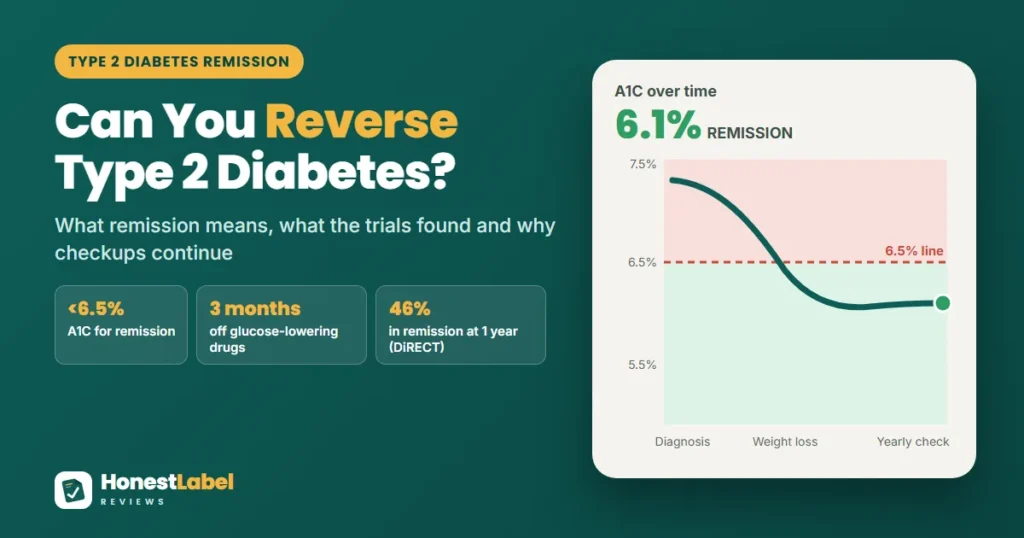
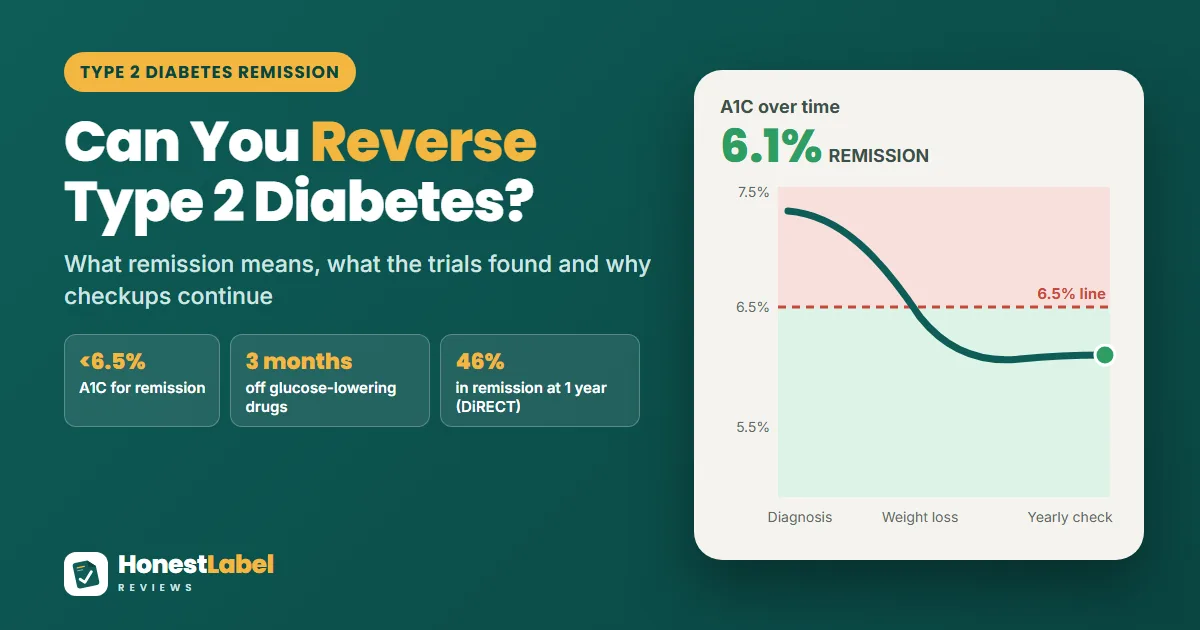
For some people, yes, though doctors call it remission rather than a cure. Remission means an A1C under 6.5% that stays there for at least 3 months after glucose-lowering drugs are stopped by your doctor. In the DiRECT trial, 46% of people on a weight-loss program reached it at one year. It can return later.
Several large studies show that blood sugar can truly return to below the diabetes range without medication, mostly after substantial weight loss. If you want a refresher on the numbers first, our guide to normal blood sugar ranges has the full chart.
Below we cover what “reverse type 2 diabetes” means in medical terms, what the trials found and why remission often fades. If your results are still in the prediabetes range, our prediabetes guide is the better place to start.
What doctors mean by remission
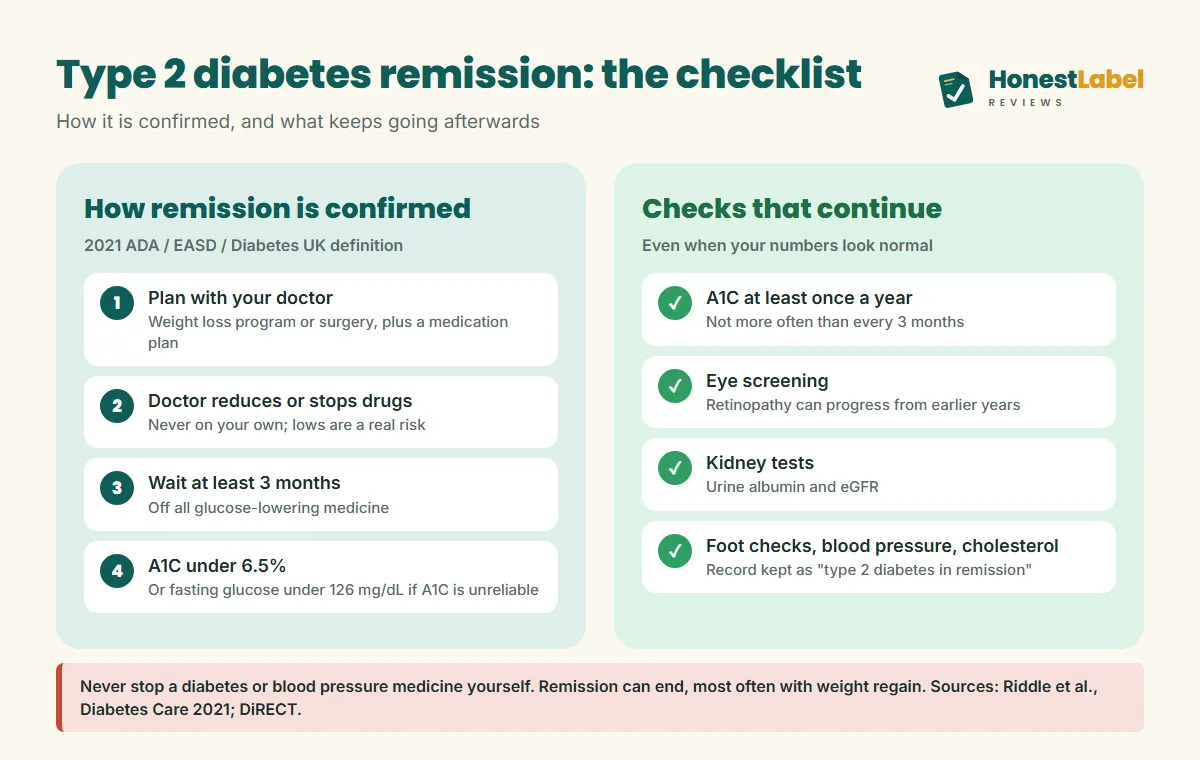
In 2021 an international expert group convened by the American Diabetes Association, with the European Association for the Study of Diabetes and Diabetes UK, agreed on one definition (Riddle et al., 2021).
Remission is an A1C below 6.5% (48 mmol/mol) measured at least 3 months after glucose-lowering medication has stopped. The group chose “remission” on purpose. “Cure” and “reversal” suggest the disease is gone for good, and the evidence shows it can come back. The ADA’s summary adds that remission can follow an intervention or happen on its own, as long as it lasts at least 3 months without the usual drugs.
| Part of the definition | What it means in practice |
|---|---|
| A1C under 6.5% | Below the A1C cut-off used to diagnose diabetes |
| At least 3 months after medication stops | A1C reflects about 3 months of blood sugar, so earlier tests would still show the drug’s effect |
| After bariatric surgery | Wait at least 3 months after the operation and 3 months off drugs |
| When A1C is unreliable (some anemias, kidney disease) | A fasting glucose under 126 mg/dL, or an A1C estimated from a continuous glucose monitor under 6.5% |
| Ongoing | A1C checked at least once a year, and not more often than every 3 months |
An A1C of 6.0% while you take metformin or a GLP-1 drug is good control, not remission. And an A1C of 5.7% to 6.4% is still the prediabetes range, where many people in remission sit. Our guide to the A1C test explains what each band means.
Why remission is possible at all
Type 2 diabetes comes from two problems working together. Cells stop responding well to insulin, and the beta cells in the pancreas that make insulin fall behind. Newcastle University researchers led by Roy Taylor have argued that fat stored inside the liver and the pancreas drives both.
Their scans of people in the DiRECT trial found that those who reached remission lost fat from the liver and the pancreas, and their first-phase insulin response came back. People who lost similar weight but did not reach remission had less recovery of beta cell function (Taylor et al., Cell Metabolism, 2018). The idea is that strained beta cells can recover if the fat load is removed in time. It is still being tested, so treat it as a strong theory.
The evidence: weight loss diets
The DiRECT trial
DiRECT is the study most people mean when they say type 2 diabetes can be reversed. It ran in 49 primary care practices in Scotland and the Tyneside area of England and enrolled 298 adults aged 20 to 65 who had been diagnosed within the past 6 years, had a BMI between 27 and 45, and were not using insulin (Lean et al., Lancet, 2018).
The intervention group stopped their diabetes and blood pressure pills at the start, under the study team’s supervision, and replaced all food with a formula diet of about 825 to 853 calories a day for 3 to 5 months. Food was then brought back step by step. The control group got usual care.
The one-year results:
- 46% of the intervention group were in remission, compared with 4% of the control group.
- Average weight loss was 10 kg (about 22 pounds) in the intervention group and 1 kg in the control group.
- 24% of the intervention group lost 15 kg or more. Nobody in the control group did.
Remission tracked weight loss closely. Across all participants, remission rates were:
| Weight lost at 12 months | Share in remission |
|---|---|
| Gained weight | 0% |
| 0 to 5 kg (up to 11 lb) | 7% |
| 5 to 10 kg (11 to 22 lb) | 34% |
| 10 to 15 kg (22 to 33 lb) | 57% |
| 15 kg or more (33 lb or more) | 86% |
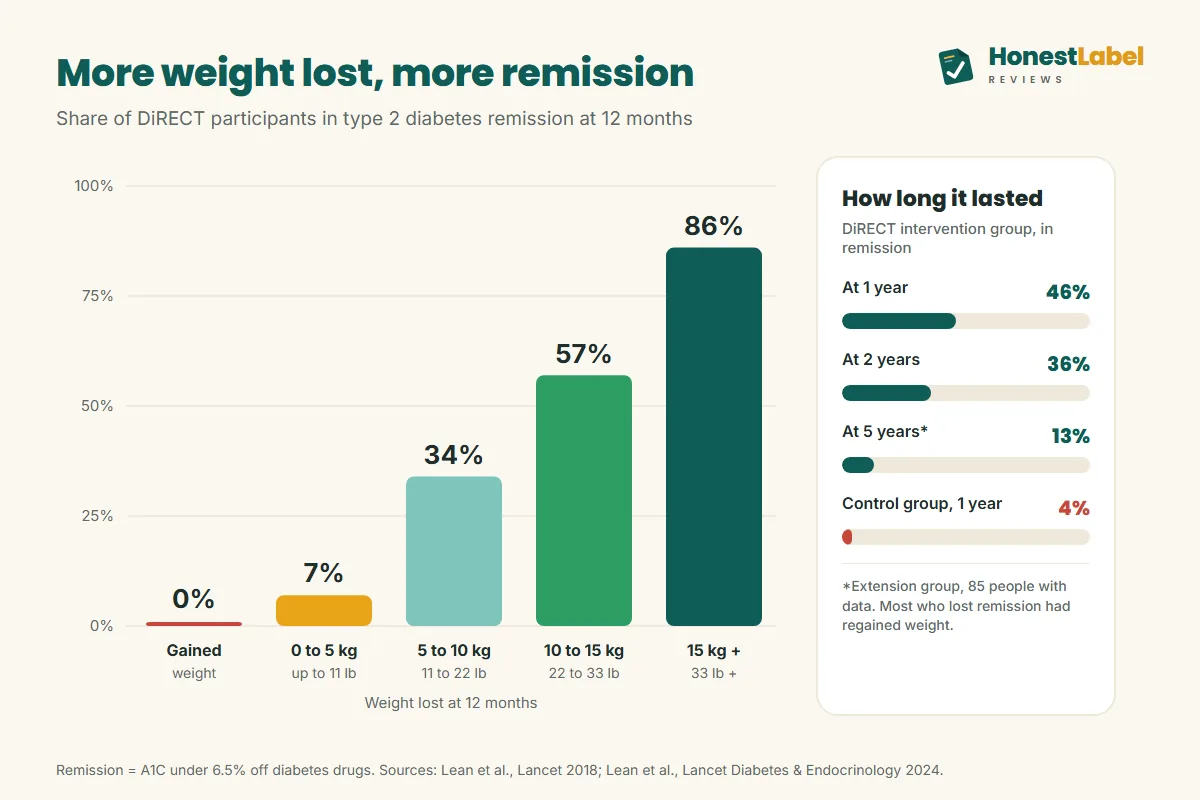
The catch is staying there. At 2 years, 36% of the intervention group were still in remission. In a five-year extension, 13% of the 85 participants with data were in remission, and of those in remission at 2 years, about a quarter (26%) were still in remission at 5 years (Lean et al., Lancet Diabetes & Endocrinology, 2024). Most people who lost remission had regained weight. The intervention group also had fewer serious illnesses needing hospital care.
Look AHEAD: a gentler approach
Look AHEAD was a large US trial of more than 4,500 adults with type 2 diabetes and overweight. It used an intensive lifestyle program of calorie reduction and about 175 minutes of exercise a week, with no meal replacement phase as strict as DiRECT’s. Remission was not its main goal, but an analysis found that 11.5% of the lifestyle group reached partial or complete remission in the first year, compared with 2.0% of the comparison group. By year 4 it had dropped to 7.3% (Gregg et al., JAMA, 2012). Its definition was looser than the 2021 one, and the program led to smaller weight loss, which helps explain the lower numbers.
What if you are not overweight?
Some people develop type 2 diabetes at a normal BMI. A small Newcastle study called ReTUNE took 20 people with a BMI of 21 to 27 through cycles of weight loss. After a year they had lost about 9% of body weight on average, and 14 of the 20 (70%) reached remission (Taylor et al., ReTUNE). The study was tiny and needs repeating, but it suggests body weight targets should be personal.
The evidence: bariatric surgery
Weight loss surgery produces the largest and fastest drops in blood sugar. In the Swedish Obese Subjects study, 72% of people with type 2 diabetes who had surgery were in remission at 2 years, compared with 16% of a matched group who had usual care. At 15 years the figures were 30% and 7% (Sjöström et al., JAMA, 2014). It was observational and used a looser glucose cut-off than the 2021 definition.
A US study of 4,434 adults who had gastric bypass found that 68% reached complete remission within 5 years. Among those, 35% saw diabetes return within the following 5 years, and the median length of remission was 8.3 years (Arterburn et al., Obesity Surgery, 2013).
Surgery is a major operation with real risks, including nutrient deficiencies and lifelong follow-up, and it is a decision to make with a specialist team.
What about GLP-1 medicines?
Newer drugs such as GLP-1 receptor agonists can lower A1C and body weight a great deal. While you take them, a normal A1C counts as well-controlled diabetes, not remission, under the 2021 definition. Weight often returns when they are stopped, and any change to them is a decision for your prescriber.
How long you’ve had diabetes matters
The single most useful predictor after weight loss is time. DiRECT only took people diagnosed within the past 6 years. In the gastric bypass study above, longer diabetes duration, insulin use and poor blood sugar control before surgery all predicted a lower chance of remission and a higher chance of relapse.
The likley reason is the beta cells. Early on, many are stressed but still alive. After many years of high glucose, more of them stop working for good, and weight loss can’t bring them back. Weight loss after 10 or 15 years still lowers blood sugar, blood pressure and the medication people need, even if full remission is less likely.
Signs that remission is more likely, based on the studies above:
- Diagnosed within the last few years
- Not using insulin
- An A1C that is only moderately high
- Able to lose and keep off around 10 to 15 kg, or roughly 10% to 15% of body weight
Why remission can be lost
The underlying tendency stays, which is why remission can end. The main reasons:
- Weight regain. In DiRECT, people who regained weight were much more likely to lose remission.
- Ageing and beta cell decline. Insulin-making capacity falls with age, even in people without diabetes.
- Illness, steroids and other drugs. Infections, steroid treatment and some other medicines can push glucose back up.
Going back above 6.5% is not a personal failure. It has occurred in most people in every long-term study, and it doesn’t erase what was gained.
Monitoring has to continue
The 2021 consensus advises an A1C test at least once a year for anyone in remission, and it recommends keeping up the usual checks for complications, becuase damage from earlier years of high blood sugar can keep progressing:
- A1C at least yearly
- Eye screening for diabetic retinopathy
- Kidney checks (urine albumin and eGFR blood test)
- Foot checks for nerve damage and circulation
- Blood pressure and cholesterol
Keep your diagnosis on your medical record as “type 2 diabetes in remission” so future doctors know your history. That matters before surgery, in pregnancy and when new medicines are prescribed.
How to work toward remission safely
If remission is your goal, talk to your doctor before you begin and ask:
- Is remission realistic for me, given how long I’ve had diabetes and what I take?
- Which of my medicines need to be reduced first if I cut calories, and who will adjust them?
- Is a supervised low-calorie program or a referral to a dietitian available?
- When should I have my A1C rechecked?
Everyday habits that support weight loss and steady glucose, such as walking after meals and eating more fiber, are covered in our guide on how to lower blood sugar naturally. Those habits definitely matter for keeping weight off after the beginning phase, which is where most people struggle.
Who should be careful
Never stop or reduce a diabetes or blood pressure medicine on your own. In DiRECT, medication changes were made by the study team on day one, with close follow-up. A very low-calorie diet while still taking some drugs can be dangerous.
- Insulin or sulfonylureas (such as glipizide or gliclazide). Cutting calories sharply can cause lows below 70 mg/dL, sometimes severe ones. Doses usually need to come down before or as you start.
- SGLT2 inhibitors. Combined with very low carbohydrate or calorie intake, these carry a risk of ketoacidosis even when glucose looks near normal, so your doctor may pause them.
- Blood pressure pills. Blood pressure often falls with weight loss, and doses may need lowering to avoid dizziness.
- Pregnancy or breastfeeding. Weight-loss diets are not advised.
- Kidney disease, heart disease or a history of eating disorders. Formula diets and rapid weight loss need specialist input.
- Gallstones. Fast weight loss raises the chance of gallstones, so report pain under the right ribs.
When to see a doctor
Book an appointment if you:
- Want to try for remission and take any diabetes or blood pressure medicine
- Have lost a lot of weight and are having frequent lows or dizzy spells
- Think you may be in remission and have not had an A1C in the last year
- Are in remission and see home readings creeping back up, such as fasting results of 126 mg/dL or more
Get urgent care for confusion, fainting or a low that doesn’t come up after treatment, and for high blood sugar with vomiting, deep fast breathing or a fruity smell on the breath.
Frequently asked questions
Can type 2 diabetes be cured?
Experts avoid the word cure, because the tendency stays and blood sugar can rise again. Remission, meaning an A1C under 6.5% for at least 3 months without glucose-lowering drugs, is possible for some people, especially after major weight loss early in the disease.
How much weight do you need to lose to reverse type 2 diabetes?
There is no single number. In DiRECT, 57% of people who lost 10 to 15 kg and 86% of those who lost 15 kg or more were in remission at one year, while very few who lost under 5 kg got there.
Can you reverse type 2 diabetes after 10 years?
It is less likely, though not impossible. Longer duration and insulin use predict lower remission rates, but weight loss still lowers blood sugar.
Is a normal A1C on metformin the same as remission?
No. Under the 2021 definition, remission is only counted at least 3 months after glucose-lowering drugs are stopped. A normal A1C while taking medication means your diabetes is well controlled.
The bottom line
You can reverse type 2 diabetes in the sense doctors use: remission, an A1C under 6.5% for at least 3 months off medication. It is most likely with large weight loss early in the disease, and the best trial reached 46% at one year. It often fades over time, mostly with weight regain, so yearly A1C tests and the usual eye, kidney and foot checks must carry on. Plan any attempt with your doctor so you receive the right medication changes along the way. Even without full remission, the weight loss itself brings a lot of benefit.
Sources
- Riddle MC, Cefalu WT, Evans PH, et al. Consensus report: definition and interpretation of remission in type 2 diabetes. Diabetes Care, 2021. PubMed.
- American Diabetes Association. International experts outline diabetes remission diagnosis criteria.
- Lean MEJ, et al. Primary care-led weight management for remission of type 2 diabetes (DiRECT): an open-label, cluster-randomised trial. Lancet, 2018. PubMed.
- Lean MEJ, et al. 5-year follow-up of the randomised Diabetes Remission Clinical Trial (DiRECT). Lancet Diabetes & Endocrinology, 2024. PubMed.
- Taylor R, et al. Remission of human type 2 diabetes requires decrease in liver and pancreas fat content but is dependent upon capacity for beta cell recovery. Cell Metabolism, 2018. PubMed.
- Gregg EW, et al. Association of an intensive lifestyle intervention with remission of type 2 diabetes. JAMA, 2012. PubMed.
- Taylor R, et al. ReTUNE: type 2 diabetes remission in people with a normal BMI. PubMed.
- Sjöström L, et al. Association of bariatric surgery with long-term remission of type 2 diabetes and with microvascular and macrovascular complications. JAMA, 2014. PubMed.
- Arterburn DE, et al. A multisite study of long-term remission and relapse of type 2 diabetes mellitus following gastric bypass. Obesity Surgery, 2013. PubMed.
Medical disclaimer: This article is for general information and is not medical advice. It does not replace a diagnosis or treatment from your doctor. If you have diabetes or take medication that affects blood sugar, talk to your healthcare provider before changing your diet, exercise or supplements.