Last reviewed: November 2026 · Sources: NIH National Center for Complementary and Integrative Health, American Diabetes Association, European Food Safety Authority and peer-reviewed trials (listed at the end)
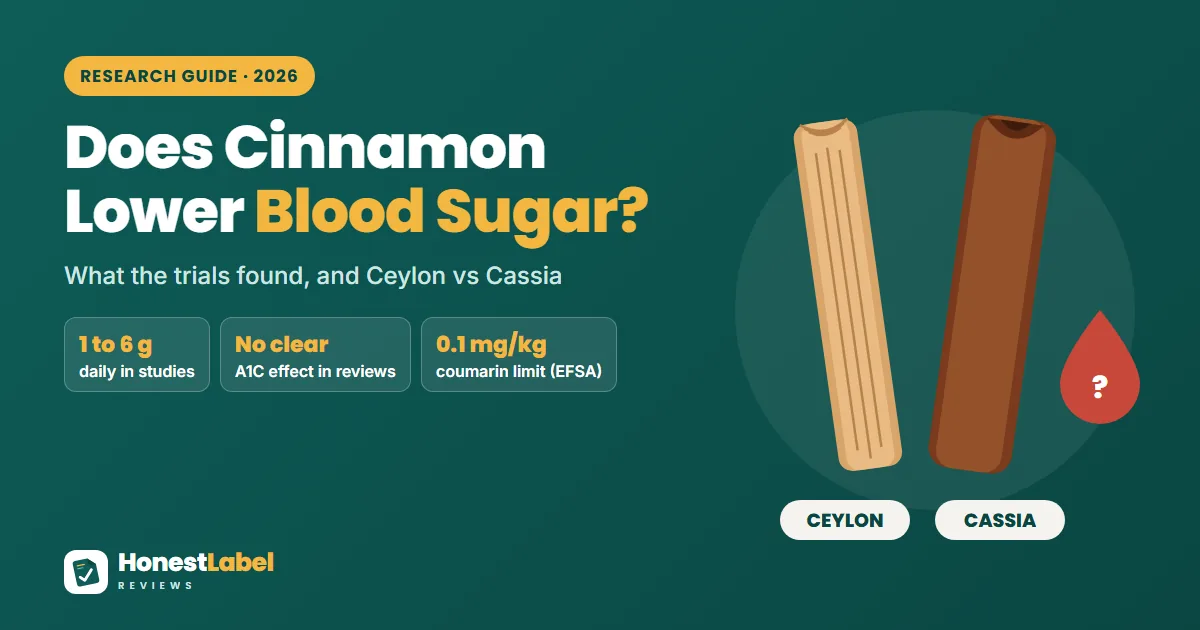
Cinnamon might lower blood sugar a little, but the evidence is mixed. Some trials using 1 to 6 grams a day found lower fasting glucose, while others found no change, and several reviews saw no clear effect on A1C. Cassia, the common kind, also contains coumarin, which can harm the liver in large amounts.
Cinnamon is cheap, tasty and already in most kitchens, so it is one of the most searched natural remedies for blood sugar. A small trial in 2003 made headlines with a big drop in fasting glucose, and the trials that came afterwards tell a less exciting story. Below we cover what the studies found, the doses used, why the type of cinnamon matters, and how to use it safely. If you want a refresher on what the numbers mean first, our guide to normal blood sugar ranges covers fasting glucose, after-meal readings and A1C.
The official view is cautious. The NIH’s National Center for Complementary and Integrative Health (NCCIH) says studies in people do not support using cinnamon for any health condition. Here is how the research got there.
What the studies actually found
The 2003 trial that started it
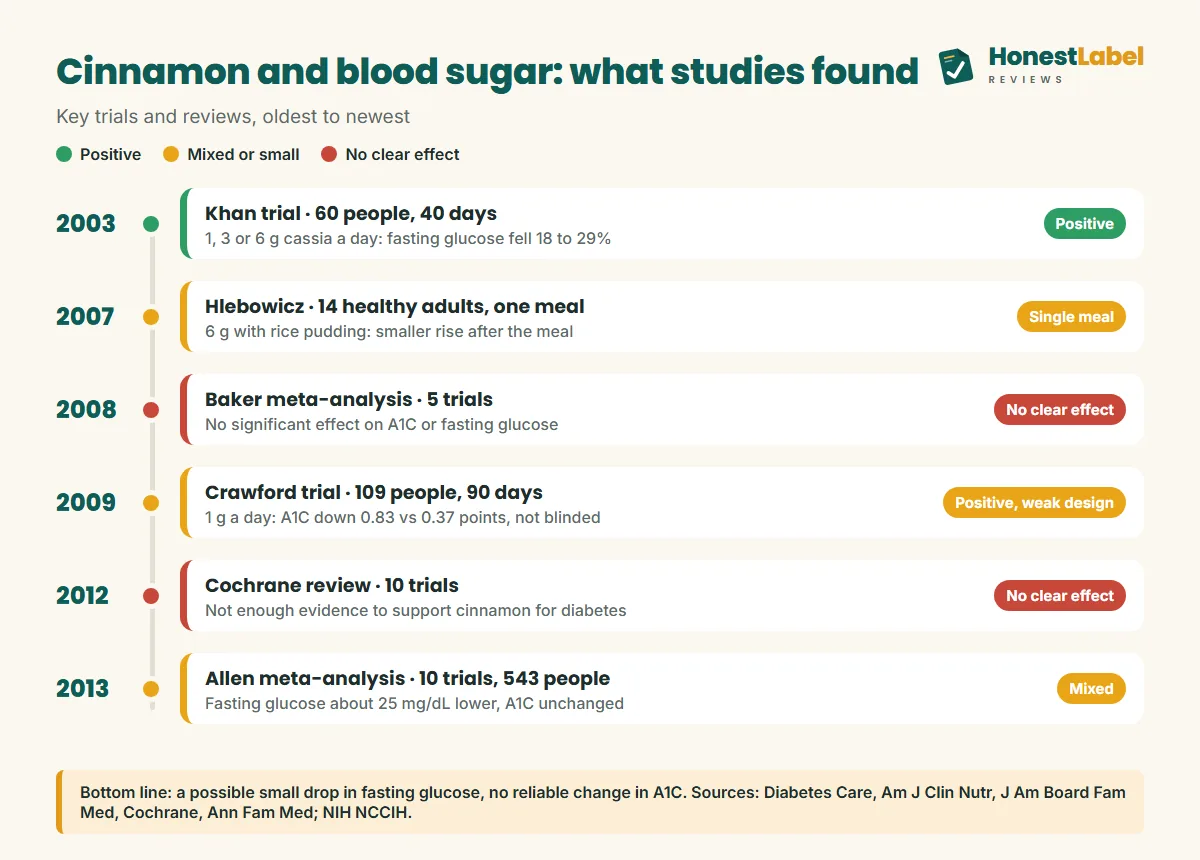
Researchers in Pakistan gave 60 adults with type 2 diabetes either 1, 3 or 6 grams of cassia cinnamon a day in capsules, or a placebo, for 40 days (Khan et al., 2003, Diabetes Care). All three cinnamon groups saw fasting glucose fall by 18 to 29 percent, and triglycerides and LDL cholesterol dropped too. The placebo groups did not change.
It was a small study, run for less than six weeks, in people who were not on insulin. Small, short trials with big effects often shrink when other teams repeat them, and that is roughly what happened here.
The trials that followed
In the years after that early trial, research groups in Europe, the US and Asia ran their own trials, with mixed results:
- A 2008 meta-analysis of five randomised trials in people with type 1 or type 2 diabetes found no significant effect on A1C, fasting glucose or cholesterol (Baker et al., 2008, Diabetes Care).
- A US trial in 109 adults with type 2 diabetes found that 1 gram of cinnamon a day for 90 days, added to usual care, lowered A1C by 0.83 percentage points compared with 0.37 points with usual care alone (Crawford, 2009). The study was not blinded, so people knew what they were taking.
- A 2012 Cochrane review of 10 trials concluded there was not enough evidence to support cinnamon for blood sugar control in diabetes (Leach and Kumar, 2012).
- A 2013 meta-analysis of 10 randomised trials with 543 people found fasting glucose fell by about 25 mg/dL on average, with no significant change in A1C (Allen et al., 2013, Annals of Family Medicine). The authors noted that results varied a lot from trial to trial, which makes the average less reliable.
Why A1C matters more than one fasting reading
Fasting glucose is a single snapshot. It can move with sleep, stress, what you ate the night before and even the time you got up. A1C reflects your average blood sugar over the past two to three months, according to MedlinePlus, so it is the number doctors lean on when they judge whether a treatment is working.
When a remedy lowers fasting glucose in some trials but leaves A1C flat in most reviews, any effect is most likley small or limited to some people.
Why the results disagree
The trials did not really test the same thing. Some used cassia, some Ceylon and some a water extract. Some enrolled people with poorly controlled diabetes, who have more room to improve, and others enrolled people whose numbers were allready near target. Most lasted only a few weeks to four months and had fewer than 100 people, so chance plays a big role, and A1C reflects about three months of blood sugar.
Cinnamon with a meal
A separate line of research looks at what cinnamon does to one meal. In a small Swedish study, 14 healthy volunteers ate 300 grams of rice pudding with or without 6 grams of cinnamon. With cinnamon, the stomach emptied more slowly and the blood sugar rise after the meal was smaller (Hlebowicz et al., 2007, American Journal of Clinical Nutrition).
Lab work suggests cinnamon polyphenols may also help insulin signal inside cells. Still, 14 people eating one meal does not tell us what happens over months.
Ceylon vs cassia: the difference that matters for safety
Most people do not know there are two main types of cinnamon. Supermarket jars in the US and many other countries usually just say “cinnamon”, and what is inside is almost allways cassia.
| Ceylon cinnamon | Cassia cinnamon | |
|---|---|---|
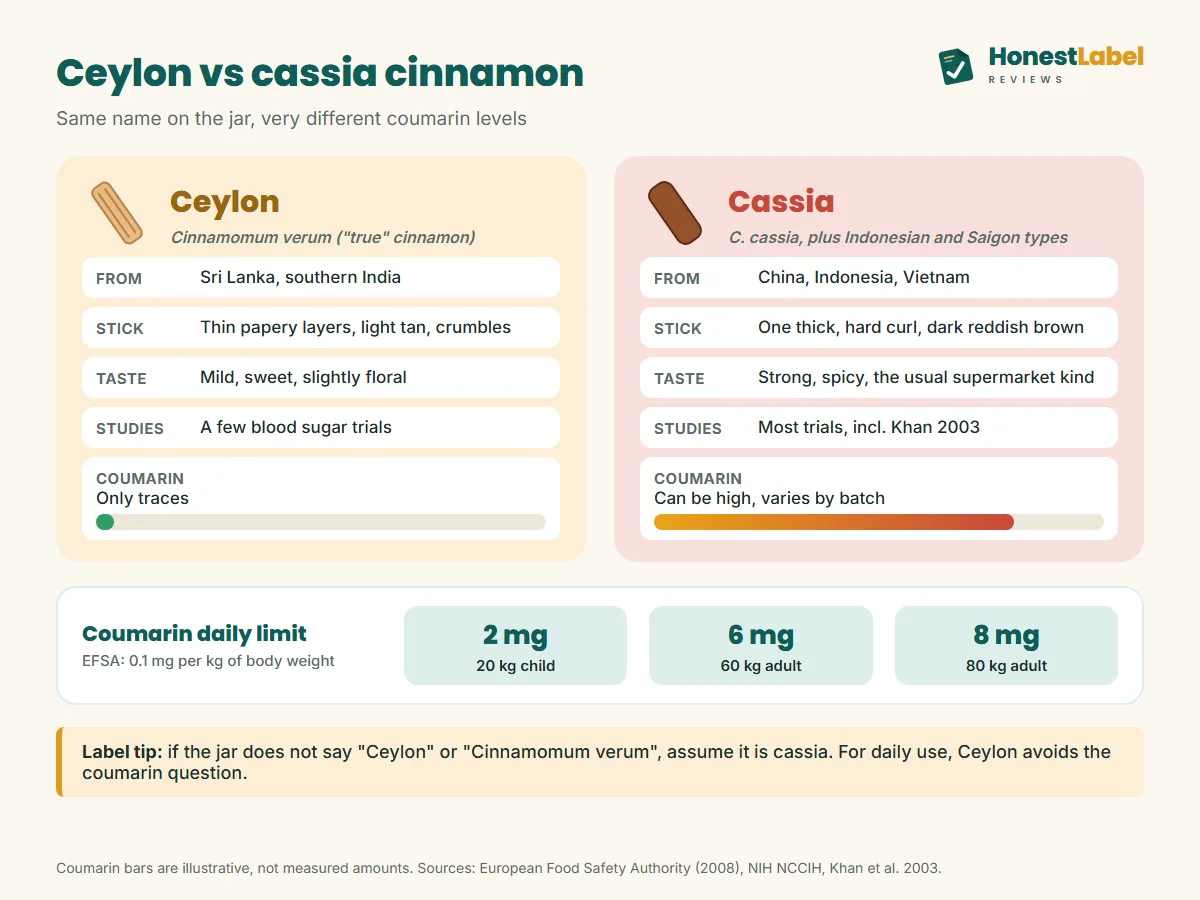
| Plant | Cinnamomum verum (also called C. zeylanicum) | Cinnamomum cassia, plus related species such as Indonesian (C. burmannii) and Saigon (C. loureiroi) |
| Main source | Sri Lanka and southern India | China, Indonesia and Vietnam |
| Stick look | Thin, papery layers rolled like a cigar, light tan, crumbles easily | One thick, hard curl of bark, darker reddish brown |
| Taste | Mild, sweet, slightly floral | Strong, spicy, the classic “cinnamon roll” flavour |
| Coumarin | Only traces | Can be high, and varies widely between samples |
| Used in blood sugar trials | A few trials | Most trials, including the 2003 Khan trial |
Ground cinnamon is harder to tell apart becuase the powder looks similar. If the label does not name the species or say “Ceylon” or “true cinnamon”, it is safest to assume it is cassia.
Here is the awkward part. Most of the positive blood sugar trials used cassia, the type with more coumarin. Ceylon is the safer type for daily use, but there is less research showing it does anything for glucose.
Coumarin and your liver
Coumarin is a natural plant compound that gives cassia part of its smell. In large amounts it can damage the liver in sensitive people. The damage usually reverses once intake stops.
The European Food Safety Authority (EFSA) set a tolerable daily intake for coumarin of 0.1 mg per kg of body weight, which it confirmed in a 2008 opinion. That works out to:
- About 6 mg of coumarin a day for a 60 kg (132 lb) adult
- About 8 mg a day for an 80 kg (176 lb) adult
- About 2 mg a day for a 20 kg (44 lb) child
The hard part is knowing how much coumarin is in your cinnamon. The amount in cassia varies widely from batch to batch, so there is no reliable figure per teaspoon. Germany’s Federal Institute for Risk Assessment (BfR) has warned that people who eat large amounts of cassia every day, such as the higher trial doses of 3 to 6 grams, can go over the limit. Ceylon contains so litle coumarin that this is not a realistic concern.
Coumarin is not the same as the blood thinner warfarin, even though the names are related. The NCCIH also notes that cinnamon can cause allergic reactions and mouth irritation in some people.
How much cinnamon was used in the studies
Trials used anywhere from about 120 mg to 6 grams a day, according to the Allen 2013 meta-analysis linked above, and many used 1 to 6 grams of powdered cassia in capsules, as in the Khan trial. Here is what that looks like in a kitchen, using the USDA FoodData Central figure of about 2.6 grams for a teaspoon of ground cinnamon:
| Daily dose in studies | Rough kitchen equivalent | Coumarin concern with cassia |
|---|---|---|
| 1 g | A little under ½ teaspoon | Usually low for most adults |
| 3 g | A bit over 1 teaspoon | May reach the limit for smaller adults |
| 6 g | About 2⅓ teaspoons | Likely over the limit for many adults |
Extract capsules are concentrated, and the label rarely tells you how much bark they equal. If you are trying to compare a product with the studies, our guide on how to read a blood sugar supplement label walks through doses, blends and testing seals.
No official body has set a cinnamon dose for blood sugar, and we would not suggest picking one of the higher trial doses on your own.
How to use cinnamon sensibly
If you enjoy cinnamon and want to keep it in your diet, these steps keep it safe and realistic:
- Choose Ceylon for daily use. Look for “Ceylon” or “Cinnamomum verum” on the label. It costs more and removes the coumarin question.
- Keep cassia to food amounts. A dusting on oatmeal or coffee is fine for most people. Several teaspoons every day is where the coumarin adds up.
- Swap sugar for spice. Using cinnamon in place of sugar in porridge, yogurt or coffee probably does more for your blood sugar than the cinnamon itself.
- Do not let it replace medicine. Keep taking what your doctor prescribed. Cinnamon is a small add-on at best.
- Track your numbers. If you try a regular amount, check your fasting glucose or keep an eye on your next A1C. It is necessary to give it a few weeks from the beginning, since one reading tells you very little.
Cinnamon often shares a capsule with chromium and berberine in blood sugar blends. We cover those in our guides on chromium for blood sugar and berberine for blood sugar. Of the three, berberine has the most consistent evidence.
Who should be careful with cinnamon supplements
Cinnamon in normal food amounts is safe for nearly everyone. Concentrated capsules or large daily amounts of cassia are another matter. Talk to your doctor first if any of these apply to you:
- You take insulin or diabetes pills. If cinnamon does lower your blood sugar, adding it to insulin or a sulfonylurea such as glipizide could push you low. The American Diabetes Association defines low blood sugar as under 70 mg/dL and treats it with 15 grams of fast sugar.
- You have liver disease or abnormal liver tests, or you drink alcohol heavily.
- You take medicines that affect the liver, including some cholesterol drugs and regular acetaminophen.
- You are pregnant or breastfeeding. There is not enough safety research on concentrated cinnamon in pregnancy, so food amounts are the safer choice.
- You are giving it to a child. Children reach the coumarin limit much faster because they weigh less.
Some people belive natural means harmless, but a spice taken as a daily capsule deserves the same caution as any other supplement.
When to see a doctor
Cinnamon cannot tell you whether your blood sugar is a problem, and it should never delay a test. Book an appointment if you:
- Get a fasting reading of 100 to 125 mg/dL (prediabetes) or 126 mg/dL or higher (possible diabetes), using the ADA’s diagnosis ranges
- Have symptoms of high blood sugar, such as constant thirst, peeing often or blurry vision
- Have readings under 70 mg/dL after starting any supplement while on diabetes medicine
- Notice yellowing of the skin or eyes, dark urine, pain in the upper right side of the belly or unusual tiredness, which can be signs of liver trouble
- Get a rash, mouth sores or swelling after using cinnamon
Get emergency help for confusion, fainting, a seizure, or very high blood sugar with vomiting or deep, fast breathing.
What is still uncertain
A few trials showed real drops in fasting glucose, and the single-meal effect has some support. We do not yet know which type, which dose and which people, if any, get a benefit big enough to be noticeable on an A1C test. Larger, longer trials of a standardised Ceylon product would help.
Frequently asked questions
How much cinnamon should I take to lower blood sugar?
There is no official dose. Studies used about 1 to 6 grams a day, mostly of cassia (Khan, 2003; Allen, 2013), and the results were mixed. Because of coumarin, large daily amounts of cassia are not a good idea. If you want to use cinnamon regularly, Ceylon in food amounts is the safer route, and your doctor should know if you take diabetes medicine.
Is Ceylon cinnamon better for blood sugar than cassia?
For safety, yes, because Ceylon has only traces of coumarin. For blood sugar, we cannot say. Most of the positive trials used cassia, and Ceylon has been studied less, so there is no good evidence that one type lowers glucose more than the other.
Can cinnamon replace metformin?
No. Metformin has decades of large trials behind it, including the Diabetes Prevention Program published in the New England Journal of Medicine, where it cut the risk of developing type 2 diabetes by 31 percent. Cinnamon has nothing close to that. Never stop a prescribed medicine to try a spice or supplement.
Is a teaspoon of cinnamon a day safe?
A teaspoon of Ceylon is fine for most adults. A teaspoon of cassia every day could reach or pass the EFSA coumarin limit of 0.1 mg per kg of body weight for some people, depending on the batch and your weight. Occasional use is not a concern for healthy adults.
The bottom line
Cinnamon may nudge fasting blood sugar down a little, but the research is inconsistent and A1C usualy does not change. The 2003 trial that made it famous was small and short, and larger reviews since then have been far less convincing. If you like cinnamon, choose Ceylon for regular use, keep cassia to normal food amounts, and use it in place of sugar in foods like oatmeal and yogurt. Walking after meals, eating more fiber and keeping up with your medication will do a lot more for your numbers than any spice.
Sources
- NIH National Center for Complementary and Integrative Health. Cinnamon: Usefulness and Safety.
- Khan A, et al. Cinnamon improves glucose and lipids of people with type 2 diabetes. Diabetes Care, 2003. PubMed.
- Baker WL, et al. Effect of cinnamon on glucose control and lipid parameters. Diabetes Care, 2008. PubMed.
- Crawford P. Effectiveness of cinnamon for lowering hemoglobin A1C in patients with type 2 diabetes: a randomized, controlled trial. Journal of the American Board of Family Medicine, 2009. PubMed.
- Leach MJ, Kumar S. Cinnamon for diabetes mellitus. Cochrane Database of Systematic Reviews, 2012. PubMed.
- Allen RW, et al. Cinnamon use in type 2 diabetes: an updated systematic review and meta-analysis. Annals of Family Medicine, 2013. PubMed.
- Hlebowicz J, et al. Effect of cinnamon on postprandial blood glucose, gastric emptying, and satiety in healthy subjects. American Journal of Clinical Nutrition, 2007. PubMed.
- European Food Safety Authority. Coumarin in flavourings and other food ingredients with flavouring properties, scientific opinion, 2008 (tolerable daily intake of 0.1 mg/kg body weight).
- American Diabetes Association. Diagnosis; Hypoglycemia (Low Blood Glucose).
- MedlinePlus (US National Library of Medicine). A1C Test.
- Diabetes Prevention Program Research Group. Reduction in the incidence of type 2 diabetes with lifestyle intervention or metformin. New England Journal of Medicine, 2002.
Medical disclaimer: This article is for general information and is not medical advice. It does not replace a diagnosis or treatment from your doctor. If you have diabetes or take medication that affects blood sugar, talk to your healthcare provider before changing your diet, exercise or supplements.