Last reviewed: November 2026 · Sources: American Diabetes Association, NIDDK (NIH), MedlinePlus, Mayo Clinic, Cleveland Clinic, the Endocrine Society and peer-reviewed studies (listed at the end)
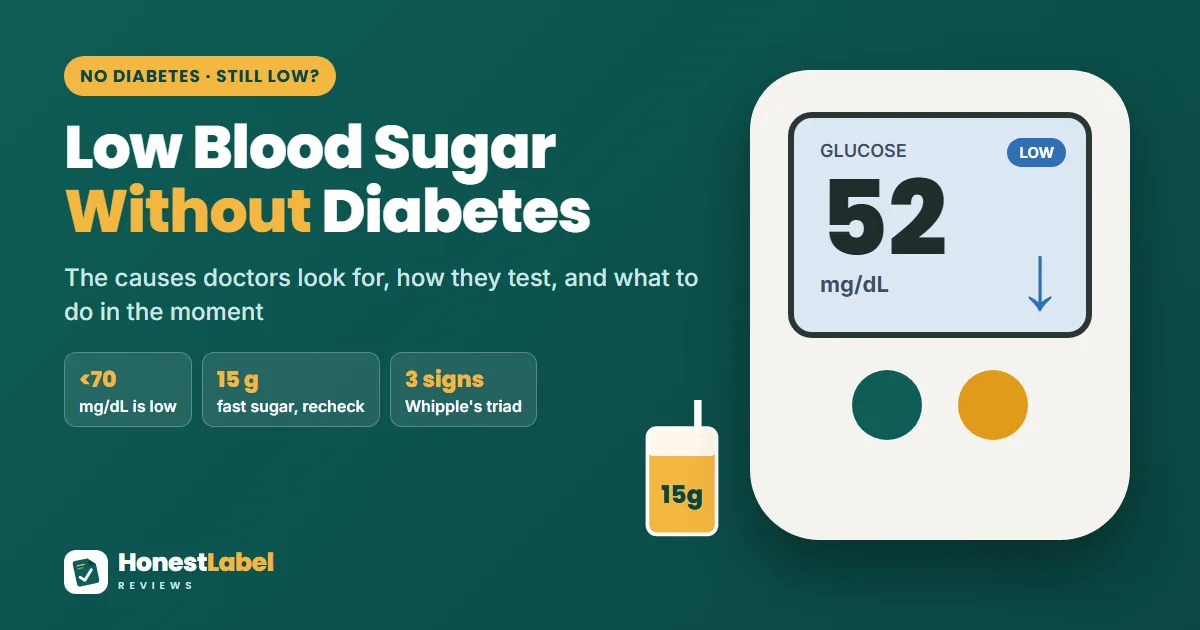
Low blood sugar is a reading under 70 mg/dL. Without diabetes it is uncommon, and doctors usually investigate only when a reading under 55 mg/dL comes with symptoms that clear once sugar is raised. Common causes are medicines, heavy drinking, serious illness, hormone problems and gastric bypass surgery. In the moment, take 15 grams of fast sugar and recheck in 15 minutes.
Most advice on low blood sugar is written for people on insulin or diabetes pills, the most common cause of a low. Without diabetes, the body has several backup systems that stop blood sugar falling too far, so a true low means something is overriding them.
Our general guide to normal blood sugar ranges covers lows mainly for people on medication. This page covers the causes doctors look for when you dont have diabetes, how the testing works, and what to do the moment you feel a low coming on.
What counts as low blood sugar if you don’t have diabetes?
For everyday safety, the line is the same for everyone. MedlinePlus treats a reading below 70 mg/dL (3.9 mmol/L) as low and notes that confusion or seizures become more likely below 54 mg/dL (3.0 mmol/L). The American Diabetes Association uses the same two levels.
For diagnosis, the bar is lower. Healthy people sometimes dip into the 60s after a long fast or hard exercise and feel fine. So when someone without diabetes is being checked for a low blood sugar disorder, doctors look for a lab glucose under about 55 mg/dL. Cleveland Clinic uses that cut-off for people without diabetes, and so does the Endocrine Society’s guideline on adult hypoglycemic disorders (Cryer et al., 2009).
Whipple’s triad: the three things doctors want to see
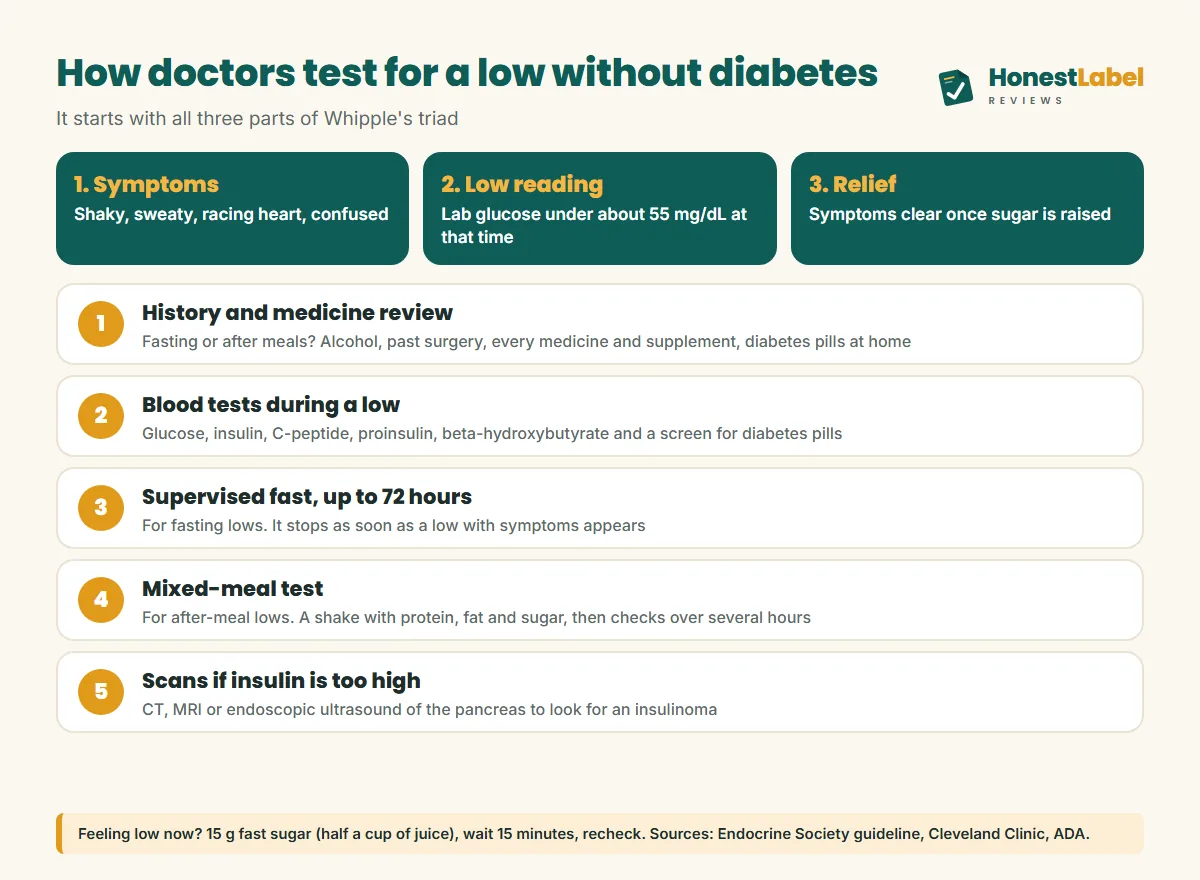
The same guideline recommends a full workup only when all three parts of Whipple’s triad are present:
- Symptoms that fit a low, such as shaking, sweating, a racing heart, confusion or blurred thinking.
- A low glucose measured at the time of those symptoms, ideally a lab blood sample rather than a finger stick.
- Relief of the symptoms once blood sugar is brought back up.
Plenty of people feel shaky and assume their sugar is low, but a reading taken at that moment comes back normal. The triad keeps people out of long tests for a problem they do not have.
Fasting lows: the main causes
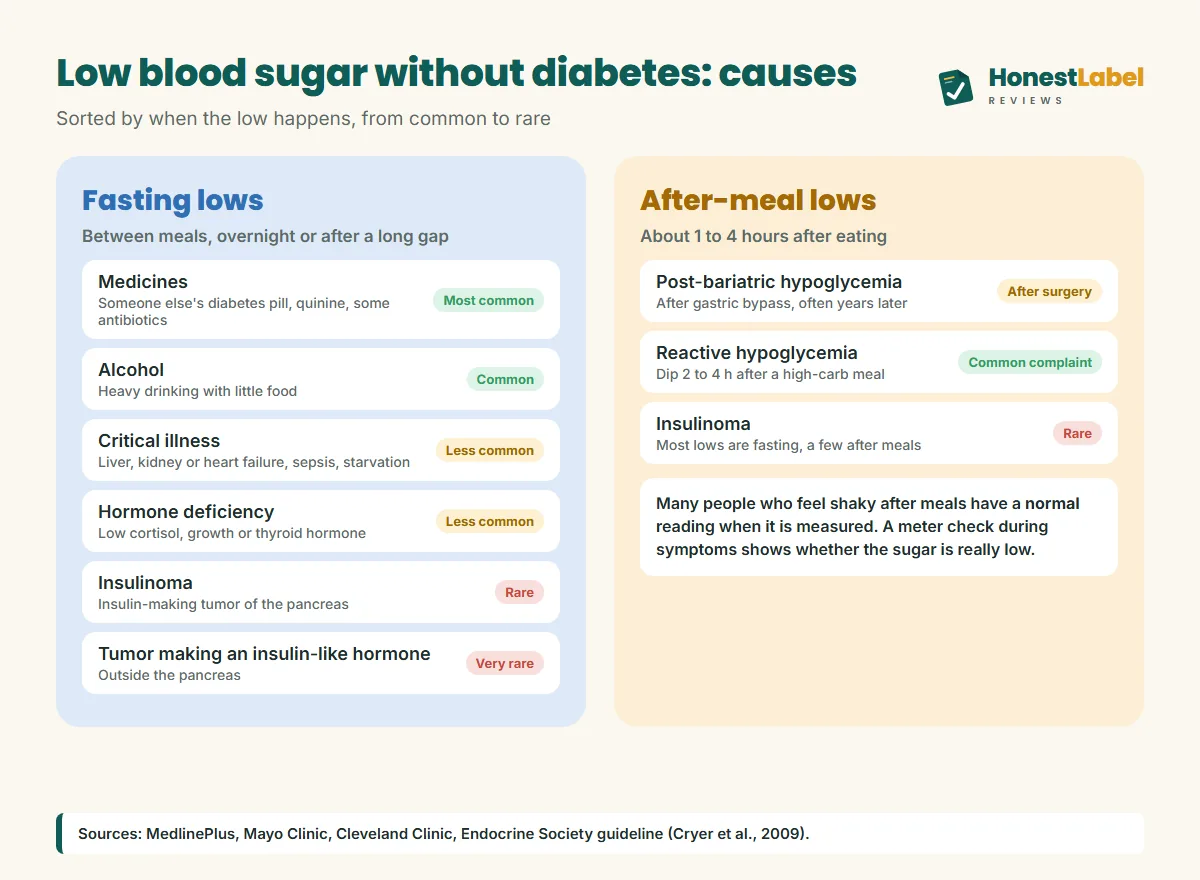
Doctors split non-diabetic lows into two groups: lows that happen when you have not eaten for a while (fasting) and lows that happen a few hours after a meal. The fasting group covers the more serious causes, so it gets checked first.
Medicines
Medicine is the most common cause of a low in general, even when someone does not have diabetes. Mayo Clinic lists taking someone else’s diabetes pill by accident as one route, and names quinine, a malaria drug, as an example of a non-diabetes drug that can do it. MedlinePlus adds that some antibiotics and heart medicines can cause lows. The risk is higher in children and in people with kidney failure, because the drug stays in the body longer.
If your lows started soon after the beginning of a new prescription, write down the drug and the start date for your doctor.
Alcohol
Your liver keeps blood sugar up between meals by releasing stored glucose and making new glucose. While it is busy breaking down alcohol, it makes much less. Mayo Clinic explains that heavy drinking without eating can block the liver from releasing glucose. Cleveland Clinic notes the risk is highest after several days of heavy drinking with little food, when the liver’s stores are already low.
The low can arrive hours after the last drink, sometimes the next morning, even if all the drinking occurred the night before. It is easy to mistake for a hangover or for being drunk, which is part of what makes it risky.
Critical illness
Severe illness can drain the body’s glucose supply or stop it being made. MedlinePlus and Cleveland Clinic list:
- Severe liver failure, since the liver is the main glucose factory
- Kidney failure, which also slows the clearance of many drugs
- Severe heart failure
- Sepsis, a body-wide infection that burns through glucose
- Starvation or a very long stretch without food, including eating disorders
Hormone deficiencies
Several hormones push blood sugar up when it starts to fall. If one of them is missing, the floor gives way. MedlinePlus names low cortisol, low growth hormone and low thyroid hormone. Low cortisol from adrenal insufficiency is the one doctors check most often. It usualy brings other clues too, such as tiredness, weight loss, low blood pressure, dizziness on standing or darker skin.
Insulinoma (rare)
An insulinoma is a small tumor of the insulin-making cells in the pancreas. It keeps releasing insulin even when blood sugar is already low. It is rare: a long-running study from Olmsted County, Minnesota, found about 4 new cases per million people each year (Service et al., 1991).
According to Cleveland Clinic, about 85 to 90 percent of insulinomas do not spread beyond the pancreas, most people have there lows while fasting, often in the morning after waking, and most cases can be cured with surgery. MedlinePlus also describes it as rare. Doctors rule it out, but it sits far down the list. Cleveland Clinic lists an even rarer cousin: a tumor elsewhere in the body that releases an insulin-like hormone.
After-meal lows
The second group of lows comes one to several hours after eating. The one that needs the most attention follows weight-loss surgery.
Post-bariatric hypoglycemia
After some weight-loss operations, especially gastric bypass, food reaches the small intestine much faster than before. Glucose floods into the blood, the body answers with a large burst of insulin, and that insulin can overshoot and pull blood sugar too low one to three hours later. Cleveland Clinic describes this sequence, and MedlinePlus notes it often shows up years after the operation, long after the person has stopped thinking of surgery as a cause.
Severe cases have been documented. A 2005 report in the New England Journal of Medicine described six patients with serious, insulin-driven lows after gastric bypass, some with confusion or seizures (Service et al., 2005). Most people have a milder form.
It is different from early dumping syndrome, which brings cramps, bloating, a racing heart and sweating within the first hour or so of eating, before any drop in sugar. Some people have both, which can be confusing.
If you get shaky, sweaty or foggy a couple of hours after meals following bariatric surgery, tell your surgical team. Treatment usually starts with small meals, fewer fast carbs and more protein, with medicines if diet is not enough.
Reactive hypoglycemia
Some people with no surgery or other condition feel a dip two to four hours after a high-carb meal. The cause is often unclear, and when blood sugar is measured during symptoms it is often normal. If your post-meal numbers run high rather than low, our page on normal blood sugar after eating covers the 1 and 2 hour ranges.
How doctors investigate a low
Becuase a low without diabetes always has a cause, the goal is to catch one in the act and test the blood at that moment. Here is how that usually works, based on the Endocrine Society guideline and Cleveland Clinic’s descriptions.
1. History and medicine review
Expect questions about timing (fasting or after meals), food and alcohol beforehand, past surgery, every medicine and supplement, and whether anyone at home takes diabetes pills. A symptom diary helps a lot here.
2. Blood tests during a low
If a low can be caught, a blood sample taken right then is worth more than any test done on a normal day. The Endocrine Society recommends measuring glucose along with insulin, C-peptide, proinsulin and beta-hydroxybutyrate, plus a screen for diabetes pills such as sulfonylureas. Together these show whether the body is making too much of its own insulin, whether insulin came from outside, or whether something else is going on.
3. A supervised fast
When lows happen while fasting, the standard test is a supervised fast of up to 72 hours, usually in hospital. You drink only water or calorie-free drinks, and staff check your blood sugar regularly. The fast stops as soon as a low with symptoms appears, and the full set of blood tests is drawn at that point. Cleveland Clinic describes this as the main test for an insulinoma.
4. The mixed-meal test
When lows come after meals, doctors use a mixed-meal tolerance test. You drink a shake that contains protein, fat and sugar, and your blood sugar is checked several times over the folowing hours, as Cleveland Clinic explains. It looks more like a real meal than the sugary drink used in a glucose tolerance test, which can produce false lows in healthy people.
5. Imaging, if the blood tests point to insulin
If the tests show the body is making too much insulin, the next step is finding the source. Scans of the pancreas such as CT, MRI or endoscopic ultrasound are used to look for an insulinoma.
What to do right now if you feel low
Check with a meter if you have one. If not and the symptoms are strong, treat anyway, since a little sugar does no harm if you turn out not to be low.
The 15-15 rule
- Take 15 grams of fast-acting carbohydrate. That is about half a cup (4 oz) of juice or regular soda, 1 tablespoon of sugar or honey, or 3 to 4 glucose tablets (ADA).
- Wait 15 minutes, then check again if you can.
- If you are still under 70 mg/dL or still have symptoms, take another 15 grams.
- Once you feel better, eat a snack or meal with some protein and starch so you do not drop again.
The NIDDK gives a similar range of 15 to 20 grams. Skip chocolate, nuts or anything fatty for the first step. Fat slows digestion, so the sugar arrives too late.
Write it down
After an episode, note the time, the reading, your last meal, any alcohol and how fast the sugar helped. A lab blood test taken while you are still low, for example at urgent care, is truly useful to your doctor.
When someone else is low
If a person is confused but awake and able to swallow, help them drink juice or regular soda. If they are drowsy, cannot swallow safely, are having a seizure or have passed out, do not put food or drink in their mouth. Call 911. Glucagon is an option only if it has been prescribed for that person.
Safety: who should be careful
- People who drink heavily or binge. Eat when you drink, and never drink on an empty stomach after a long fast or hard exercise.
- Anyone who has had gastric bypass or sleeve surgery. New symptoms after meals, even years later, belong with your surgical team.
- People with liver or kidney disease. Both raise the risk of lows and change how medicines are cleared. Ask before starting any new drug or supplement.
- Households with diabetes medicine. Keep pills in their labeled bottles and away from children. An accidental mix-up is one of the causes Mayo Clinic lists.
When to see a doctor
Mayo Clinic advises anyone without diabetes who has symptoms of a low to see a doctor, because the low is a sign of another problem. Book an appointment if you:
- Have had a meter reading under 70 mg/dL with symptoms, more than once
- Get symptoms while fasting or first thing in the morning
- Have had gastric bypass or other weight-loss surgery and now feel unwell after meals
- Started a new medicine shortly before the episodes began
- Also have weight loss, constant tiredness, dizziness when standing or other signs of a hormone problem
Get emergency help for confusion that does not clear with sugar, a seizure, passing out, or a low that keeps coming back after treatment. MedlinePlus advises calling 911 if symptoms do not improve after a sugary snack, and not driving yourself to the hospital.
You will usually be referred to an endocrinologist. It helps to bring your diary and a list of every medicine and supplement. If you also suspect your sugar runs high at other times, our guide to early signs of insulin resistance lists the tests worth asking about at the same visit.
Frequently asked questions
Can you have low blood sugar without diabetes?
Yes, but it is uncommon. The body normally stops blood sugar from falling too far, so a true low points to a cause such as a medicine, alcohol, serious illness, a hormone problem, weight-loss surgery or, rarely, an insulinoma. Feeling shaky with a normal reading is much more common than a real low.
What blood sugar level is too low for a non-diabetic?
Under 70 mg/dL is treated as low for safety. For diagnosis, doctors look for a lab glucose under about 55 mg/dL with symptoms that clear once sugar is raised. Under 54 mg/dL is a serious low for anyone.
Can anxiety cause low blood sugar?
Anxiety does not lower blood sugar, but the symptoms overlap a lot: shaking, sweating, a pounding heart. That is why doctors want a reading taken during the episode before they call it hypoglycemia.
Is low blood sugar without diabetes a sign of cancer?
Very rarely. Insulinomas are rare, and most do not spread. The common causes are medicines, alcohol and illness. Still, any repeated low with a confirmed reading deserves a proper workup.
The bottom line
Low blood sugar without diabetes is unusual, and it always has a reason. Medicines, alcohol, serious illness, missing hormones and gastric bypass explain most cases, and insulinoma is a rare one doctors rule out. A diagnosis depends on catching a real low with a measured reading and testing the blood at that moment, through a supervised fast or a mixed-meal test if needed. Until then, keep fast sugar on hand, use the 15-15 rule, write down every episode and book that appointment.
Sources
- American Diabetes Association. Hypoglycemia (Low Blood Glucose).
- National Institute of Diabetes and Digestive and Kidney Diseases (NIH). Low Blood Glucose (Hypoglycemia).
- MedlinePlus (US National Library of Medicine). Low blood sugar; Insulinoma.
- Mayo Clinic. Hypoglycemia: symptoms and causes.
- Cleveland Clinic. Hypoglycemia (Low Blood Sugar); Insulinoma.
- Cryer PE, Axelrod L, Grossman AB, et al. Evaluation and management of adult hypoglycemic disorders: an Endocrine Society clinical practice guideline. Journal of Clinical Endocrinology & Metabolism, 2009. PubMed.
- Service FJ, et al. Functioning insulinoma: incidence, recurrence, and long-term survival of patients. Mayo Clinic Proceedings, 1991. PubMed.
- Service GJ, et al. Hyperinsulinemic hypoglycemia with nesidioblastosis after gastric-bypass surgery. New England Journal of Medicine, 2005. PubMed.
Medical disclaimer: This article is for general information and is not medical advice. It does not replace a diagnosis or treatment from your doctor. If you have diabetes or take medication that affects blood sugar, talk to your healthcare provider before changing your diet, exercise or supplements.