Last reviewed: November 2026 · Sources: American Diabetes Association, CDC, NIH (MedlinePlus) and peer-reviewed studies on PubMed (listed at the end)
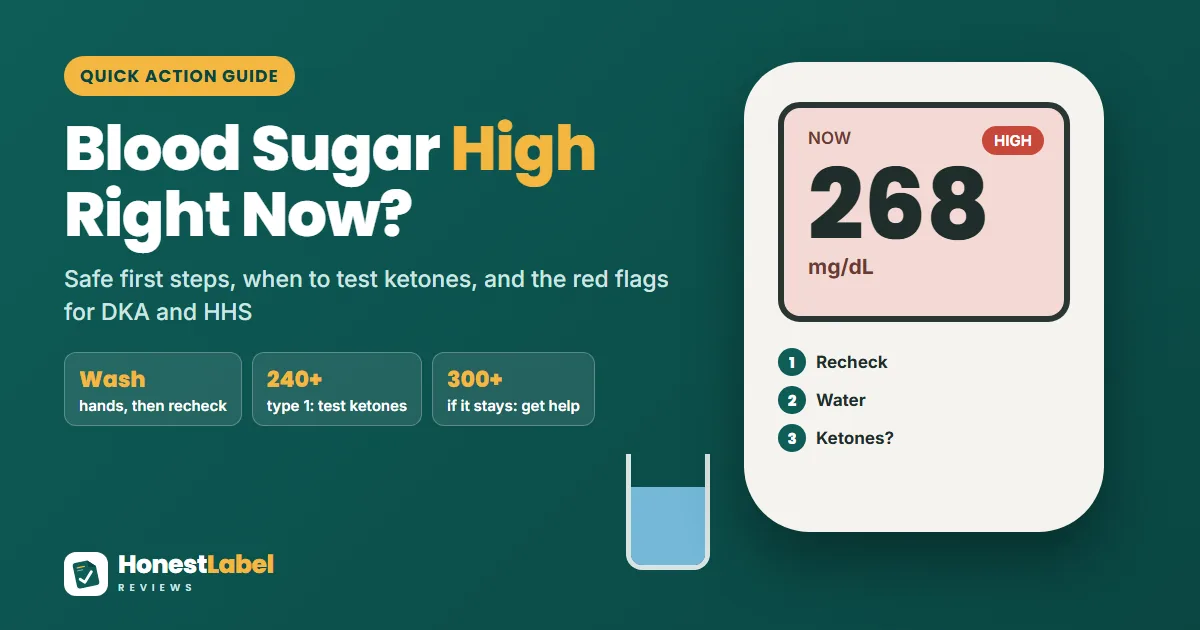
If your blood sugar is high right now, wash your hands and recheck, drink water, and follow your own correction plan if you use insulin. With type 1 diabetes and a reading over 240 mg/dL, test for ketones before you exercise. Vomiting, deep fast breathing, confusion or ketones need urgent medical care.
Most high readings are not emergencies, and a few calm steps sort out which ones are. This page covers the next hour or two. For what counts as high in the first place, see our guide to normal blood sugar ranges. The long-term side (weight, fiber, sleep, walking after meals) is in 10 research-backed habits to lower blood sugar.
If you have diabetes, the plan your own doctor or diabetes team gave you comes first. The steps below are general information and can’t replace a plan written for your body, your medicines and your targets.
First, how high is high?
The American Diabetes Association sets these general targets for most non-pregnant adults with diabetes: 80 to 130 mg/dL before meals and under 180 mg/dL one to two hours after starting a meal. Without diabetes, fasting blood sugar normally sits under 100 mg/dL and usually drops back under 140 mg/dL two hours after eating.
| Your reading | What it usually means | What to do now |
|---|---|---|
| 140 to 180 mg/dL soon after a meal, no diabetes | Often a normal after-meal peak | Recheck 2 hours after the meal started |
| 180 to 240 mg/dL, with diabetes | Above target, common after a big meal, a missed dose or illness | Recheck, water, your usual correction plan |
| Over 240 mg/dL, type 1 diabetes | Ketones may be building up | Test ketones before anything else, including exercise |
| 300 mg/dL or above, any type | Very high | Recheck; if it stays at 300 or above, get emergency care |
| Any high reading with vomiting, confusion or hard breathing | Possible DKA or HHS | Emergency care now |
The 240 mg/dL ketone cut-off comes from the ADA’s hyperglycemia guidance. The CDC advises going to the emergency room if blood sugar stays at 300 mg/dL or above. If your own plan sets diffrent numbers, use those. For after-meal numbers in more detail, see what is normal after eating.
Step 1: wash your hands and recheck
Before you act on a high number, make sure it’s real. A trace of sugar on your fingertip can make a finger-prick reading look far higher than your blood actually is. In a small Japanese study of healthy volunteers, fingertip readings taken after peeling fruit were falsely high, even after wiping with an alcohol swab, while readings after washing with tap water were normal (Hirose et al., Diabetes Care 2011).
Wash with soap and warm water, dry your hands completely, and use a fresh, in-date strip. If the second reading is normal, the first was probably contamination.
A continuous glucose monitor (CGM) reads the fluid under your skin and runs a few minutes behind your blood. Follow your device instructions on when to confirm with a finger-prick.
Step 2: think about why it’s high
A quick cause check helps:
- A bigger or more carb-heavy meal than usual, or a sweet drink
- A missed or late dose of insulin or diabetes tablets
- A pump problem: a kinked tube, an old site or an empty reservoir
- Insulin that is out of date or got too hot or cold
- Illness or infection, even a cold
- Steroid medicines such as prednisone, pain or emotional stress
MedlinePlus lists most of these, including insulin that has been stored somewhere too hot or cold. A pump has no long-acting insulin in reserve, so if delivery stops, ketones can build quickly. Follow your pump plan.
If your readings are high mainly on waking, that is a separate pattern with its own causes, covered in why blood sugar is high in the morning.
Step 3: drink water
When blood sugar runs high, your kidneys flush extra glucose out in urine and pull water with it, which is why you feel thirsty. Drinking water replaces the lost fluid and helps the kidneys keep clearing glucose.
- Sip plain water steadily: a glass now and more over the next hour.
- Avoid juice, regular soda, sports drinks, sweet tea and alcohol.
- If your doctor limits fluids for heart or kidney disease, stick to those limits. Large amounts are not necessary.
Step 4: if you use insulin, follow your correction plan
Many people on mealtime insulin have a correction factor or sliding scale that says how much extra rapid-acting insulin to take. Use it exactly as your diabetes team set it up.
- Don’t stack doses. Rapid-acting insulin keeps working for several hours. A second correction an hour after the first, because the number hasn’t moved yet, is a common cause of a hard low later.
- Don’t guess a dose without a written plan. Call your care team or the on-call service.
- Keep taking your basal (long-acting) insulin even if you are sick or not eating. The CDC’s sick day advice is to keep taking insulin and diabetes pills as usual unless your doctor says otherwise.
- Recheck in about two hours, or when your plan says.
If you take tablets only, there is usualy no “extra dose”. Doubling up can cause lows or side effects, so take your normal dose on time.
Step 5: test ketones if you have type 1 and you’re over 240
Ketones are acids your body makes when it burns fat because there isn’t enough insulin to use glucose. A buildup of ketones leads to diabetic ketoacidosis (DKA). The ADA advises checking for ketones when blood sugar is above 240 mg/dL, and the CDC gives similar advice at 250 mg/dL or above when you are sick.
- Urine strips change colour from negative to large. They are cheap but reflect the last few hours.
- Blood ketone meters use a finger-prick, show a number in mmol/L and reflect right now.
The CDC says that if ketones are present, call your doctor right away. Ask your team for your own blood ketone action levels. In the 2024 international consensus on hyperglycemic crises, a blood ketone level of 3.0 mmol/L or higher is part of the definition of DKA (Umpierrez et al., Diabetes Care 2024), so a reading like that means going to the emergency room straight away.
If you take an SGLT2 inhibitor (empagliflozin, dapagliflozin, canagliflozin and others in that group), the same report notes that DKA can happen even when blood sugar is only mildly raised. If you take one and feel sick, test ketones whatever your glucose says.
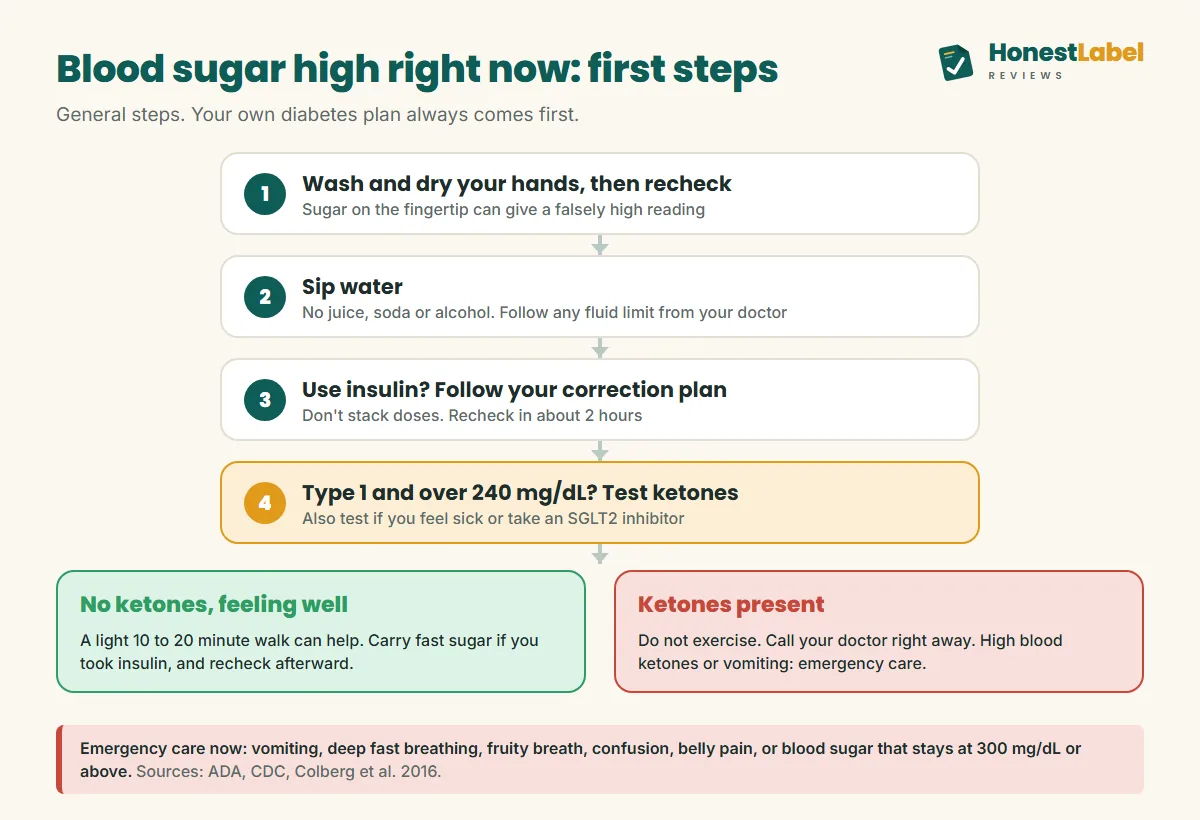
Step 6: a light walk, only if there are no ketones
Working muscles pull glucose out of the blood, so a gentle walk often helps a high reading come down. For many people with type 2 diabetes who feel well and have no ketones, 10 to 20 minutes of easy walking is a sensible step.
Ketones change that. Without enough insulin, exercise makes the liver release more glucose and speeds up fat burning, so glucose and ketones can both rise. The ADA says that if you have ketones, do not exercise. Its exercise position statement adds that people with high glucose but no ketones can be active if they feel well and are drinking enough (Colberg et al., Diabetes Care 2016).
- Keep it light. Hard efforts can push glucose up for a while.
- If you took correction insulin, walking makes it act faster. Carry fast sugar and check again afterward.
- If you feel dizzy, confused or very unwell, skip the walk and get help.
What not to do
- Don’t take an unplanned extra dose of insulin or tablets.
- Don’t use vinegar, cinnamon or a supplement as a rescue. None of them treats a high reading.
Emergency red flags: DKA and HHS
Two conditions turn a high reading into an emergency. Both need hospital treatment.
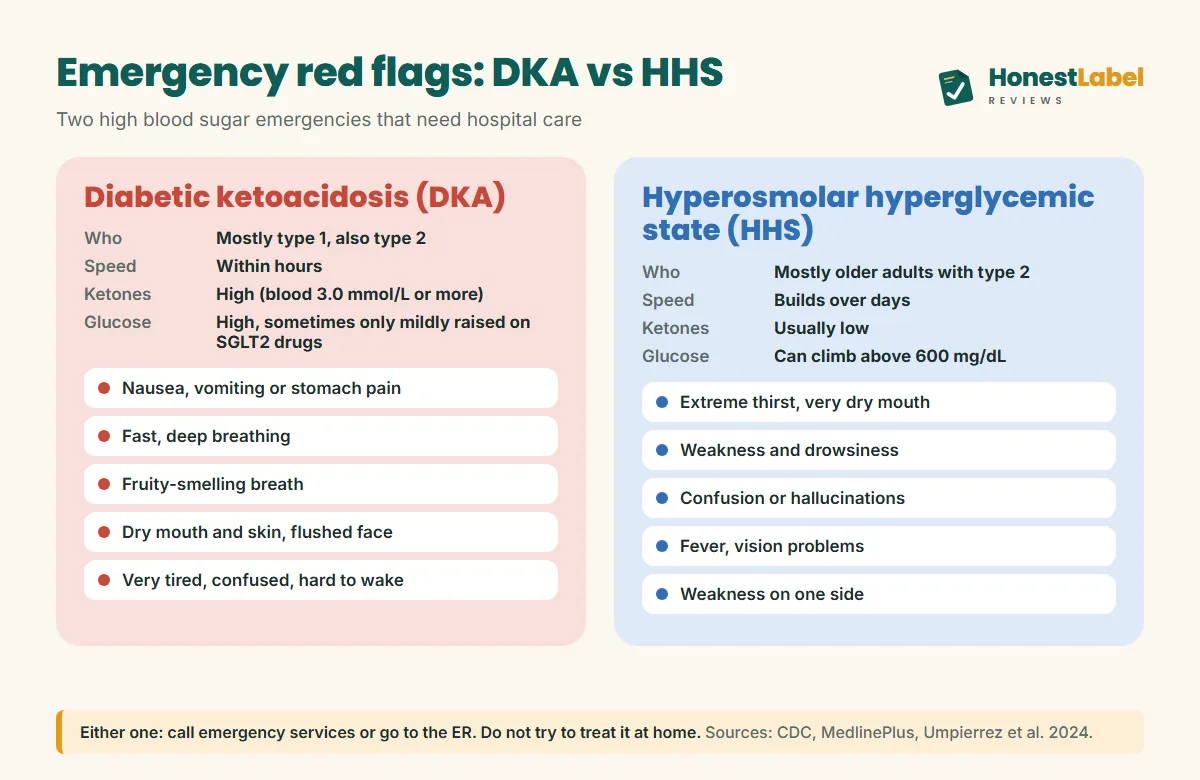
Diabetic ketoacidosis (DKA)
DKA happens mostly in type 1 diabetes, though people with type 2 can get it too, and it can come on within hours. The CDC and MedlinePlus list these warning signs:
- Nausea, vomiting or stomach pain
- Fast, deep breathing
- Fruity-smelling breath
- Dry mouth and skin, a flushed face
- Being very tired, confused or hard to wake
Hyperosmolar hyperglycemic state (HHS)
HHS is more common in older adults with type 2 diabetes, often after an infection or other illness. It builds over days, and blood sugar can climb above 600 mg/dL (Umpierrez et al., 2024). Ketones are usually low. MedlinePlus lists extreme thirst, a very dry mouth, weakness, drowsiness, confusion, fever, vision problems, hallucinations and weakness on one side among the signs.
When to see a doctor or get emergency help
Call emergency services or go to the emergency room if a high reading comes with:
- Vomiting, or you can’t keep food or fluids down
- Ketones in your urine, or blood ketones at your team’s emergency level
- Blood sugar that stays at 300 mg/dL or above
- Deep, fast or difficult breathing, or fruity breath
- Confusion, unusual drowsiness, fainting or belly pain
Call your doctor or diabetes team the same day if:
- Your blood sugar stays above target despite your plan, with no clear reason. MedlinePlus advises a ketone check if this lasts 6 hours with type 1 diabetes, or 3 days with type 2
- You have a fever, diarrhea or vomiting but can keep fluids down. The CDC advises emergency care if vomiting or severe diarrhea lasts more than 6 hours, or a temperature over 101°F lasts 24 hours
- You suspect a pump or insulin problem you can’t fix
If you aren’t sure which group your in, call.
If you don’t have diabetes and got one high reading
One high reading on a friend’s meter or at a pharmacy does not mean you have diabetes, and if you feel fine there is usually no need to rush. First, put it in context:
- When did you last eat? Blood sugar peaks within about an hour of a meal. The numbers that count are fasting (under 100 mg/dL is normal) and two hours after a meal (usually under 140 mg/dL).
- Were your hands clean? Fruit, juice or hand cream on the finger is a common cause of a weird result. Wash, dry and retest.
- Are you ill, stressed or on steroids? MedlinePlus notes that infection, surgery, injury and some medicines can raise blood sugar for a while, and it usually returns to normal afterward.
Under the ADA’s diagnostic criteria, diabetes is diagnosed with a fasting glucose of 126 mg/dL or higher, an A1C of 6.5% or higher, a 2-hour glucose tolerance result of 200 mg/dL or higher, or a random reading of 200 mg/dL or higher with classic symptoms. Otherwise a diagnosis needs two abnormal results.
- High but under 200 mg/dL and you feel well: book a routine appointment and ask for a fasting glucose or A1C test. Home meters track; a lab test diagnoses.
- 200 mg/dL or higher, or you also have thirst, frequent urination, weight loss you can’t explain or blurry vision: see a doctor within a day or two.
- Those symptoms plus vomiting, belly pain, fast breathing or drowsiness: go to the emergency room. Type 1 diabetes can first show up as DKA in adults as well as children, and it is easy to mistake for a stomach bug.
Who should be extra careful
- Pregnancy: targets are tighter, so call your prenatal team.
- Children and teens with diabetes: they can move into DKA quickly. Follow the plan from their pediatric team and test ketones early.
- Older adults: HHS is more likely. If an older relative with diabetes has been ill and seems drowsy or muddled, check their blood sugar.
- Insulin or sulfonylureas: walking, corrections and skipped meals can swing a high into a low. The ADA defines low as under 70 mg/dL and serious as under 54 mg/dL, so check again after any step you take.
Once you are back in range, note the number and likely cause for your doctor. We believe it also helps to share your sick day plan with someone you live with.
Frequently asked questions
How can I bring my blood sugar down quickly?
If you use insulin, the fastest safe way is the correction dose in your own plan. Without insulin, water and a light walk (only if you have no ketones) are the safest options.
Should I go to the ER for high blood sugar?
Go if a high reading comes with vomiting, deep or fast breathing, confusion, belly pain, fruity breath or ketones, or if your blood sugar stays at 300 mg/dL or above.
Does drinking water lower blood sugar?
Water helps your kidneys clear extra glucose and replaces fluid lost through frequent urination. It helps, but it won’t fix a high caused by missing insulin.
Is it safe to exercise when blood sugar is high?
A light walk is usually fine if you feel well and have no ketones. With type 1 diabetes and ketones, the ADA advises against exercise because it can raise glucose and ketones further.
Can blood sugar be high without diabetes?
Yes, for a short time. A big meal, illness, stress, steroid medicine or sugar on the fingertip can all cause a high reading. If it happens again, ask your doctor for a fasting glucose or A1C test.
The bottom line
When your blood sugar is high, wash your hands and recheck first, because false readings are common. Then drink water, follow your own correction plan if you use insulin, and test ketones if you have type 1 diabetes and you’re over 240 mg/dL. Vomiting, fast or hard breathing, confusion, belly pain, ketones or a reading that stays at 300 mg/dL or above mean emergency care. If you don’t have diabetes and feel well, one high number is a reason to book a proper test.
Sources
- American Diabetes Association. Hyperglycemia (High Blood Glucose); Checking Your Blood Glucose; Diagnosis; Hypoglycemia.
- Centers for Disease Control and Prevention. Diabetic Ketoacidosis; Managing Sick Days.
- MedlinePlus (US National Library of Medicine). High blood sugar: self-care; Diabetic ketoacidosis; Diabetic hyperglycemic hyperosmolar syndrome.
- Umpierrez GE, et al. Hyperglycemic crises in adults with diabetes: a consensus report. Diabetes Care, 2024. PubMed.
- Colberg SR, et al. Physical activity/exercise and diabetes: a position statement of the American Diabetes Association. Diabetes Care, 2016. PubMed.
- Hirose T, et al. Glucose monitoring after fruit peeling: pseudohyperglycemia when neglecting hand washing before fingertip blood sampling. Diabetes Care, 2011. PubMed.
Medical disclaimer: This article is for general information and is not medical advice. It does not replace a diagnosis or treatment from your doctor. If you have diabetes or take medication that affects blood sugar, talk to your healthcare provider before changing your diet, exercise or supplements.