Last reviewed: November 2026 · Sources: NIH (LiverTox, NCCIH, MedlinePlus), American Diabetes Association and peer-reviewed studies (listed at the end)
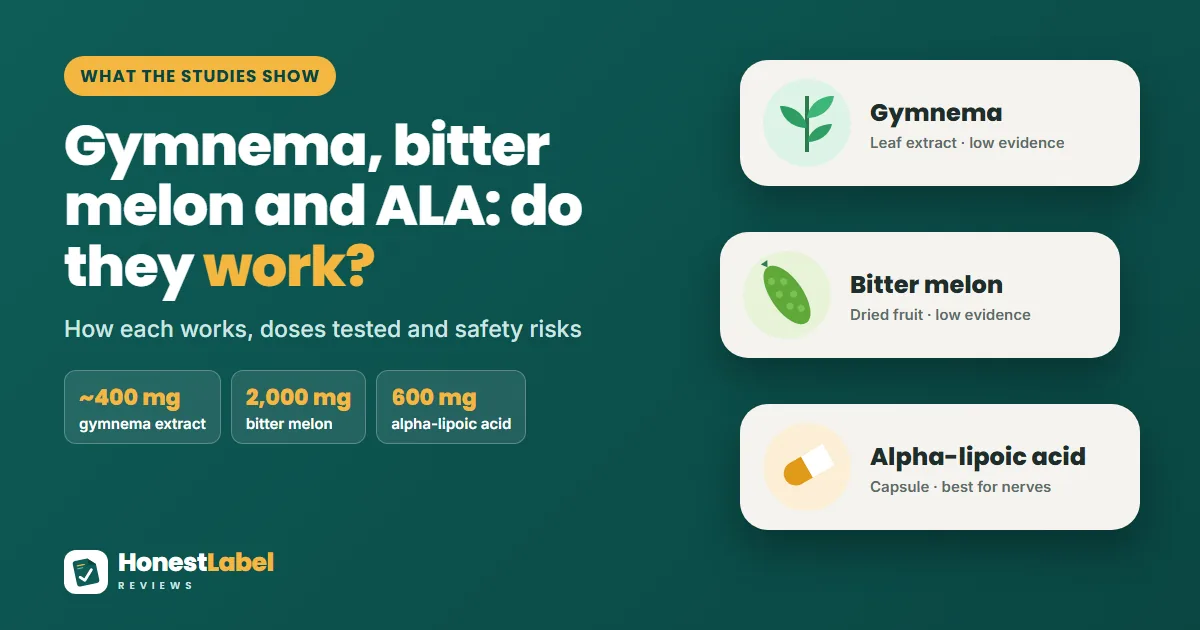
All three may lower blood sugar a little, but the evidence is thin. Gymnema has a few small trials, the best known at 400 mg of extract a day. Bitter melon at 2,000 mg a day did less than metformin in its best trial. Alpha-lipoic acid at 600 mg a day has better evidence for diabetic nerve pain than for glucose.
These three often appear together on blood sugar formulas, listed below bigger names like berberine and cinnamon. Below we cover how each is thought to work, what the human studies found, the doses tested, and the safety problems. For a refresher on normal blood sugar ranges, our main guide has the full chart. In short, using the American Diabetes Association cut-offs, a fasting reading under 100 mg/dL is normal, 100 to 125 mg/dL points to prediabetes, and an A1C of 6.5% or higher points to diabetes.
Most studies on these three are small, short and often lack a placebo group. Results like that have shrunk in bigger trials for a lot of supplements, so we flag study quality as we go.
Gymnema sylvestre: the “sugar destroyer”
Gymnema sylvestre is a woody vine used in Ayurvedic medicine. Its Hindi name, gurmar, means roughly “sugar destroyer”. Chew a leaf, then eat something sweet, and the sweetness mostly disappears for a while.
How gymnema is thought to work
The leaves contain compounds called gymnemic acids. Researchers think they act in a few ways:
- They block sweet taste receptors on the tongue, which may reduce sugar cravings for a short time.
- They may reduce some glucose absorption in the gut.
- Animal and lab studies suggest they may help the pancreas release more insulin. Claims that gymnema helps beta cells regrow have never been confirmed in people.
What the studies show
The trial cited most often is from 1990. Researchers in India gave 22 people with type 2 diabetes 400 mg a day of a leaf extract (called GS4) alongside their usual medication for 18 to 20 months. Fasting blood sugar and A1C fell, and some participants lowered their drug doses (Baskaran et al., 1990). The weakness is design: there was no placebo, everyone knew who took the extract, and the comparison group was simply people on standard treatment.
Later trials have been small and short, mostly from India, with different extracts and doses. Some report lower fasting glucose and A1C, others show little change. The results justify better trials, and they are too weak to call gymnema a treatment.
Typical study doses
The best-known trial used 400 mg a day of the GS4 extract (Baskaran et al., 1990). Other small trials used lower and higher amounts, and there is no agreed dose. Study extracts were standardized to a set level of gymnemic acids, so a plain leaf powder of the same weight is a different thing. Our guide to reading a supplement label shows how to spot this.
Side effects, liver reports and interactions
In trials, gymnema was usually well tolerated, with stomach upset and a dulled sweet taste the main complaints.
The bigger concern is the liver. The NIH’s LiverTox database, which tracks drug and supplement liver injury, has an entry on gymnema and describes rare published case reports of hepatitis in people taking it (LiverTox: Gymnema). Cases are uncommon and cause is hard to prove, but stop taking it and see a doctor if you notice dark urine, yellow skin or eyes, or pain under the right ribs.
Because gymnema may raise insulin release, it can add to the effect of diabetes medicines. Combining it with insulin or a sulfonylurea such as glipizide raises the chance of a low, which the ADA defines as under 70 mg/dL. There is too little safety data for pregnancy or breastfeeding.
Bitter melon: a vegetable with a medicine reputation
Bitter melon (Momordica charantia), also called bitter gourd or karela, looks like a warty green cucumber and tastes as bitter as the name says. Traditional medicine from India to the Caribbean has long used it for diabetes.
How bitter melon is thought to work
Several of its compounds lowered blood sugar in lab and animal work. Charantin is a mix of plant sterols. Polypeptide-p is a protein nicknamed “plant insulin” becuase it acts a bit like insulin in lab tests. Vicine sits mainly in the seeds. How much of this survives into a capsule is unclear, because levels vary hugely between plants and products.
What the studies show
When Cochrane reviewers looked at the randomized trials in 2012, they found only a handful, all small and of poor or uncertain quality, and concluded there was not enough evidence to recommend bitter melon for type 2 diabetes (Ooi et al., Cochrane review, 2012).
The most useful single trial came from Thailand. People with newly diagnosed type 2 diabetes took 500, 1,000 or 2,000 mg a day of dried bitter melon, or 1,000 mg a day of metformin, for four weeks. Only the 2,000 mg group showed a meaningful drop in fructosamine, a short-term blood sugar marker, and the drop was smaller than with metformin (Fuangchan et al., 2011).
Typical study doses
In the Thai trial, only 2,000 mg a day of dried fruit powder, split across meals, made a measurable difference (Fuangchan et al., 2011). The trials in the Cochrane review used capsules, juice and fresh fruit, so there doses are hard to compare.
Side effects and who should avoid it
Bitter melon in normal meals is fine for most people. Supplements carry more risk:
- Low blood sugar. The main concern, especially with insulin or sulfonylureas. Children have had hypoglycemic comas after bitter melon tea, so keep products away from kids.
- Pregnancy. Some of its compounds caused bleeding, contractions and miscarriage in animal studies, and it has a traditional use for ending pregnancy. Avoid it if you are pregnant or trying to conceive.
- G6PD deficiency. The vicine in the seeds can trigger a favism-like anemia in people with this inherited enzyme problem.
- Stomach trouble. Diarrhea and stomach pain are the most common complaints.
Alpha-lipoic acid: better for nerves than for glucose
Alpha-lipoic acid (ALA) is made by your body in small amounts. It helps enzymes in the mitochondria turn food into energy and works as an antioxidant. It is a different thing from alpha-linolenic acid, the omega-3 fat in flaxseed, even though both get shortened to ALA.
How it is thought to work
High blood sugar creates oxidative stress, a chemical wear and tear that damages nerves and blood vessels over time. ALA neutralizes some of it. Lab studies also suggest it may help muscle cells take up glucose, which is where the blood sugar claims come from.
What the studies show for blood sugar
A 2018 meta-analysis pooled randomized trials of ALA in people with metabolic diseases and found small reductions in fasting glucose, insulin, insulin resistance and A1C (Akbari et al., 2018). The trials varied a lot in dose, length and who took part. ALA may nudge glucose down a little, and nobody should expect it to act like a diabetes drug.
The stronger evidence: diabetic neuropathy
ALA’s real track record is in diabetic nerve damage, the burning, tingling and numbness many people with diabetes get in their feet.
In the SYDNEY 2 trial, 181 people with diabetic neuropathy took 600, 1,200 or 1,800 mg of oral ALA a day, or a placebo, for five weeks. All three ALA groups had a noticeable improvement in symptoms compared with placebo, and 600 mg worked about as well as the higher doses with fewer side effects (Ziegler et al., 2006). A four-year trial of 600 mg a day (NATHAN 1) was less clear: it missed its main goal, though some nerve measures did better on ALA (Ziegler et al., 2011). The short-term symptom evidence is fairly good, and the long-term evidence is mixed.
Typical study doses
Most oral studies used 600 mg a day. In SYDNEY 2, the 1,200 and 1,800 mg doses brought no extra benefit and mainly added nausea (Ziegler et al., 2006). Trials usualy gave it before breakfast, since it is absorbed better on an empty stomach.
Side effects and a rare autoimmune reaction
Common side effects are nausea, heartburn, itching and rash. Beyond that:
- Low blood sugar. Like the other two, ALA may add to diabetes medicines.
- Insulin autoimmune syndrome. In this rare condition the body makes antibodies against its own insulin, causing sudden, repeated lows. There are published reports of it starting after people took ALA, mostly in people of East Asian descent with a particular gene type (PubMed case reports). It usually settles once the supplement is stopped.
- Thyroid and cancer treatment. ALA may interact with thyroid hormone and some chemotherapy, so check with the prescribing doctor.
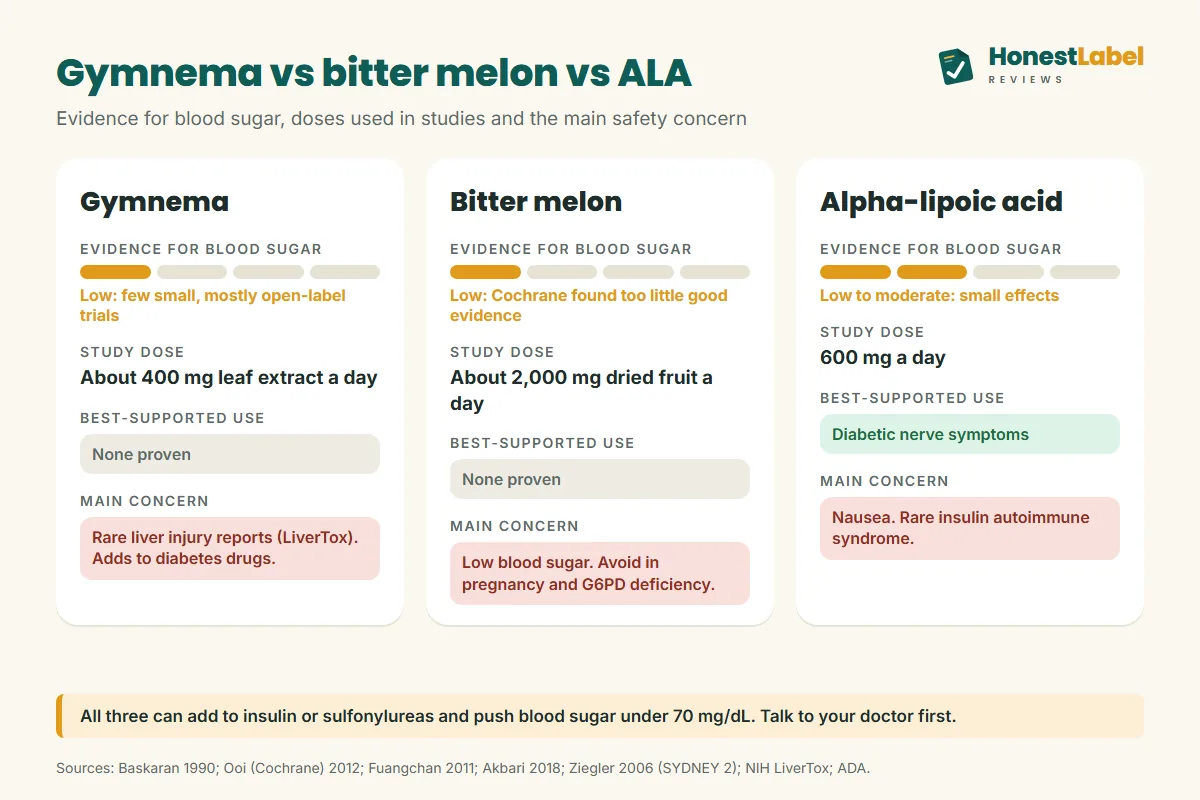
Gymnema vs bitter melon vs alpha-lipoic acid: side by side
| Gymnema | Bitter melon | Alpha-lipoic acid | |
|---|---|---|---|
| Main idea | Blocks sweet taste, may lower sugar absorption and raise insulin release | Insulin-like compounds, may help cells take up glucose | Antioxidant, may improve insulin sensitivity |
| Evidence for blood sugar | Low: a few small, mostly open-label trials | Low: Cochrane found too little good evidence | Low to moderate: small effects in pooled trials |
| Typical study dose | About 400 mg extract a day | About 2,000 mg dried fruit a day | 600 mg a day |
| Best-supported use | None proven | None proven | Diabetic nerve symptoms |
| Main safety concern | Rare liver injury reports | Lows, avoid in pregnancy and G6PD deficiency | Rare insulin autoimmune syndrome, nausea |
| Adds to diabetes drugs? | Yes, risk of lows | Yes, risk of lows | Yes, risk of lows |
For context, the evidence for all three is weaker than for berberine, which has several meta-analyses behind it, and roughly level with chromium. The NIH’s National Center for Complementary and Integrative Health makes the same point in its overview of diabetes and dietary supplements: no supplement has good enough evidence to treat diabetes.
Many formulas combine all three with other ingredients, and nobody has tested most of these mixes. If a side effect appears, you cannot tell which ingredient caused it.
Safety: who should be careful
Check with your doctor or pharmacist before trying gymnema, bitter melon or ALA if any of these apply:
- You take insulin, a sulfonylurea (glipizide, glyburide, glimepiride) or any other diabetes medicine. The ADA’s guide to low blood sugar covers the warning signs and the 15-15 rule for treating a low.
- You are pregnant, trying to get pregnant or breastfeeding.
- You have liver or kidney disease, or have had abnormal liver tests.
- You have G6PD deficiency (bitter melon).
- You take thyroid medication or are having cancer treatment (ALA).
- You have surgery coming up. Tell your surgeon about every glucose-lowering supplement you take.
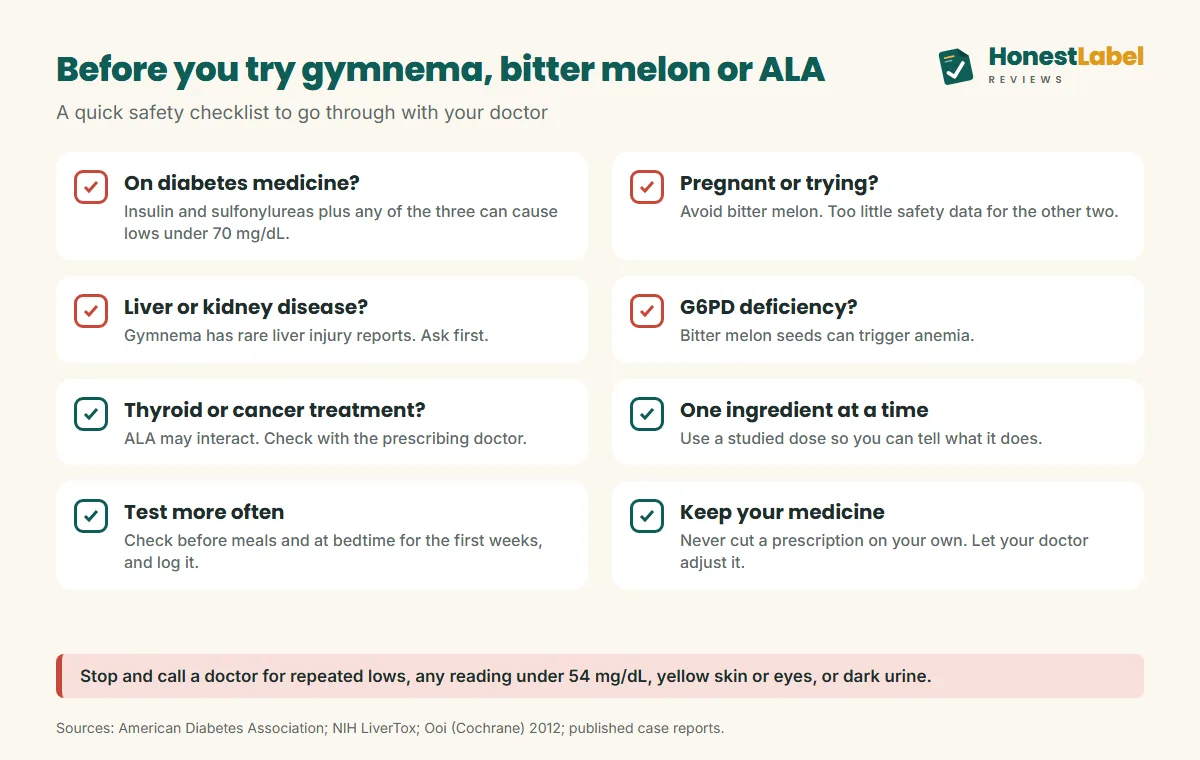
If you do start one, here is a practical way to do it:
- Pick one ingredient, at the dose used in studies, and write down the start date.
- Check your blood sugar more often for the first few weeks, before meals and at bedtime, and log the readings.
- Never cut or stop a prescribed medicine on your own. If your readings drop, your doctor can adjust the dose safely.
We think it is necessary to keep expectations realistic: even in the better trials, the drops were small.
When to see a doctor
Stop the supplement and see a doctor promptly if you notice any of these:
- Readings under 70 mg/dL, or lows that keep coming back even when you eat normally
- Any reading under 54 mg/dL, or a low that needed someone else’s help
- Yellow skin or eyes, dark urine, pale stools or pain under the right ribs
- Bleeding, cramping or contractions in pregnancy
- A new rash, hives or swelling of the face or lips
Get emergency help for confusion, fainting or a seizure. Even without any supplement, book an appointment if your fasting readings stay at 126 mg/dL or higher, or you have constant thirst and frequent urination.
Frequently asked questions
Does gymnema really stop sugar cravings?
Gymnema dulls sweet taste for a short time after it touches your tongue, and a few small studies found people ate fewer sweets after gymnema lozenges or tea. Swallowed capsules do not have this taste effect.
Is it safe to eat bitter melon every day?
As part of normal meals, it is generally safe for most adults. The risk rises with concentrated juices, teas and capsules. Pregnant women and people with G6PD deficiency should avoid it, and it should never be given to children as a remedy.
How long does alpha-lipoic acid take to work for neuropathy?
In the five-week SYDNEY 2 trial, people taking 600 mg a day had less burning, pain and tingling than the placebo group by the end of the study (Ziegler et al., 2006). ALA does not reverse nerve damage, and good blood sugar control is still the main way to protect your nerves.
Can these supplements replace metformin?
No. None of the three has been shown to match a diabetes drug, and stopping prescribed medicine can cause dangerous high blood sugar.
The bottom line
Each of the three has a plausible way to lower blood sugar and a few small studies with modest results, and none can replace medication or proven habits. ALA at 600 mg a day stands out for nerve symptoms more than glucose. All three can add to diabetes medicines, gymnema has rare liver injury reports, bitter melon should be avoided in pregnancy, and ALA has been linked to a rare autoimmune cause of lows. If you truly want to try one, choose a single ingredient at a studied dose and clear it with your doctor first.
Sources
- Baskaran K, et al. Antidiabetic effect of a leaf extract from Gymnema sylvestre in non-insulin-dependent diabetes mellitus patients. Journal of Ethnopharmacology, 1990. PubMed.
- National Institutes of Health. LiverTox: Clinical and Research Information on Drug-Induced Liver Injury, Gymnema.
- Ooi CP, et al. Momordica charantia for type 2 diabetes mellitus. Cochrane Database of Systematic Reviews, 2012. PubMed.
- Fuangchan A, et al. Hypoglycemic effect of bitter melon compared with metformin in newly diagnosed type 2 diabetes patients. Journal of Ethnopharmacology, 2011. PubMed.
- Akbari M, et al. Alpha-lipoic acid and glucose control in metabolic diseases: a meta-analysis of randomized controlled trials. Metabolism, 2018. PubMed.
- Ziegler D, et al. Oral treatment with alpha-lipoic acid improves symptomatic diabetic polyneuropathy: the SYDNEY 2 trial. Diabetes Care, 2006. PubMed.
- Ziegler D, et al. Efficacy and safety of antioxidant treatment with alpha-lipoic acid over 4 years in diabetic polyneuropathy: the NATHAN 1 trial. Diabetes Care, 2011. PubMed.
- Case reports of insulin autoimmune syndrome after alpha-lipoic acid. PubMed search.
- National Center for Complementary and Integrative Health (NIH). Diabetes and Dietary Supplements.
- MedlinePlus (US National Library of Medicine). Diabetic Nerve Problems.
- American Diabetes Association. Diagnosis; Hypoglycemia (Low Blood Glucose).
Medical disclaimer: This article is for general information and is not medical advice. It does not replace a diagnosis or treatment from your doctor. If you have diabetes or take medication that affects blood sugar, talk to your healthcare provider before changing your diet, exercise or supplements.